A Tectonic Shift in Indian Higher Education
The University Grants Commission (UGC) has been the cornerstone of India’s higher education system since 1956, functioning as both a funding body and a regulatory authority. However, the proposed UGC Bill 2023 (officially titled “The University Grants Commission (Setting and Maintenance of Standards in Higher Education) Bill, 2023”) has ignited one of the most intense academic and political controversies in recent years. This legislation seeks to replace the UGC Act of 1956 with a completely new regulatory framework, potentially transforming the very architecture of India’s higher education landscape.
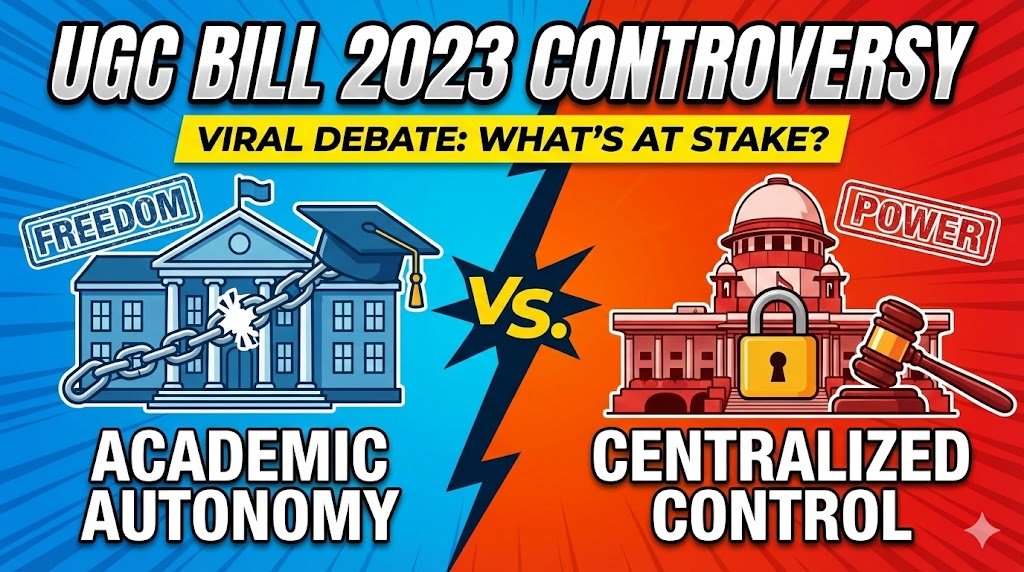
The controversy represents a fundamental clash between two visions: one advocating for greater governmental control and standardization, and another fiercely defending institutional autonomy and academic freedom. With protests erupting across campuses, sharp divisions within Parliament, and international academic bodies expressing concern, the UGC Bill has become a lightning rod for debates about federalism, autonomy, and the future of knowledge production in India.
Part 1: The Bill’s Key Provisions – What’s Changing?
1.1 Centralization of Power
The most contentious aspect is the proposed complete centralization of regulatory authority. The bill envisions:
- Direct government appointment of the UGC chairperson and members (removing the collegium system)
- Expanded ministerial control over commission functioning
- Reduced representation of academicians in decision-making bodies
- Increased bureaucratic oversight of university operations
1.2 New Regulatory Mechanisms
- Single regulatory regime for higher education (replacing multiple bodies)
- Mandatory accreditation framework with potential funding consequences
- Standardized curriculum development processes
- Digital university initiatives under direct government control
1.3 Changed Funding Paradigm
- Performance-based funding replacing block grants
- Greater conditionality attached to financial support
- Enhanced power to withhold funds for non-compliance
1.4 Governance Restructuring
- Reconstituted executive bodies with increased government nominees
- Modified autonomy frameworks for different categories of institutions
- New compliance requirements for universities
Part 2: The Core Controversies – Why the Opposition?
2.1 Erosion of Federalism
States’ Rights vs. Central Control
The bill has triggered a major federalism debate, with several states accusing the central government of encroaching on their constitutional rights:
- Education is on the Concurrent List (Entry 25 of List III), giving both center and states jurisdiction
- Opposition-ruled states (particularly Kerala, Tamil Nadu, West Bengal) argue the bill violates the federal spirit
- Financial implications: States fear loss of control over their own universities’ funding and policies
Legal Challenge
The Kerala Legislative Assembly passed a unanimous resolution opposing the bill, calling it “unconstitutional.” Legal experts debate whether the bill oversteps central government authority under the Constitution.
2.2 Threat to Academic Autonomy
“Government Knows Best” Approach
Academic communities nationwide have raised alarm about potential micromanagement:
- Curriculum interference: Fear of politically motivated syllabus changes
- Research freedom: Concerns about “approved” and “unapproved” research areas
- Appointment processes: Worries about political considerations overriding merit
International Precedents
Comparisons are being drawn with Hungary’s 2017 higher education law and Turkey’s post-2016 academic purges, though proponents deny any similarity.
2.3 Exclusion of Academic Voices
Demographic Shift in Governance
The proposed composition of UGC has caused particular concern:
- Current system: 10-12 members, majority being academicians
- Proposed system: More government officials and “eminent persons” (often political appointees)
- Reduced institutional representation: Fewer vice-chancellors and academic leaders
Professor N. Sukumar (Delhi University) argues: “This bill transforms UGC from an academic body to a government department. The soul of higher education—academic expertise—is being systematically removed.”
2.4 Quality vs. Standardization Paradox
One-Size-Fits-All Approach
Critics argue the bill prioritizes standardization over quality:
- Regional diversity: Ignores varying needs across India’s linguistic and cultural landscape
- Institutional diversity: Treats research universities, teaching colleges, and specialized institutions identically
- Pedagogical freedom: Restricts innovative teaching methods and curriculum design
The NEP 2020 Connection
While the bill claims to implement the National Education Policy 2020, critics argue it contradicts NEP’s stated commitment to institutional autonomy and flexibility.
Part 3: Political Dimensions and Ideological Battles
3.1 Government’s Stated Position
The Ministry of Education defends the bill as necessary for:
- Eliminating regulatory fragmentation (over 15 different regulatory bodies currently)
- Implementing NEP 2020 effectively
- Ensuring “minimum standards” across the country
- Promoting “Indian knowledge systems” and national values
- Fighting “corruption and nepotism” in some universities
Education Minister’s Assurance
The minister has repeatedly stated: “Autonomy of serious academic institutions will not be affected. We’re only targeting mismanagement and quality deficits.”
3.2 Opposition’s Counter-Narrative
Opposition parties frame the bill as:
- Political control mechanism: To install ideologically aligned leadership
- Centralization agenda: Part of larger pattern undermining states’ rights
- Privatization push: Through performance-based funding favoring certain institutions
- Majoritarian project: To reshape education along particular ideological lines
3.3 Student and Faculty Movements
Nationwide Protests
- #SavePublicEducation campaign across universities
- Joint statements from multiple teachers’ associations
- Student unions from Left to Ambedkarite groups finding common cause
- International solidarity from global academic associations
Part 4: Comparative Analysis – International Perspectives
4.1 Global Regulatory Trends
The controversy reflects a worldwide tension:
- UK’s Research Excellence Framework: Performance-based funding criticized for bureaucratic burden
- Australia’s TEQSA: Similar quality assurance body with its own controversies
- European Bologna Process: Standardization efforts facing resistance
4.2 Specific International Concerns
- UNESCO has emphasized the need to protect academic freedom globally
- Scholars at Risk network monitoring the situation
- Comparative constitutional law experts analyzing federalism implications
Part 5: The Way Forward – Potential Compromises
5.1 Parliamentary Standing Committee Recommendations
The bill was referred to the Standing Committee on Education, which suggested:
- Greater state representation in UGC composition
- Protection of regional languages in curriculum
- Clearer autonomy safeguards for top institutions
- Phased implementation rather than abrupt change
5.2 Expert Committee Proposals
Various academic bodies have proposed middle paths:
- Dual governance model: Separating funding and regulatory functions
- Category-based regulation: Different frameworks for different institution types
- Independent appellate mechanism: For dispute resolution
- Sunset clauses: For experimental provisions
5.3 Constitutional Solutions
Legal experts suggest:
- Strengthening the Interstate Council for education matters
- Clear division of subjects between center and states
- Cooperative federalism model rather than hierarchical control
Part 6: Historical Context – Evolution of UGC
6.1 Original Vision (1956)
- Radhakrishnan Commission (1948-49) recommended an independent grants commission
- Original Act emphasized autonomy and academic leadership
- Balanced representation from various stakeholders
6.2 Gradual Erosion
- Increasing governmental intervention over decades
- Politicization of appointments across different governments
- Bureaucratic expansion at expense of academic focus
6.3 Current Crisis as Turning Point
Many see this bill as the final transformation from an academic to a bureaucratic body.
Part 7: Implications for Different Stakeholders
7.1 For Universities
- Central universities: Mixed impacts based on political alignment
- State universities: Potential resource and autonomy losses
- Private institutions: Possibly less affected but facing new compliance
7.2 For Students
- Curriculum changes: Possible ideological shifts in syllabus
- Mobility issues: Credit transfer mechanisms
- Quality concerns: Standardization vs. excellence debate
7.3 For Faculty
- Research constraints: Particularly in social sciences and humanities
- Career progression: New evaluation parameters
- Intellectual freedom: Self-censorship concerns
7.4 For Indian Academia Globally
- International rankings: Possible impact on perception
- Collaboration networks: Foreign universities’ comfort levels
- Brain drain/gain: Effect on academic migration patterns
Conclusion: Democracy’s Classroom at a Crossroads
The UGC Bill controversy represents more than a policy disagreement—it’s a fundamental debate about the role of education in a democracy. At stake are crucial questions:
- Who controls knowledge production in the world’s largest democracy?
- How is federalism balanced with national standards?
- What constitutes academic excellence—compliance or innovation?
- How does India position itself in global knowledge networks?
The resolution of this controversy will shape Indian higher education for generations. The middle path—one that ensures quality without sacrificing diversity, maintains standards without crushing autonomy, and implements national vision while respecting federal principles—remains elusive but essential.
As the parliamentary process continues, with the bill likely to be taken up in the upcoming session, all eyes are on whether amendments will address core concerns or whether the controversy will deepen. What’s clear is that the classroom has expanded beyond university walls into the public square, with the nation itself becoming both student and teacher in this critical lesson about democracy, education, and governance.
read : Veteran Indian Politician Ajit Pawar Dies in Tragic Plane Crash, Nation in Shock