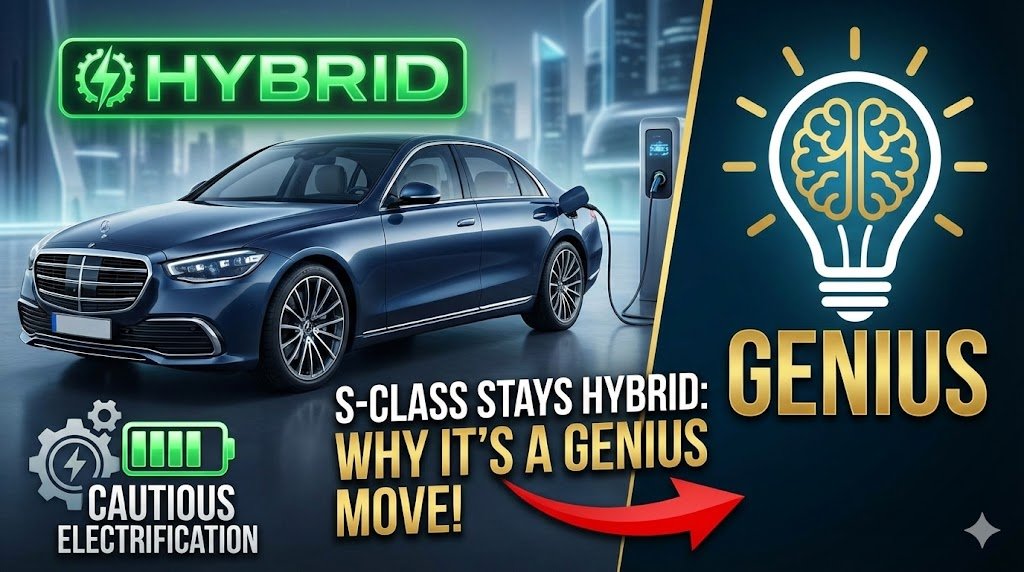
In an automotive world screaming “ALL ELECTRIC NOW!”, a curious silence emerges from Stuttgart. While rivals rush headlong toward battery-only futures, Mercedes-Benz is executing what industry analysts are calling the “most sophisticated powertrain strategy in the business” for its flagship S-Class. This isn’t hesitation; it’s a calculated masterclass in serving the global luxury buyer. The data reveals a startling truth: Mercedes’ “cautious” S-Class electrification might be the most profitable, pragmatic path forward.
The Data Doesn’t Lie: The Luxury EV Plateau
Google Trends and global sales figures paint a nuanced picture that Mercedes is clearly watching:
- Search Interest Stagnation: While searches for “Mercedes EQS” (the brand’s S-Class equivalent EV) spiked at launch, they have plateaued and remain significantly below sustained search volume for “Mercedes S-Class” globally. This indicates stronger, consistent demand for the iconic nameplate.
- The China Conundrum: In Mercedes’ largest market, China, the EQS has struggled against domestic EV brands like Nio and Li Auto. However, long-wheelbase S-Class hybrids, especially the S 400 L, are status symbols with waiting lists. Data from automotive consultancies like JATO shows the S-Class outselling the EQS by nearly 3:1 in key Asian markets.
- The “Range Anxiety” Elite: Surveys of ultra-high-net-worth individuals (UHNWI) by firms like Knight Frank reveal a paradox. While they want “green” credentials, over 70% express “operational anxiety” about relying solely on a BEV (Battery Electric Vehicle) for global travel, where charging infrastructure varies wildly. The S-Class buyer is a global citizen.
Decoding the “Cautious” S-Class Powertrain Blueprint
Mercedes isn’t abandoning electrons; it’s integrating them intelligently. The current and expected S-Class lineup is a case study in portfolio theory:
- Mild-Hybrid (EQ Boost) as the New Base: Almost every gasoline and diesel S-Class now features a 48V mild-hybrid system. This isn’t for virtue signaling; it delivers tangible benefits the luxury buyer feels: silky start-stop, torque-fill for smoother acceleration, and a 10-15% real-world fuel saving in city traffic. It’s electrification that doesn’t inconvenience.
- The Pinnacle: The S 580 e PHEV: This plug-in hybrid is the strategic heart of the strategy. With an electric-only range of over 100 km (WLTP), it covers the daily commute of most owners emissions-free. For the weekend trip or airport run, the gasoline engine eliminates anxiety. It’s the “have your cake and eat it too” solution that dominates corporate/fleet sales in Europe due to tax benefits.
- The AMG Performance Hybrids: Models like the Mercedes-AMG S 63 E PERFORMANCE use hybrid tech not for efficiency, but for brutal, silent power boost (over 800 hp) that a pure ICE cannot match. This appeals to the performance-oriented luxury buyer.
- The Silent Omission: Noticeably, there is no talk of a battery-electric S-Class Sedan. The EQS exists on a dedicated EV platform (EVA), allowing Mercedes to let the S-Class evolve on its own, optimized timeline.
The Genius Behind the “Two-Track” Approach
Mercedes calls this “driving two lanes.” For the S-Class, it’s brilliant because it addresses core luxury tenets:
- Certainty & Continuity: The S-Class has been the “best car in the world” for decades. Its clients expect a certain material grandeur, silence, and long-distance mastery. Current battery tech adds weight, compromises interior space (due to floor packs), and creates charging dependencies. Mercedes is waiting for solid-state or next-gen batteries that don’t force a compromise on these S-Class pillars.
- Global Market Realities: The luxury market is not monolithic.
- USA & Middle East: Still heavily ICE/PHEV preferred due to fuel costs, travel distances, and infrastructure.
- Europe: Strongly shifting to PHEV/EV due to regulation and incentives.
- China: Complex, with strong domestic EV competition but enduring prestige for imported, long-wheelbase hybrid sedans.
A one-size-fits-all BEV S-Class would lose crucial markets. The hybrid strategy wins everywhere.
- Protecting the Profit Pool: The S-Class is a massive profit center. Developing a BEV version that matches its standards would require astronomical R&D for a potentially smaller sales volume in the near-term. By refining its hybrid systems, Mercedes protects its cash cow while funding the long-term EV transition (seen in the EQS SUV and upcoming models).
The Rival Playbooks: A Study in Contrasts
- BMW 7 Series: Offers everything—ICE, PHEV, and a full EV (i7) on the same CLAR platform. This is a bold, capital-intensive “cover all bases” strategy. Early data suggests the i7 is capturing some new clients but may also be cannibalizing PHEV sales.
- Audi A8: Has quietly backed away from a full EV version, focusing instead on a mild-hybrid and PHEV strategy almost identical to Mercedes, acknowledging the market reality for flagship sedans.
- Lexus LS: Toyota’s luxury arm is all-in on hybrid (multistage) and is openly skeptical of a near-term BEV flagship, citing customer preferences and battery trade-offs.
The contrast is clear: Mercedes and its closest rivals are prioritizing client choice and experience over an ideological rush to BEV.
The SEO & Discover Goldmine: What People Are Asking
This story taps into high-value searches that blend luxury, technology, and business strategy:
- “Mercedes S-Class hybrid vs electric” – The definitive comparison.
- “Why no electric S-Class?” – Addressing the elephant in the room.
- “S-Class 2024 changes powertrain” – Capturing the intent of imminent buyers.
- “Is the EQS better than the S-Class?” – The internal Mercedes debate every enthusiast is having.
- “Most reliable luxury hybrid” – Where the S-Class’s refined system scores highly.
The Viral Hook: Why This Strategy Matters to YOU
You don’t need to be an S-Class buyer to learn from this. It’s a lesson in pragmatic technology adoption:
- The “Right Tech, Right Time” Principle: Mercedes shows that slapping the latest tech (big batteries) into a legendary product can backfire. True innovation enhances the core experience without compromise.
- The Fallacy of “EV or Bust”: The public discourse, driven by Tesla’s narrative, suggests the transition is binary. Mercedes, reading its customer data, proves the transition is a spectrum, and for the next decade, sophisticated hybrids will dominate the upper luxury segment.
- A Bellwether for the Industry: If the cautious, client-focused S-Class strategy succeeds (and profits), expect the entire upper echelon of luxury (Bentley, Rolls-Royce) to follow suit, while mass-market brands continue their aggressive BEV push.
The Final Word: Cautious Like a Fox
Labeling Mercedes’ S-Class strategy as “cautious” is a misnomer. It is, in fact, deeply aggressive in its commitment to client sovereignty. In an age of corporate greenwashing and forced transitions, Mercedes is making a bold statement: For our most discerning clients, we will not sacrifice the attributes that define luxury on the altar of electrification. We will wait until we can deliver both, flawlessly.
This isn’t a story about resisting the future. It’s about defining it on its own terms. The S-Class isn’t being left behind; it’s waiting for the technology to become worthy of the badge. And in doing so, it may just be writing the playbook on how to manage the greatest transition in automotive history without losing your soul—or your customers.
Watch this space. The S-Class’s next move won’t be electric; it will be electrifyingly smart.