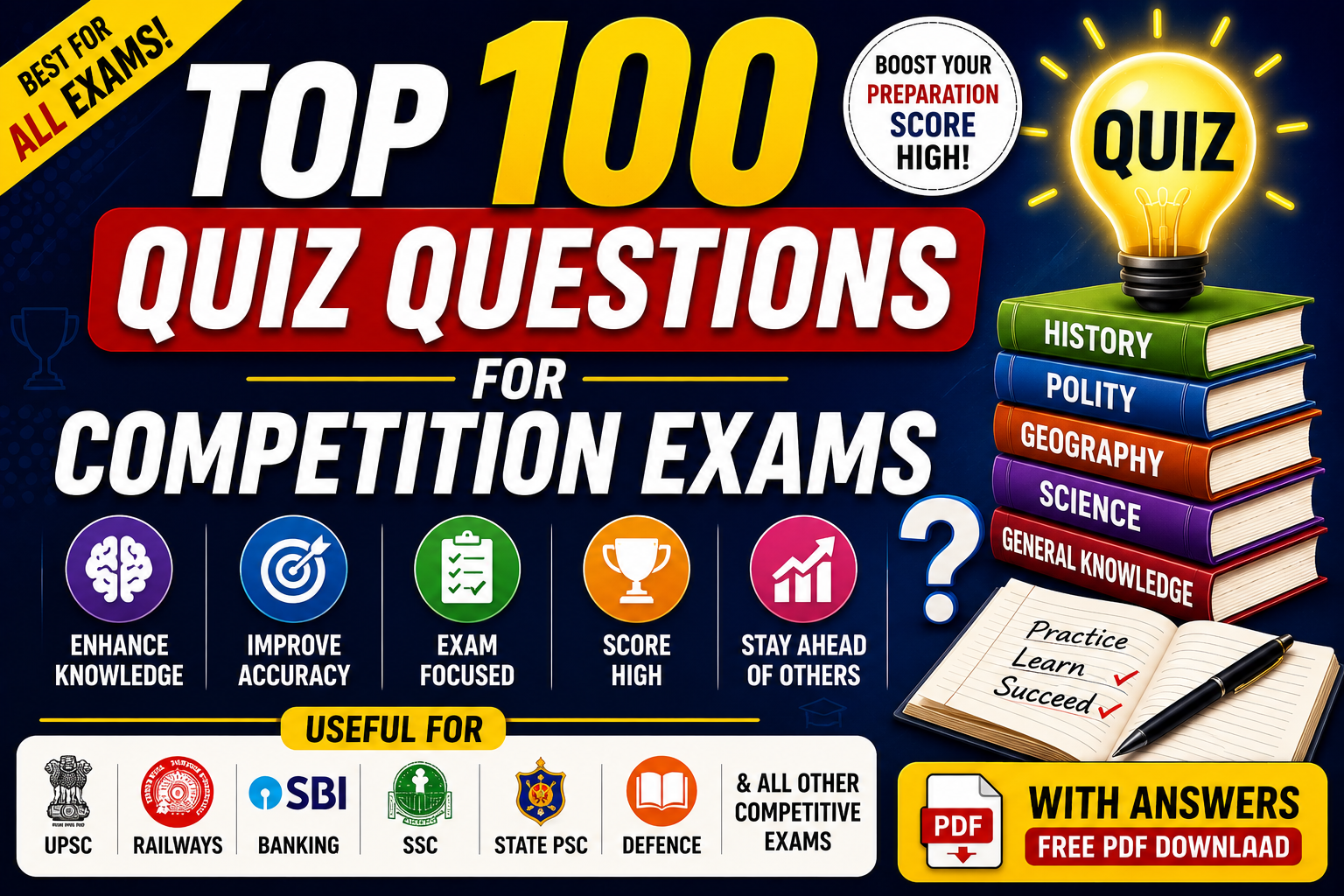
Quiz Questions Are the Best Way to Prepare
Let me ask you a question.
How do top performers prepare for competitive exams?
They don’t just read. They test themselves.
Reading gives you familiarity. But testing gives you mastery. When you actively recall an answer, your brain strengthens that neural pathway. You remember longer. You recall faster. You perform better under pressure.
Quiz questions are the most effective way to:
- Identify your weak areas
- Practice active recall
- Simulate exam conditions
- Build speed and accuracy
- Boost confidence before the real exam
In this blog, I have created 100 original, exam-relevant quiz questions for competition exams. Each question is immediately followed by its answer. No separate answer key. No flipping pages. Instant learning.
These questions cover:
- Indian Constitution and Polity (15 questions)
- Ancient, Medieval, and Modern History (35 questions)
- Indian and World Geography (15 questions)
- General Science (10 questions)
- Economy, Sports, Awards, Books, and Miscellaneous (25 questions)
Let us begin.
(Add Image with Alt Text: “Quiz questions for competition exams – a student solving a quiz on a laptop with a timer running”)
Dofollow External Resource: National Testing Agency (NTA) – Official Exam Patterns – understand the format of major competitive exams.
Part 1 – Indian Constitution and Polity (Questions 1 to 15)
Question 1. Who is the Constitutional head of the Indian Republic?
Answer: The President of India.
Question 2. Under which Article of the Constitution is the President of India elected?
Answer: Article 54.
Question 3. Who elects the President of India?
Answer: An Electoral College consisting of elected members of both houses of Parliament and elected members of state legislative assemblies.
Question 4. Who is the Commander-in-Chief of the Indian Armed Forces?
Answer: The President of India.
Question 5. Who appoints the Prime Minister of India?
Answer: The President of India (appoints the leader of the majority party in Lok Sabha).
Question 6. What is the maximum strength of the Lok Sabha as per the Constitution?
Answer: 552 members (530 from states + 20 from union territories + 2 nominated from Anglo-Indian community – nomination provision expired in 2020).
Question 7. What is the maximum strength of the Rajya Sabha as per the Constitution?
Answer: 250 members (238 elected + 12 nominated by the President).
Question 8. Who presides over the Lok Sabha?
Answer: The Speaker of the Lok Sabha.
Question 9. Who presides over the Rajya Sabha?
Answer: The Vice President of India (ex-officio Chairman of Rajya Sabha).
Question 10. Who appoints the Chief Justice of India?
Answer: The President of India (based on seniority and consultation with senior judges).
Question 11. What is the retirement age of a Supreme Court judge?
Answer: 65 years.
Question 12. What is the retirement age of a High Court judge?
Answer: 62 years.
Question 13. Which Article of the Indian Constitution provides for the Right to Education?
Answer: Article 21A (added by the 86th Constitutional Amendment Act, 2002).
Question 14. Which Article of the Indian Constitution provides for the Right to Privacy?
Answer: Article 21 (Supreme Court declared Right to Privacy a Fundamental Right under Article 21 in the K.S. Puttaswamy case, 2017).
Question 15. Which Schedule of the Indian Constitution deals with the division of powers between the Union and States?
Answer: Seventh Schedule (Union List, State List, Concurrent List).
Part 2 – Ancient Indian History (Questions 16 to 25)
Question 16. The Indus Valley Civilization belongs to which age?
Answer: Bronze Age.
Question 17. What is the approximate time period of the mature Harappan Civilization?
Answer: 2600 BCE to 1900 BCE.
Question 18. Which metal was NOT known to the Indus Valley people?
Answer: Iron.
Question 19. The famous “Great Bath” was discovered at which Indus Valley site?
Answer: Mohenjo-Daro.
Question 20. Which Indus Valley site is located in present-day India (Gujarat)?
Answer: Dholavira and Lothal. (Lothal is known for its dockyard.)
Question 21. Who composed the “Rig Veda”?
Answer: The Rig Veda is a collection of hymns composed by multiple sages (rishis) over centuries. No single author.
Question 22. What is the literal meaning of the word “Upanishad”?
Answer: “Sitting down near” (referring to a student sitting near a guru for philosophical instruction).
Question 23. Who was the 23rd Tirthankara of Jainism?
Answer: Parshvanatha (Parshva).
Question 24. The famous “Triratna” (Three Jewels) of Buddhism are Buddha, Dhamma, and what is the third?
Answer: Sangha (the monastic community).
Question 25. Where did Mahavira attain Kevala Jnana (omniscience)?
Answer: Jrimbhikagrama (near the banks of the Rijuvaluka River, present-day Bihar).
Part 3 – Medieval Indian History (Questions 26 to 35)
Question 26. Who was the founder of the Slave Dynasty (Mamluk Dynasty) in India?
Answer: Qutb-ud-din Aibak (1206-1210 CE).
Question 27. Who completed the construction of the Qutub Minar in Delhi?
Answer: Iltutmish.
Question 28. Who was the only Muslim woman ruler of India?
Answer: Razia Sultan (1236-1240 CE).
Question 29. Which Delhi Sultan introduced the “Market Control Policy” and price regulation?
Answer: Alauddin Khalji.
Question 30. Who was the famous Moroccan traveler who visited India during the reign of Muhammad bin Tughlaq?
Answer: Ibn Batuta (1304-1369 CE).
Question 31. Who founded the Vijayanagara Empire (1336 CE)?
Answer: Harihara I and Bukka Raya I (the Sangama brothers).
Question 32. Who built the famous “Lodhi Gardens” in Delhi?
Answer: The tombs belong to the Sayyid and Lodi dynasties. Sikandar Lodi built structures in the complex.
Question 33. Who was the last ruler of the Lodi Dynasty?
Answer: Ibrahim Lodi (defeated by Babur in the First Battle of Panipat, 1526 CE).
Question 34. The famous “Moti Masjid” (Pearl Mosque) inside the Red Fort, Delhi, was built by which Mughal emperor?
Answer: Aurangzeb (1659-1660 CE).
Question 35. Who wrote “Humayun Nama” (a biography of Humayun)?
Answer: Gulbadan Begum (daughter of Babur and sister of Humayun).
Part 4 – Modern Indian History (Questions 36 to 50)
Question 36. In which year was the British East India Company formed?
Answer: 1600 CE (December 31 – the “Company of Merchants of London Trading into the East Indies”).
Question 37. Who was the British Prime Minister at the time of the Indian Independence Act 1947?
Answer: Clement Attlee.
Question 38. The Regulating Act of 1773 established the office of which official?
Answer: Governor-General of Bengal (first holder: Warren Hastings).
Question 39. Who introduced the “Permanent Settlement of Bengal” in 1793?
Answer: Lord Cornwallis.
Question 40. The “Ryotwari System” of land revenue was introduced by whom?
Answer: Captain Alexander Read and Thomas Munro (in the Madras Presidency).
Question 41. Which British official introduced the “Doctrine of Lapse”?
Answer: Lord Dalhousie (Governor-General, 1848-1856).
Question 42. The “Ilbert Bill” controversy (1883) was related to which issue?
Answer: Allowing Indian judges to try British offenders in criminal cases.
Question 43. Who founded the “Indian Home Rule League” in 1916?
Answer: Bal Gangadhar Tilak (April 1916) and Annie Besant (September 1916) started separate leagues.
Question 44. The “Jallianwala Bagh Massacre” took place in which year?
Answer: 1919 (April 13).
Question 45. Who was the Governor-General of India at the time of the Jallianwala Bagh Massacre?
Answer: Lord Chelmsford.
Question 46. The “Chauri Chaura” incident (1922) led to the withdrawal of which movement?
Answer: The Non-Cooperation Movement (Mahatma Gandhi called it off).
Question 47. Who was the Viceroy of India when the Indian National Congress celebrated “Independence Day” for the first time (January 26, 1930)?
Answer: Lord Irwin.
Question 48. The famous “Poona Pact” (1932) was signed between whom?
Answer: Mahatma Gandhi and Dr. B.R. Ambedkar (ended Gandhi’s fast against separate electorates for Dalits).
Question 49. The “August Offer” (1940) was made by which Viceroy?
Answer: Lord Linlithgow.
Question 50. The “Cripps Mission” visited India in which year?
Answer: 1942.
Part 5 – Indian and World Geography (Questions 51 to 65)
Question 51. Which is the largest delta in the world?
Answer: Sundarbans Delta (Bengal Delta, formed by the Ganga, Brahmaputra, and Meghna rivers).
Question 52. Which is the largest river island in the world, located in Assam?
Answer: Majuli Island (Brahmaputra River).
Question 53. Which Indian state has the highest forest cover?
Answer: Madhya Pradesh (in terms of area). In terms of percentage of forest cover, Mizoram has the highest.
Question 54. Which Indian state has the longest coastline?
Answer: Gujarat.
Question 55. What is the name of India’s southernmost point (mainland)?
Answer: Kanyakumari (Cape Comorin), Tamil Nadu. The southernmost point of Indian territory is Indira Point (Great Nicobar Island).
Question 56. Which line divides India and China?
Answer: Line of Actual Control (LAC) – not a fully demarcated border. The McMahon Line is the eastern boundary.
Question 57. Which line divides India and Pakistan?
Answer: Radcliffe Line.
Question 58. Which is the longest mountain range in the world?
Answer: Andes (South America).
Question 59. Which is the driest inhabited continent?
Answer: Australia.
Question 60. Which strait separates India from Sri Lanka?
Answer: Palk Strait.
Question 61. Which strait separates Malaysia from Indonesia (Sumatra)?
Answer: Strait of Malacca.
Question 62. Which is the world’s largest saltwater lake?
Answer: Caspian Sea (it is actually a lake, despite its name). The world’s largest saltwater lake by area is the Caspian Sea.
Question 63. Which is the world’s largest freshwater lake by volume?
Answer: Lake Baikal (Siberia, Russia).
Question 64. Which is the world’s largest freshwater lake by area?
Answer: Lake Superior (USA-Canada border).
Question 65. Which river passes through the maximum number of countries?
Answer: The Danube River (10 countries). The Nile passes through 11 countries but is disputed.
Part 6 – General Science (Questions 66 to 75)
Question 66. What is the hardest naturally occurring substance on Earth?
Answer: Diamond.
Question 67. What is the chemical name of baking soda?
Answer: Sodium bicarbonate (NaHCO₃).
Question 68. What is the chemical name of common salt?
Answer: Sodium chloride (NaCl).
Question 69. What is the chemical name of laughing gas?
Answer: Nitrous oxide (N₂O).
Question 70. Which acid is found in the human stomach?
Answer: Hydrochloric acid (HCl).
Question 71. Which vitamin is called the “sunshine vitamin”?
Answer: Vitamin D.
Question 72. Which mineral is essential for the formation of hemoglobin?
Answer: Iron.
Question 73. Which scientist is credited with discovering penicillin?
Answer: Alexander Fleming (1928).
Question 74. Who discovered the vaccine for smallpox?
Answer: Edward Jenner (1796).
Question 75. What is the unit of electric resistance?
Answer: Ohm.
Part 7 – Indian Economy (Questions 76 to 80)
Question 76. In which year was the Reserve Bank of India (RBI) established?
Answer: 1935 (April 1).
Question 77. Who was the first Indian Governor of the Reserve Bank of India?
Answer: C.D. Deshmukh (1943-1949).
Question 78. What is the full form of NITI Aayog?
Answer: National Institution for Transforming India Aayog.
Question 79. What is the base year for the calculation of Gross Domestic Product (GDP) in India (as of 2025)?
Answer: 2011-12. (Note: The government may update the base year in the future; confirm the latest.)
Question 80. What is the full form of SEBI?
Answer: Securities and Exchange Board of India.
Part 8 – Sports and Games (Questions 81 to 88)
Question 81. What is the length of a cricket pitch in yards?
Answer: 22 yards (20.12 meters).
Question 82. Who is the first Indian cricketer to score a double century in One Day International (ODI) cricket?
Answer: Sachin Tendulkar (200* against South Africa, 2010).
Question 83. Who is the first Indian woman to win an Olympic medal?
Answer: Karnam Malleswari (bronze, weightlifting, Sydney 2000).
Question 84. Who is the first Indian to win an individual Olympic gold medal?
Answer: Abhinav Bindra (shooting, Beijing 2008).
Question 85. Who is known as the “Flying Sikh of India”?
Answer: Milkha Singh (athlete).
Question 86. What is the national game of Japan?
Answer: Sumo wrestling.
Question 87. What is the national game of China?
Answer: Table tennis (Ping Pong is the national sport, though not officially declared).
Question 88. Who has won the most Formula 1 World Championships?
Answer: Michael Schumacher (7) and Lewis Hamilton (7) – tied.
Part 9 – Awards, Books, and Culture (Questions 89 to 95)
Question 89. Who was the first Indian to receive the Nobel Prize?
Answer: Rabindranath Tagore (Nobel Prize in Literature, 1913).
Question 90. Who was the first Indian to receive the Nobel Prize in Physics?
Answer: Sir C.V. Raman (1930).
Question 91. Who was the first Indian to receive the Nobel Prize in Economics?
Answer: Amartya Sen (1998).
Question 92. Who wrote the famous novel “The God of Small Things”?
Answer: Arundhati Roy (1997, won the Booker Prize).
Question 93. Who wrote the famous novel “Midnight’s Children”?
Answer: Salman Rushdie (1981, won the Booker Prize and the Booker of Bookers).
Question 94. What is the classical dance form of Tamil Nadu?
Answer: Bharatanatyam.
Question 95. What is the classical dance form of Andhra Pradesh?
Answer: Kuchipudi.
Part 10 – Miscellaneous (Questions 96 to 100)
Question 96. What is the full form of UNESCO?
Answer: United Nations Educational, Scientific and Cultural Organization.
Question 97. What is the full form of WHO?
Answer: World Health Organization.
Question 98. What is the full form of NASA?
Answer: National Aeronautics and Space Administration.
Question 99. What is the full form of ISRO?
Answer: Indian Space Research Organisation.
Question 100. What is the full form of PDF?
Answer: Portable Document Format.
12. Conclusion – How to Use These 100 Questions Effectively
Dosto, these 100 quiz questions for competition exams cover the most important topics from every major subject.
Why quiz-based learning works:
| Traditional Learning | Quiz-Based Learning |
|---|---|
| Passive reading | Active recall |
| Low retention after 24 hours | High retention after 24 hours |
| You know “I have seen this” | You know “I remember this” |
| Difficult to identify weak areas | Easy to identify weak areas |
Your 10-Day Action Plan:
| Day | Focus Area | Questions |
|---|---|---|
| Day 1 | Indian Constitution and Polity | Q1-Q15 |
| Day 2 | Ancient and Medieval History | Q16-Q35 |
| Day 3 | Modern Indian History | Q36-Q50 |
| Day 4 | Indian and World Geography | Q51-Q65 |
| Day 5 | General Science | Q66-Q75 |
| Day 6 | Economy + Sports | Q76-Q88 |
| Day 7 | Awards, Books, Culture + Miscellaneous | Q89-Q100 |
| Day 8 | Full revision – all 100 questions | Q1-Q100 |
| Day 9 | Self-test (cover answers, recall) | Q1-Q100 |
| Day 10 | Take a full mock test | Simulated exam |
Pro Tips:
- Set a timer – Give yourself 30 seconds per question (simulates exam pressure)
- Keep score – Track how many you get right on the first attempt
- Mark difficult questions – Revisit them after 2 days
- Teach a friend – Explaining answers helps you remember
- Create flashcards – For questions you keep forgetting
Bonus Challenge: Try to answer all 100 questions without looking at the answers. Score yourself. Then revise the ones you got wrong. Repeat after 3 days.
Comment below: What is your score out of 100 on your first attempt?
Share this quiz with your study group. Challenge each other. Learn together.
Also Check: Most Repeated GK Questions in Exams – 100 Top Questions with Answers