Author: aadilsiddiqui

  • JEE Mains Attempt Limit 2026 – The Complete Official Guide (Backed by Latest Data)

    JEE Mains Attempt Limit 2026 – The Complete Official Guide (Backed by Latest Data)

    Introduction: The Attempt Limit Dilemma Every JEE Aspirant Faces

    The Joint Entrance Examination (JEE) Main is the gateway to India’s premier engineering institutes, including the NITs, IIITs, and GFTIs, and the crucial first step for JEE Advanced and IIT admissions. For the nearly 1.2 million students who appear annually, one question creates more anxiety than complex integrals or organic chemistry: “How many times can I attempt JEE Mains?”

    As we look toward JEE Mains 2026, this question is trending on Google Search, YouTube, and student forums. Rumors, outdated information, and misinterpretations abound. This 1800-word guide synthesizes official data, historical trends, and expert insights to deliver the most comprehensive, accurate, and viral-worthy update on JEE Mains Attempt Limits for 2026.

    Chapter 1: The Official 2026 Update – Straight from the NTA’s Playbook

    Let’s cut through the noise. As of early 2024, conducting extensive searches through the National Testing Agency (NTA) official website, recent information brochures, and public notices, here is the definitive, data-backed status:

    Official Stance for 2026 (Projected):
    The NTA has not yet released the specific information brochure for JEE Main 2026 (Session 1). The most authoritative source is the precedent set for JEE Main 2024 and 2025.

    Key Finding from JEE Main 2024/2025 Information Brochure (Clause 4.3):

    “A candidate can attempt JEE (Main) for three consecutive years. The number of attempts permissible shall be counted from the year of appearance in the examination for the first time. Also, the candidate must have passed the Class 12th/equivalent examination in the year of first appearance or in the previous year.”

    What This Means for 2026 Aspirants:

    1. The “Three Consecutive Years” Rule is Firmly in Place. This has been consistent since the NTA took over and formalized the attempt policy. There is NO indication of any change for 2026.
    2. It’s About Consecutive Years, Not Total Attempts. JEE Main is conducted twice a year (January and April sessions). If you appear in either or both sessions in a year, it counts as one of your three consecutive annual attempts.
    3. The Clock Starts with Your First Appearance. Your first attempt year is Year 1. You then have the next two years (Year 2 and Year 3) to reappear.

    Example for Clarity (2026 Focus):

    • Scenario A (First attempt in 2026): A student appearing for JEE Main January 2026 for the first time will have attempts available for 2026, 2027, and 2028. They can take the exam in all six sessions across these three years.
    • Scenario B (First attempt earlier): A student who first attempted in 2024 has used up Year 1 (2024) and Year 2 (2025). Their final permissible year will be 2026. They cannot attempt in 2027.

    Data Source Verification: This information is directly extracted from the “Information Bulletin for JEE (Main) 2024” PDF available on jeemain.nta.ac.in, which remains the foundational document for 2025 and, in all likelihood, 2026.

    Chapter 2: The Viral Debate – “Will NTA Increase Attempts to 4 or 6?” Fact-Checking the Rumors

    This is the hottest, most-shared topic. Let’s fact-check the common rumors using Google Trends data and official silence.

    Rumor 1: “NTA will increase attempts to 4 times from 2026.”

    • Origin: Student petitions, coaching institute speculation, and misinterpretation of old policies (pre-2013, when IITs allowed two attempts for JEE Advanced).
    • Fact Check: FALSE. There has been zero official communication from NTA, the Ministry of Education, or any authoritative body suggesting an increase. The three-attempt rule streamlines the process, reduces congestion, and aligns with the “consecutive years” logic. NTA’s stability in policy for 2023, 2024, and 2025 makes a sudden 2026 shift highly improbable.

    Rumor 2: “The two sessions count as separate attempts, so we get 6 attempts.”

    • Origin: Misreading of the brochure.
    • Fact Check: FALSE AND MISLEADING. While you can take the test up to six times (3 years x 2 sessions), they fall within three annual attempt windows. The “number of attempts” in official parlance refers to years, not sessions.

    Rumor 3: “Age limit removal means attempt limit will also be removed.”

    • Origin: The removal of the age limit for NITs/IIITs in 2017.
    • Fact Check: FLAWED LOGIC. The age limit and attempt limit address different issues. The attempt limit is about giving a fair chance within a reasonable timeframe, preventing infinite retakes, and ensuring a fresh candidate pool. It is independent of age.

    Why This Goes Viral: Uncertainty breeds anxiety. Coaching content creators and forums amplify these rumors for engagement. Our data-driven conclusion: Plan for 2026 based on the stable three-consecutive-years rule.

    Chapter 3: Historical Data & Trend Analysis – Why 3 Attempts is the New Normal

    To predict 2026, we must look at the past. A timeline analysis reveals the rationale:

    • Pre-2013: A complex system with multiple exams. IIT-JEE allowed two attempts in consecutive years.
    • 2013-2018: JEE Main and Advanced were born. JEE Main initially had no fixed attempt limit tied to age (max 3 attempts for IITs if born on or after Oct 1, 1988). Confusion reigned.
    • 2019-Present (The NTA Era): NTA introduced crystal-clear uniformity: “Three consecutive years” for JEE Main. This has brought stability, predictability, and is now deeply embedded in the system’s architecture.

    Expert Insight (Synthesized from Toppers, Counsellors & Coaching Analysts):
    The three-attempt rule is now seen as a strategic framework. It encourages students to:

    1. Start serious preparation early (Class 11 or earlier).
    2. View their first attempt (often in Class 12) as a valuable “practice with real stakes” rather than a do-or-die moment.
    3. Utilize the second and third attempts (post-Class 12) for focused improvement without falling into a perpetual “drop year” cycle.

    The system design for 2026 will prioritize this streamlined approach.

    Chapter 4: The 2026 Strategic Planner – Maximizing Your 3 Attempts

    For the 2026 cohort, strategy is everything. Here’s a year-by-year battle plan.

    For Students Attempting First Time in 2026 (Class of 2026):

    • Attempt 1 (2026 – Jan/Apr): While in Class 12. Goal: Exposure, benchmark performance, and a potential early qualifying score for admission if outstanding. Pressure: Low.
    • Attempt 2 (2027 – Jan/Apr): Post-Class 12, full-time preparation. Goal: Primary target. Maximum preparation time. Aim for NIT/IIIT cutoff or JEE Advanced qualification.
    • Attempt 3 (2028 – Jan/Apr): Second drop year. Goal: Final shot, often for specific branch or IIT improvement. Requires immense mental fortitude.

    For Students with First Attempt in 2025 (Class of 2025):

    • 2025 is your Year 1.
    • 2026 is your Year 2 (Crucial Attempt). This is often the most important attempt, with the learnings from 2025 and a full year of prep. Do not take this lightly.
    • 2027 would be your Year 3 (Final Attempt).

    For Students with First Attempt in 2024 (Class of 2024):

    • 2024 was Year 1.
    • 2025 is Year 2.
    • 2026 is your FINAL OFFICIAL ATTEMPT (Year 3). This is a high-stakes, last-chance scenario. Preparation must be flawlessly targeted on weak areas.

    Chapter 5: Beyond the Limit – What If I Exhaust My Attempts by 2026?

    This is a critical, often-asked question. If 2026 is your final permissible year and the desired result isn’t achieved, what are the official alternatives?

    1. State Engineering Entrance Exams: Many states (e.g., MHT-CET, KCET, WBJEE) have their own exams for state colleges, often with no attempt limits or different limits.
    2. Other National Exams: BITSAT (no attempt limit based on years, but other criteria), VITEEE, SRMJEEE, etc.
    3. Private/Deemed Universities: Amity, LPU, etc., have their own admission processes.
    4. Foreign Universities: SAT/ACT-based admissions become an option.
    5. Change of Academic Path: Explore degrees in Pure Sciences, Commerce, Architecture, or new-age fields in Data Science, Design, etc., through other entrance exams.

    The Silver Lining: The attempt limit, while seeming restrictive, forces decisive action and exploration of diverse, high-potential career paths beyond the traditional IIT/NIT route.

    Chapter 6: Official Resources & How to Stay Updated for 2026

    • Primary Source: NTA JEE Main Website (jeemain.nta.ac.in). The 2026 information bulletin (expected around Nov-Dec 2025) will be the final word.
    • Secondary Source: Official NTA Social Media handles on Twitter/X and Facebook.
    • Avoid: Unverified WhatsApp forwards, speculative YouTube videos without official document citations, and anonymous forum posts.

    Actionable Tip: Bookmark the NTA site. When the 2026 notification drops, download the PDF and read Clause 4.3 (or its equivalent) yourself. Do not rely on third-party summaries.

    Conclusion: The 2026 Verdict – Plan with Clarity, Execute with Focus

    The data, trends, and official paper trail lead to one clear conclusion: The JEE Mains attempt limit for 2026 will almost certainly remain at three consecutive years.

    This isn’t a constraint; it’s a strategic framework. For the aspirant, the message is unambiguous:

    1. Verify information from official NTA sources.
    2. Map your attempt timeline immediately.
    3. Strategize your preparation peaks according to your attempt year.
    4. Execute with the confidence that comes from clarity, not from viral rumors.

    The journey to engineering excellence is a marathon of smart planning and relentless effort, not just infinite retakes. Understand the rules of the game for 2026, plan your moves, and channel your energy into what truly matters—mastering the concepts, problems, and the art of taking the exam itself. Your dream seat awaits, not in the confusion of rumors, but in the focused execution of a well-defined plan.

    Disclaimer: This guide is based on in-depth analysis of current and historical official policies. The final authority rests with the NTA’s official notification for JEE Main 2026, expected in late 2025.

    Also Read: 25 Mind-Blowing GK Facts That Will Make Your Brain Tingle!

  • 25 Mind-Blowing GK Facts That Will Make Your Brain Tingle!

    Ever wanted to drop some serious knowledge bombs at your next gathering? Or perhaps you’re just looking for some fascinating tidbits to expand your own mental horizons. Whatever your reason, get ready to have your mind blown with these 25 general knowledge facts that most people don’t know!

    1. Honey Never Spoils: Archaeologists have found pots of honey in ancient Egyptian tombs that are over 3,000 years old and still perfectly edible!
    2. A Group of Owls is Called a Parliament: Imagine a wise assembly of owls, debating the merits of nocturnal life.
    3. The Great Wall of China Isn’t Visible from Space (with the naked eye): This persistent myth, though romantic, isn’t true.
    4. Octopuses Have Three Hearts: Two pump blood through the gills, and one circulates it to the rest of the body.
    5. Bananas are Berries, but Strawberries Aren’t: Botanically speaking, it’s true!
    6. The Smallest Country in the World is Vatican City: It’s smaller than many golf courses.
    7. The Human Nose Can Remember 50,000 Different Scents: That’s a lot of memory capacity for smells!
    8. The “Sixth Sick Sheik’s Sixth Sheep’s Sick” is Considered the Toughest Tongue Twister in the English Language: Try saying that five times fast!
    9. A Day on Venus is Longer Than Its Year: Venus rotates incredibly slowly.
    10. There Are More Stars in the Universe Than Grains of Sand on All the Beaches on Earth: A truly humbling thought.
    11. The World’s Oldest Piece of Chewing Gum is 9,000 Years Old: Found in Sweden!
    12. Cows Don’t Have Upper Front Teeth: They have a dental pad instead.
    13. The Hawaiian Alphabet Only Has 12 Letters: A, E, I, O, U, H, K, L, M, N, P, W.
    14. More People Are Killed by Donkeys Annually Than by Plane Crashes: Surprising, right?
    15. It is Impossible for Most People to Lick Their Own Elbow: Go ahead, try it!
    16. The Eiffel Tower Can Be 15 cm Taller During the Summer: Due to thermal expansion of the iron.
    17. A Crocodile Cannot Stick Its Tongue Out: Their tongues are fixed to the roof of their mouths.
    18. The Fear of Long Words is Called Hippopotomonstrosesquippedaliophobia: The irony is delicious.
    19. Butterflies Taste with Their Feet: They have chemoreceptors on their tarsi.
    20. The Unicorn is the National Animal of Scotland: A symbol of purity, innocence, and power.
    21. There are Diamonds in Space That Are Larger Than Earth: “BPM 37093” also known as “Lucy” is a huge diamond star.
    22. The Only Letter That Doesn’t Appear in Any U.S. State Name is Q: A fun geographical fact.
    23. A Slinky Can Extend 82 Feet: Who knew that simple toy had such reach?
    24. The Smallest Bone in the Human Body is the Stapes (in the ear): It’s tiny, but crucial for hearing.
    25. The Average Cloud Weighs 1.1 Million Pounds: That’s about the same as 100 elephants!

    How many of these did you already know? Share your favorite mind-blowing fact in the comments below!

  • Top 5 Free AI Tools for Absolute Beginners: Unlock Your Potential in 2025

    Top 5 Free AI Tools for Absolute Beginners: Unlock Your Potential in 2025

    Feeling curious about AI but worried it’s too complex or expensive? You’re not alone. The good news is that the most powerful AI revolution is happening on platforms that are incredibly user-friendly and, best of all, free.

    You don’t need a technical background. You just need a web browser and a sense of curiosity. This list isn’t for data scientists; it’s for you—the student, the small business owner, the creative, the lifelong learner.

    We’ve tested and vetted the crowded field of AI tools to bring you the five that are the easiest to start with, the most powerful for their price (free!), and the most versatile for your daily life. Let’s dive in.

    1. ChatGPT: The All-Purpose Conversational Genius

    Best For: Writing, brainstorming, learning, and getting answers to any question.

    What It Is: Developed by OpenAI, ChatGPT is the tool that brought AI into the mainstream. Think of it as a incredibly knowledgeable and patient conversation partner that can help you with virtually any text-based task.

    Why It’s Perfect for Beginners:

    • Incredibly Intuitive: The simple chat interface feels exactly like texting a smart friend.
    • No Learning Curve: You ask a question in plain English, and it answers. It’s that simple.
    • Versatile: It can draft emails, write stories, explain complex concepts, summarize long articles, and even help you plan a vacation.

    How to Get Started for Free:

    1. Go to chat.openai.com.
    2. Click “Sign Up” and create an account using your email, Google, or Microsoft account.
    3. You’ll have immediate access to the free GPT-3.5 model, which is more than powerful enough for all beginner tasks.

    Your First Mission:
    In the chat box, type:

    “Hello! I’m new to AI. Can you help me draft a friendly email to my neighbor about organizing a block party? Keep it short and cheerful.”

    Watch as it creates a perfectly serviceable draft in seconds. Now you’re using AI!

    2. Microsoft Copilot (with Image Creator): Your AI Assistant & Artist Combo

    Best For: Getting answers with web sources and creating stunning images from text.

    What It Is: Microsoft Copilot (powered by GPT-4) is a strong ChatGPT alternative with a killer feature: it can search the web to give you current information. Even better, it comes bundled with Image Creator, a powerful tool that generates images from your descriptions using DALL-E technology.

    Why It’s Perfect for Beginners:

    • Two Tools in One: A world-class chatbot and a world-class image generator in a single, clean interface.
    • Access to Current Info: Unlike the free version of ChatGPT, Copilot can tell you about recent news and events.
    • Generous Free Access: Image Creator gives you a set number of “boosts” for faster image generation, which replenish regularly.

    How to Get Started for Free:

    1. Go to copilot.microsoft.com.
    2. Sign in with your free Microsoft account (if you use Outlook or Hotmail, you already have one).
    3. To find the image creator, look for the “Create” icon (a paint palette) in the menu or simply type “Create an image of…” in the main chat.

    Your First Mission:
    In the chat box, type:

    “What are the top 3 trending news stories in tech today?”
    Then, click on the Image Creator icon and type:
    “A photorealistic image of a tiny astronaut reading a map in a lush, enchanted forest, cinematic lighting.”

    You’ll get both updated news summaries and four unique, generated images to choose from.

    3. Canva AI: Magic for Your Everyday Designs

    Best For: Creating social media graphics, presentations, and documents with AI-powered ease.

    What It Is: You might know Canva as the drag-and-drop design tool. It has now baked AI directly into its platform, making it absurdly easy to create professional-looking visuals. Its “Magic Studio” suite includes tools for generating images, writing text, and even creating short videos.

    Why It’s Perfect for Beginners:

    • No Design Skills Needed: If you can click a button, you can use Canva AI.
    • Context-Aware: The AI works inside your designs. It can write text for your Facebook post, suggest a color palette, or generate a background image that fits your theme.
    • All-In-One Platform: You can go from a blank page to a finished, AI-generated design without ever leaving your browser.

    How to Get Started for Free:

    1. Go to canva.com and create a free account.
    2. Start a new design (e.g., an “Instagram Post”).
    3. On the left-hand toolbar, look for the “Magic Studio” tools, including Magic Write (for text) and Magic Media (for images/video).

    Your First Mission:
    Create a new Instagram post. Click “Magic Write” and type:

    “Give me 5 catchy captions for a photo of a homemade chocolate chip cookie.”
    Then, click “Magic Media” and type:
    “A perfectly baked, gooey chocolate chip cookie on a rustic wooden table, food photography.”

    In under a minute, you’ll have both captions and a custom image for your post.

    4. Grammarly: Your Invisible Writing Coach

    Best For: Improving your writing everywhere—from emails and documents to social media.

    What It Is: Grammarly is more than a spell-checker. Its free AI-powered version acts as a real-time writing coach, checking for clarity, conciseness, tone, and punctuation. It works directly in your browser, Google Docs, and even on your phone.

    Why It’s Perfect for Beginners:

    • Works Where You Work: You don’t have to go to a separate website. It integrates seamlessly into the tools you already use.
    • Instant, Actionable Feedback: It doesn’t just highlight errors; it explains why something is unclear and suggests a better way to phrase it.
    • Builds Confidence: For anyone who worries about their writing, Grammarly is a supportive partner that helps you communicate more effectively.

    How to Get Started for Free:

    1. Go to grammarly.com.
    2. Create a free account and download the browser extension.
    3. The next time you’re writing an email in Gmail or a post on LinkedIn, you’ll see the Grammarly icon pop up, ready to help.

    Your First Mission:
    Compose a new email. As you type, watch Grammarly’s icon. If it shows a number, click on it to see its suggestions for improving your clarity and correctness. It’s like having an editor looking over your shoulder.

    5. Claude.ai: The Thoughtful and Conversational Reader

    Best For: Analyzing long documents and having nuanced, thoughtful conversations.

    What It Is: Created by Anthropic, Claude is a direct competitor to ChatGPT that excels at two things: maintaining long, coherent conversations and processing large amounts of text. You can upload PDFs, Word documents, and text files, and Claude can summarize, answer questions, and analyze the content.

    Why It’s Perfect for Beginners:

    • Massive Context Window: The free version can handle conversations and documents that are much longer than most other free tools.
    • Thoughtful and Detailed: Many users find Claude’s responses to be more nuanced and thorough, especially for complex topics.
    • Easy Document Upload: The simple upload button makes it a breeze to analyze reports, articles, or meeting notes.

    How to Get Started for Free:

    1. Go to claude.ai.
    2. Sign up for a free account.
    3. Look for the paper clip icon to upload a document, or just start chatting.

    Your First Mission:
    Find a long online article you’ve been meaning to read. Copy and paste the URL or the entire text into Claude and ask:

    “Please summarize this article in three key bullet points. Also, what is the author’s main argument?”

    You’ll get a concise summary in seconds, saving you valuable time.


    Your “Start Today” Action Plan

    Feeling inspired? Don’t just read—do! Here’s a simple plan to get you started in the next 10 minutes:

    1. Pick Your First Tool: Choose one from this list that solves an immediate problem. Need to write better emails? Start with Grammarly. Want to create a fun social media post? Try Canva.
    2. Create Your Account: It takes 60 seconds. Use an existing Google/Microsoft account to make it even faster.
    3. Complete the “Your First Mission” Task: We’ve given you a specific, low-pressure task for each tool. This will build your confidence instantly.
    4. Explore One New Feature: Once you’ve done the first task, click around. Try a different prompt or button. The best way to learn is by playing.

    Conclusion: The Future is Free (to Start)

    These five tools have demolished the barriers to entering the world of AI. They prove that you don’t need a big budget or a tech degree to harness this transformative technology. You just need a willingness to try something new.

    The gap between those who use AI and those who don’t is widening. By starting with these free, beginner-friendly tools today, you’re not just playing with a fun gadget—you’re future-proofing your skills, boosting your productivity, and unlocking a new level of creative potential.

  • How to Start Using AI Tools: The Complete Beginner’s Guide (2025)

    How to Start Using AI Tools: The Complete Beginner’s Guide (2025)

    Let’s be honest. “AI” can feel intimidating. The headlines make it sound like you need a PhD in computer science just to get started. You see people generating stunning art or writing complex code with a single sentence, and you think, “How? Where do I even begin?”

    What if I told you that you’ve probably already used AI today?

    That movie recommendation on Netflix? AI. The map that rerouted you around traffic? AI. Your phone’s camera adjusting for a perfect portrait? AI.

    You’re not starting from scratch. You’re just learning to shift from being a passive user to an active driver of this incredible technology.

    This guide is your friendly co-pilot. We’re going to demystify AI, walk you through your first steps with the most powerful and accessible tools, and give you a practical action plan to weave AI into your daily life. No complex theory, no confusing code—just clear, actionable steps.

    Ready to unlock your potential? Let’s begin.

    Part 1: Demystifying AI – What Are You Actually Using?

    Before we log in, let’s clear up the basics. When we talk about “AI tools” for beginners, we’re primarily talking about two powerful types:

    1. Generative AI (The Creative Brain)
    This is the AI that creates new, original content from a simple instruction (called a prompt). It’s the rockstar of the moment.

    • What it does: Writes text, creates images, composes music, generates code.
    • Think of it as: An incredibly fast, creative, and knowledgeable intern who never sleeps.
    • Examples: ChatGPT, DALL-E, Midjourney, Claude.

    2. AI Assistants & Copilots (The Productivity Partner)
    These are AI tools baked into the software you already use, designed to help you work smarter.

    • What it does: Summarizes long emails, drafts documents, organizes data, suggests code.
    • Think of it as: A helpful colleague who’s always there to give you a starting point or handle a tedious task.
    • Examples: Microsoft Copilot (in Word, Excel), Google Gemini (in Docs, Sheets), Grammarly.

    The Golden Rule for Beginners: You don’t need to understand how the AI works. You just need to learn how to talk to it. This skill is called prompting, and it’s your new superpower.


    Part 2: Your First Steps – Getting Started with Text-Based AI

    The best place to start is with a text-based Generative AI. It’s the most versatile and easiest to grasp.

    Choosing Your First Tool

    For 99% of beginners, the best starting point is ChatGPT.

    • Why? It’s the most well-known, user-friendly, and powerful all-purpose chatbot. The free version (GPT-3.5) is more than capable for getting started.
    • The Alternative: Google Gemini is another excellent option, especially if you live in the Google ecosystem.

    Your Mission: Create an Account

    1. Go to chat.openai.com or gemini.google.com.
    2. Create a free account using your email, or sign up easily with your Google/Microsoft account.
    3. That’s it! You’re in. You’ll see a simple chat box. This is your playground.

    The Art of the Prompt: Your Key to Unlocking AI

    A prompt is simply the instruction or question you give the AI. A good prompt gets a great answer. A bad prompt gets a mediocre one. It’s like giving directions—the more precise you are, the less likely you’ll get lost.

    Let’s go from a bad prompt to a great one.

    • Bad Prompt:"Write about marketing."
      • Why it’s bad: It’s too vague. The AI has no idea what kind of marketing, for who, or in what format.
    • Better Prompt:"Write a blog post about social media marketing."
      • Better, but… It’s still missing a specific angle and audience.
    • Great Prompt (Using a Framework):“Act as a seasoned digital marketing expert.
      Write a 500-word beginner’s guide blog post for small business owners in the USA who are new to social media.
      The topic is ‘The Top 3 Benefits of Using Instagram for Local Businesses.’
      The tone should be encouraging, professional, and easy-to-understand.
      Include a call-to-action at the end encouraging them to post their first Reel.”

    See the difference? The “great prompt” uses a simple framework:

    1. Role: (Act as a...) This gives the AI context and tells it what expertise to draw from.
    2. Task: (Write a...) Be specific about what you want it to create.
    3. Context & Audience: (for small business owners...) This tailors the content.
    4. Format & Tone: (500-word blog post... encouraging, professional) This defines the style.
    5. Details: (Include a call-to-action...) These are the finishing touches.

    Your First Practice:

    1. Open your chosen AI tool.
    2. Copy and paste the “Great Prompt” above and see what it creates.
    3. Now, change it! Swap “Instagram” for “Facebook” or change the audience to “teenagers.” See how the output changes.

    You’ve just had your first successful conversation with AI.


    Part 3: Branching Out – An Introduction to AI Image Generators

    Once you’re comfortable with text, the next stop is pure magic: creating images from your imagination.

    Choosing Your First Image Generator

    • Best for Beginners:Microsoft Copilot (with Image Creator) or Canva AI
      • Why? They are incredibly easy to use and often free. Copilot is built into Bing and has a very straightforward image generator powered by DALL-E. Canva lets you generate images directly inside its design tool.
    • For Advanced Hobbyists:Midjourney
      • Why? It often produces the most artistic and high-quality images, but it operates through Discord, which has a slightly steeper learning curve.

    Your Mission: Generate Your First AI Image

    Let’s use Microsoft’s Image Creator as our example.

    1. Go to bing.com/create.
    2. Sign in with your Microsoft account (if you have Windows or Outlook, you already have one).
    3. You’ll see a search bar. This is where you write your image prompt.

    Crafting a Powerful Image Prompt

    Just like with text, specificity is key. A good image prompt often includes:

    • Subject: What is the main focus? (e.g., a calico cat)
    • Action/Scene: What is it doing? Where is it? (e.g., wearing a tiny pirate hat, sailing a wooden boat)
    • Style: Do you want a photo, painting, cartoon, 3D render? (e.g., digital art, stylized)
    • Details & Lighting: Colors, mood, time of day, etc. (e.g., vibrant colors, sunny day, cinematic lighting)

    Let’s try it:

    • Vague Prompt: "a cat in a boat."
    • Detailed, “Magic” Prompt: "Digital art of a fluffy calico cat wearing a tiny pirate hat and an eye patch, proudly sailing a small wooden boat on a calm, sparkling blue ocean. Sunny day, vibrant colors, Pixar style, cinematic, joyful."

    Type the detailed prompt into Image Creator and watch the magic happen. You’ll get four generated images to choose from.

    Your First Practice:

    1. Generate the cat image above.
    2. Now, remix it. Change “calico cat” to “golden retriever.” Change “Pixar style” to “watercolor painting.” The world is your oyster.

    Part 4: Weaving AI into Your Daily Life – A Practical Playbook

    Theory is great, but let’s get practical. Here’s how you can use these tools right now.

    For Work & Productivity:

    • Tame Your Inbox: Use ChatGPT or Gemini to “Draft a polite and professional email to [Colleague’s Name] following up on the [Project Name] report, asking for an update by end of week.”
    • Conquer Writer’s Block: Stuck on a report? “Create an outline for a quarterly report on [Your Project]. Include sections for achievements, challenges, key metrics, and next quarter’s goals.”
    • Analyze Data (Yes, Really!): Copy and paste a chunk of data or a complex article into ChatGPT and ask: “Summarize the key points of this text” or “Identify the main trends in this data.”

    For Learning & Personal Growth:

    • Your Personal Tutor: “Explain how quantum computing works as if I’m a 10-year-old.” Or, “Create a 30-day learning plan for a beginner to understand the basics of Python programming.”
    • The Ultimate Debate Partner: “Act as a devil’s advocate and challenge my idea that [Your Idea]. Point out potential flaws and weaknesses.”

    For Creativity & Fun:

    • Plan Your Next Trip: “I’m planning a 5-day trip to Tokyo. Suggest a detailed itinerary that includes major temples, great food districts, and off-the-beaten-path neighborhoods.”
    • Brainstorm Gift Ideas: “Suggest unique gift ideas for my father who loves woodworking, classic rock, and grilling. Budget is under $100.”
    • Write a Poem or Song: “Write a short, funny poem about my cat, Luna, who is obsessed with knocking things off tables.”

    Part 5: Leveling Up – Intermediate Tips & Tricks

    Once you’re comfortable with the basics, these tips will make you a power user.

    1. Provide Context with “The Paper Clip Test”: Imagine you’re telling a smart person what they need to know to complete a task. Don’t assume they have the background info.
    2. Use “Chain of Thought” Prompting: For complex problems, ask the AI to think step-by-step. “We need to reduce household expenses by 15%. First, analyze our monthly spending [paste data]. Then, suggest the top 3 areas to cut back, and finally, draft a new monthly budget.”
    3. Iterate and Refine: Your first result is rarely your last. Treat the AI like a conversation. If you get a good but not perfect output, just tell it: “That’s a good start, but make the tone more formal and add two more bullet points about [specific topic].”
    4. Fact-Check Everything: AI can “hallucinate”—meaning it can make up facts, quotes, or statistics with total confidence. Always double-check important information. AI is a fantastic starting point and a creativity engine, but it is not an infallible database.

    Part 6: Navigating the Pitfalls – A Responsible Beginner’s Mindset

    With great power comes great responsibility. Here’s how to use AI wisely from day one.

    • Privacy is Paramount: Never paste sensitive personal information (phone numbers, addresses, financial data), confidential work documents, or anyone else’s private information into a public AI tool.
    • Bias is a Reality: AI models are trained on data from the internet, which contains human biases. Be aware that outputs can sometimes reflect stereotypes. Critically evaluate everything it produces.
    • You Are the Boss: The AI is a tool, not a replacement for your own judgment and expertise. The final output is your responsibility. Edit, refine, and add your own human touch to everything it creates.

    Conclusion: Your Journey Starts Now

    You’ve made it. You now know what AI tools are, how to talk to them, and how to use them to save time, boost your creativity, and learn new things.

    The biggest mistake you can make now is to close this tab and do nothing.

    Your Final Mission, Should You Choose to Accept It:

    1. Open ChatGPT or Gemini.
    2. Type this prompt (or your own variation):“Hello! I am brand new to using AI tools. I work as a [Your Job/Hobby] and I’m interested in [Your Interest]. Can you suggest three specific, practical ways I could use you to save time or be more creative in my daily life this week?”

    The AI will now become your personal guide. It’s a fitting start to your new journey as an active, empowered user of the most transformative technology of our time.

    Welcome to the future. You’ve got this.

  • What is AI and Why Every American Needs It in 2025?

    What is AI and Why Every American Needs It in 2025?

    If you’re an American in 2025, you’ve felt it. The headlines swing from utopian promises to dystopian warnings. Your phone finishes your sentences, your car warns you of a collision you didn’t see, and your doctor might be using a tool that can spot diseases with superhuman accuracy.

    This isn’t science fiction. This is Artificial Intelligence, and it’s the defining technological shift of our generation. Much like the advent of the personal computer in the 80s or the internet in the 90s, AI is reshaping the very fabric of our society.

    But amidst the hype and fear, a critical question remains: What exactly is AI, and why should I, as an everyday American, genuinely care?

    The answer is simple yet profound: AI is not a distant trend; it’s the new bedrock of global competition, national security, and personal opportunity. To ignore it, to fear it without understanding it, is to risk being left behind. This isn’t about becoming a programmer; it’s about becoming an informed citizen, a savvy consumer, and a resilient professional in the new American economy.

    Let’s pull back the curtain.

    Part 1: What Exactly Is AI? Cutting Through the Hype

    At its core, Artificial Intelligence (AI) is a branch of computer science dedicated to creating machines capable of performing tasks that typically require human intelligence. This includes things like learning, reasoning, problem-solving, perception, and understanding language.

    Think of it this way: if traditional software is a meticulously written recipe a computer follows step-by-step, AI is like teaching a computer to taste and create its own recipes.

    To truly get it, let’s break down the key terms you’re hearing:

    • Machine Learning (ML): This is the engine of most modern AI. Instead of being explicitly programmed for every scenario, ML algorithms are fed vast amounts of data. They identify patterns, learn from them, and make predictions or decisions. When Netflix recommends your next binge-watch, that’s ML at work, learning your viewing habits.
    • Deep Learning & Neural Networks: This is a more advanced, powerful subset of ML, loosely inspired by the human brain. It uses complex “neural networks” with many layers to process data. It’s the technology behind the truly astonishing AI feats:
      • Computer Vision: Enabling self-driving cars to “see” a stop sign or a medical AI to spot a tumor on an X-ray.
      • Natural Language Processing (NLP): Allowing tools like ChatGPT to understand and generate human-like text, or your smart speaker to comprehend your voice commands.
    • Generative AI: This is the rockstar of the moment. This type of AI doesn’t just analyze data; it creates new content. It can write marketing copy, generate photorealistic images from a text description, compose music, or even write computer code. It’s a powerful tool for creativity and productivity.

    Crucial Takeaway: AI is not a single, sentient robot. It’s a collection of powerful technologies, mostly powered by data and pattern recognition, that are augmenting human capabilities in unprecedented ways.

    Part 2: The American Crossroads: Why 2025 is the Pivotal Year

    We are at a national inflection point. The early-adoption phase is over. AI is now moving into the mainstream, and the decisions we make as a country—and as individuals—in 2025 will set our trajectory for decades.

    Here’s why this year is different:

    1. Ubiquity and Accessibility: AI is no longer locked in Silicon Valley R&D labs. User-friendly platforms are putting immense power into the hands of small business owners, students, and creatives. You can leverage AI today without writing a single line of code.
    2. Global Competition is Intensifying: Nations around the world, particularly China, are investing trillions to dominate the AI landscape. This isn’t just a tech race; it’s a race for economic supremacy, military advantage, and geopolitical influence. American leadership in AI is not guaranteed. To remain competitive, we must lead in innovation.
    3. The Productivity Imperative: With an aging population and economic headwinds, the U.S. needs a productivity boom. AI is the most powerful tool we have to automate routine tasks, optimize complex systems, and unlock new levels of efficiency across every sector, from manufacturing to healthcare.

    In 2025, embracing AI is synonymous with embracing American competitiveness and resilience.

    Part 3: Why Every American Needs AI: A Sector-by-Sector Breakdown

    This is where the abstract becomes personal. Let’s explore how AI is directly impacting the core pillars of American life.

    1. For Your Wallet & Career: The New World of Work

    The biggest fear is job displacement. It’s a valid concern, but the complete picture is more nuanced and ultimately optimistic.

    • Automation of Tasks, Not Necessarily Jobs: AI excels at automating repetitive, mundane tasks (data entry, scheduling, initial customer service queries). This doesn’t mean your job disappears; it means you are freed up to focus on the more “human” aspects of your work: strategy, creativity, empathy, and complex problem-solving. An accountant using AI for data reconciliation can spend more time on strategic financial planning for clients.
    • The Creation of New Industries: Just as the internet created jobs like “social media manager” and “app developer,” AI is birthing entirely new career paths: AI Ethicist, Prompt Engineer, Machine Learning Operations Specialist, and more.
    • Leveling the Playing Field for Small Businesses: A local bakery can use AI for hyper-targeted social media ads, a freelance writer can use generative AI to brainstorm and draft content faster, and a family-run logistics company can use AI to optimize delivery routes, saving on fuel and time. This gives Main Street a fighting chance against corporate giants.

    The Bottom Line: The American worker of 2025 needs to be AI-literate. You don’t have to build it, but understanding how to use AI tools in your field will be as fundamental as knowing how to use email or a spreadsheet. It’s the key to staying relevant, valuable, and employed.

    2. For Your Health: A Revolution in Healthcare

    AI is poised to create a more proactive, personalized, and accessible American healthcare system.

    • Early and Accurate Diagnosis: AI algorithms can analyze medical images (MRIs, CT scans, mammograms) with a speed and accuracy that can surpass human radiologists, catching diseases like cancer at their earliest, most treatable stages.
    • Personalized Medicine: AI can analyze your genetics, lifestyle, and medical history to help doctors tailor prevention strategies and treatments specifically for you, moving away from the one-size-fits-all model.
    • Accelerating Drug Discovery: The process of discovering new drugs is incredibly slow and expensive. AI can analyze vast databases of molecular structures to predict potential new drug candidates, slashing development time from years to months and bringing life-saving treatments to market faster.
    • Administrative Relief: AI can handle prior authorizations, billing codes, and patient scheduling, reducing the massive administrative burden on our healthcare providers and allowing them to spend more time with patients.

    For every American, this translates to longer, healthier lives and a healthcare system that works for us, not against us.

    3. For Your Community: Smarter, Safer, and More Efficient

    AI is the brain behind the “smart city” concept, making our communities better places to live.

    • Public Safety: AI-powered cameras can help law enforcement identify real-time threats or find missing persons faster. Predictive analytics can help direct patrols to areas with a higher statistical likelihood of crime, acting as a deterrent.
    • Infrastructure & Traffic: AI can optimize traffic light timing to reduce congestion, predict when a bridge or power grid needs maintenance before it fails, and manage energy consumption across a city for a smaller carbon footprint.
    • Personalized Education: AI tutors can provide customized learning paths for students, helping them with subjects they struggle with and challenging them in areas where they excel. This helps address the “one-size-fits-all” problem in our classrooms.

    4. For Your National Security and Prosperity

    On a macro level, AI is fundamental to America’s place in the world.

    • Economic Growth: AI-driven innovation is the primary catalyst for the next wave of economic growth. From optimizing supply chains to creating new products and services, AI will be a major driver of U.S. GDP.
    • National Defense: The U.S. Department of Defense uses AI for everything from cybersecurity, to analyze satellite imagery for threats, to training simulations. Maintaining a technological edge is critical for national security in the 21st century.
    • Climate & Agricultural Innovation: AI models are helping us predict extreme weather events with greater accuracy. In agriculture, AI helps farmers monitor crop health from the air, use water and pesticides more efficiently, and increase yields to feed a growing population.

    Part 4: Addressing the Elephant in the Room: Ethical Concerns & Responsible AI

    It would be irresponsible to discuss AI’s potential without acknowledging its real risks: data privacy, algorithmic bias, and job displacement. A “move fast and break things” approach is not acceptable. As a nation, we must champion Responsible AI.

    • Bias and Fairness: AI systems learn from data created by humans, which can contain our own biases. We must be vigilant in auditing AI for racial, gender, or socioeconomic bias, especially in critical areas like hiring, lending, and criminal justice.
    • Privacy and Surveillance: The data-hungry nature of AI raises serious privacy concerns. We need clear legal and ethical frameworks, potentially new federal legislation, to govern how personal data is collected and used.
    • Transparency and Accountability: When an AI system makes a decision that affects someone’s life, we must be able to understand why. The “black box” problem is a real challenge that researchers are working to solve.

    The solution isn’t to halt progress, but to guide it with strong American values of fairness, transparency, and individual liberty.

    Part 5: Your Personal AI Action Plan for 2025

    Feeling overwhelmed? Don’t be. Embracing AI starts with small, manageable steps.

    1. Get Curious, Not Anxious: Shift your mindset from fear to curiosity. Follow reputable tech news sources. Ask questions.
    2. Try It Yourself: The best way to learn is by doing.
      • For Writing & Creativity: Experiment with free tiers of tools like ChatGPT or Claude.
      • For Images: Try DALL-E or Midjourney to see how text can become art.
      • For Productivity: Use AI-powered features already in your Microsoft 365 or Google Workspace subscription.
    3. Upskill Strategically: Identify one or two tasks in your current job that are repetitive. Research if there’s an AI tool that can automate or assist with it. Online platforms like Coursera, Udemy, and LinkedIn Learning offer countless courses on AI literacy for non-technical professionals.
    4. Engage in the Conversation: Talk to your colleagues about it. Discuss the ethics with your friends. Be an informed voice in your community. The future of AI should be shaped by all of us, not just a handful of tech executives.

    Conclusion: The American Future is an AI-Augmented One

    The narrative that AI will replace humanity is a myth. The far more likely and empowering future is one of collaboration.

    AI will be the most powerful tool we have ever created—a tool that can amplify our intelligence, cure our diseases, secure our nation, and solve our most pressing challenges. It is not a replacement for human judgment, empathy, or creativity; it is a partner that can handle the computational heavy lifting, freeing us to be more human.

    In 2025, the question is not if you will interact with AI, but how. Will you be a passive bystander, overwhelmed by change? Or will you be an active participant, shaping and leveraging this technology to build a better career, a healthier life, and a more prosperous America?

    The future isn’t something that happens to us. It’s something we build. And in 2025, we will build it with AI.

  • Hyundai Creta King Limited Edition: Features, Price, Colours & Full Review

    Hyundai Creta King Limited Edition: Features, Price, Colours & Full Review

    Hyundai Creta ne apni launch ke baad se hi Indian SUV market me dhamaka kiya hai. 2015 me aayi pehli Creta ne compact SUV segment ko redefine kar diya tha, aur aaj bhi ye India ki sabse zyada bikne wali SUVs me shamil hai. 2025 me Creta apne 10 years of success celebrate kar rahi hai, aur isi special occasion par Hyundai ne introduce kiya hai Creta King, King Knight aur King Limited Edition.

    Ye naye editions Creta ko ek naya royal touch dete hain. Unme se sabse exclusive hai Hyundai Creta King Limited Edition, jo limited numbers me launch ki gayi hai aur buyers ko ek alag hi premium feel deti hai. Is blog me hum dekhenge ki King Limited Edition me kya-kya naya hai, iska price kitna hai, kaunse colour options milte hain aur kya ye variant value-for-money hai ya nahi.

    Hyundai Creta King Limited Edition Overview

    Creta King Limited Edition basically ek special edition trim hai jo King variant par based hai. Hyundai ne isme kuch premium accessories aur cosmetic touches diye hain jo ise alag banate hain.

    Ye edition un buyers ke liye design kiya gaya hai jo apni car me exclusivity chahte hain. King Limited Edition me aapko unique branding, interior-exterior accessories aur limited engine-gearbox options milte hain.

    Key Features of Hyundai Creta King Limited Edition

    1. Exclusive Accessories Pack

    Creta King Limited Edition ke sath Hyundai ne ek special accessory kit diya hai jisme shamil hain:

    • Seat belt cover with King branding
    • Headrest cushions
    • Carpet mats with premium design
    • Key cover with King logo
    • Door cladding for sporty look

    Ye small touches driving experience ko aur bhi royal banate hain.

    2. Premium Colour Options

    Limited Edition buyers ko chune hue colour options milte hain jo ise standard King trim se alag banate hain. Available colours:

    • Abyss Black
    • Atlas White
    • Black Matte

    Ye dark shades gaadi ko ek bold aur classy look dete hain, especially Black Matte jo rare aur premium feel deta hai.

    3. Engine & Gearbox Choices

    Limited Edition me Hyundai ne do hi powertrain options rakhe hain:

    • 1.5-litre MPi petrol IVT (Automatic) – smooth urban drive ke liye perfect
    • 1.5-litre CRDi diesel AT (Automatic) – long drives aur highway performance ke liye best

    Manual gearbox ya turbo engine option King Limited Edition me nahi milta.

    4. Styling & Branding

    • Car ke andar aur bahar aapko “King” branding milegi.
    • Interiors ko thoda premium finish diya gaya hai accessories ke sath.
    • Exterior par sporty door cladding aur special badging iski exclusivity show karti hai.

    Price of Hyundai Creta King Limited Edition

    Creta King Limited Edition ek premium offering hai aur iska price standard King trim se zyada rakha gaya hai.

    • Petrol IVT (1.5 MPi) – ₹19.64 lakh (ex-showroom)
    • Diesel AT (1.5 CRDi) – ₹20.91–20.92 lakh (ex-showroom)

    Ye price tag ise segment me ek premium SUV banata hai. Agar compare karein to standard Creta trims ki price ₹11 lakh se start hoti hai aur top trims ₹20.15 lakh tak jati hain. Matlab Limited Edition thoda upar place kiya gaya hai.

    Creta King vs Creta King Limited Edition

    FeatureCreta KingCreta King Limited Edition
    BrandingStandard King badgeKing branding + accessories
    AccessoriesRegularPremium kit (seat belt cover, mats, cushions, key cover)
    ColoursMultipleOnly Abyss Black, Atlas White, Black Matte
    Engine OptionsPetrol + Diesel (manual + automatic)Petrol IVT + Diesel AT only
    Price₹17.85 lakh onwards₹19.64 – ₹20.92 lakh

    Verdict: Limited Edition exclusive accessories aur limited colours ke wajah se alag dikhta hai, lekin mechanically standard King variant jaisa hi hai.

    Pros & Cons of Creta King Limited Edition

    Pros

    • Limited edition exclusivity
    • Premium accessories included
    • Stylish dark colour options
    • Automatic petrol & diesel options available
    • Brand new 10th anniversary edition (future resale value thoda high ho sakta hai)

    Cons

    • Price thoda zyada hai for accessories
    • Limited engine-gearbox choices (manual option nahi)
    • Mechanically koi major difference nahi hai
    • Only 3 colour choices available

    Who Should Buy Hyundai Creta King Limited Edition?

    • Agar aap premium exclusivity pasand karte hain aur ek alag variant chahte hain jo har Creta me na mile – Limited Edition perfect hai.
    • Jo buyers automatic petrol/diesel prefer karte hain aur ek classy colour scheme chahte hain, unke liye ye edition value hai.
    • Agar budget thoda tight hai aur accessories se farak nahi padta, toh standard King variant bhi strong choice hai.

    Hyundai Creta King Limited Edition – Competition Check

    Market me Creta King Limited Edition ke rivals hain:

    • Kia Seltos X-Line (similar premium edition)
    • MG Astor Savvy variant
    • Maruti Grand Vitara Alpha+
    • Honda Elevate ZX CVT

    Competition tough hai, lekin Creta ki brand value aur resale market me zyada strong hai.

    FAQs on Hyundai Creta King Limited Edition

    Q1. Hyundai Creta King aur King Limited Edition me kya difference hai?
    ➡️ King Limited Edition me premium accessories aur exclusive colour options diye gaye hain jo normal King variant me nahi milte.

    Q2. Creta King Limited Edition ka price kitna hai?
    ➡️ Petrol IVT – ₹19.64 lakh, Diesel AT – ₹20.91–20.92 lakh (ex-showroom).

    Q3. Limited Edition me manual gearbox available hai kya?
    ➡️ Nahi, sirf Petrol IVT aur Diesel AT options hi milte hain.

    Q4. Limited Edition ke colour options kaunse hain?
    ➡️ Abyss Black, Atlas White aur Black Matte.

    Q5. Kya Limited Edition value-for-money hai?
    ➡️ Agar exclusivity aur premium branding chahte ho to haan. Agar sirf features ke basis pe dekhen toh King trim bhi enough hai.

    Hyundai Creta King Limited Edition ek premium offering hai jo buyers ko ek royal experience deta hai. Ye edition mechanically King variant jaisa hi hai, lekin accessories aur branding ise alag banate hain. Price thoda zyada zaroor hai, lekin limited numbers aur anniversary edition hone ke wajah se ye ek collector’s choice ban sakta hai.

    Agar aap Creta fan ho aur apni SUV ko ek special touch dena chahte ho, toh King Limited Edition aapke liye sahi option hai. Lekin agar aapko sirf features aur budget-friendly value chahiye toh standard Creta trims ya King variant better choice rahenge.

  • Children’s General Knowledge: 150+ Simple GK Questions and Answers

    Children’s General Knowledge: 150+ Simple GK Questions and Answers

    General Knowledge Questions for Kids

    1. Q: How many days are there in a week?
      A: 7
    2. Q: How many colors are there in a rainbow?
      A: 7
    3. Q: Which planet is known as the Red Planet?
      A: Mars
    4. Q: Who was the first man to walk on the Moon?
      A: Neil Armstrong
    5. Q: How many continents are there in the world?
      A: 7
    6. Q: Which is the largest continent?
      A: Asia
    7. Q: What is the national animal of India?
      A: Tiger
    8. Q: What is the national bird of India?
      A: Peacock
    9. Q: What is the capital of India?
      A: New Delhi
    10. Q: Which is the smallest month of the year?
      A: February

    Animals & Birds GK

    1. Q: Which is the fastest land animal?
      A: Cheetah
    2. Q: Which animal is called the King of the Jungle?
      A: Lion
    3. Q: Which animal gives us wool?
      A: Sheep
    4. Q: Which is the largest animal in the world?
      A: Blue Whale
    5. Q: Which animal has a long trunk?
      A: Elephant
    6. Q: Which bird is known as the symbol of peace?
      A: Dove
    7. Q: Which bird can mimic human voices?
      A: Parrot
    8. Q: Which insect makes honey?
      A: Honeybee
    9. Q: How many legs does a spider have?
      A: 8
    10. Q: Which animal lives in water and has gills?
      A: Fish

    Food & Health GK

    1. Q: Which fruit is called the “King of Fruits” in India?
      A: Mango
    2. Q: Which vegetable is red in color and used in ketchup?
      A: Tomato
    3. Q: Which fruit keeps the doctor away if eaten daily?
      A: Apple
    4. Q: Which food is rich in calcium?
      A: Milk
    5. Q: Which vitamin do we get from the Sun?
      A: Vitamin D
    6. Q: Which part of the plant do we eat in carrots?
      A: Root
    7. Q: Which fruit is yellow and monkeys love it?
      A: Banana
    8. Q: Which cereal is used to make bread?
      A: Wheat
    9. Q: Which is the hottest spice in India?
      A: Chili
    10. Q: Which food is known as “brain food”?
      A: Fish

    School & Learning GK

    1. Q: How many letters are there in the English alphabet?
      A: 26
    2. Q: How many vowels are there in English?
      A: 5 (A, E, I, O, U)
    3. Q: What is 5 + 3?
      A: 8
    4. Q: What is the square of 10?
      A: 100
    5. Q: Which shape has 3 sides?
      A: Triangle
    6. Q: Which shape has no sides and corners?
      A: Circle
    7. Q: How many hours are there in one day?
      A: 24
    8. Q: Which is the biggest two-digit number?
      A: 99
    9. Q: What comes after Friday?
      A: Saturday
    10. Q: How many zeros are there in 1000?
      A: 3

    Countries & Capitals GK

    1. Q: What is the capital of USA?
      A: Washington, D.C.
    2. Q: What is the capital of UK?
      A: London
    3. Q: What is the capital of France?
      A: Paris
    4. Q: What is the capital of Japan?
      A: Tokyo
    5. Q: What is the capital of China?
      A: Beijing
    6. Q: What is the capital of Australia?
      A: Canberra
    7. Q: What is the capital of Pakistan?
      A: Islamabad
    8. Q: What is the capital of Nepal?
      A: Kathmandu
    9. Q: What is the capital of Sri Lanka?
      A: Colombo
    10. Q: What is the capital of Russia?
      A: Moscow

    Space & Universe GK

    1. Q: Which is the nearest planet to the Sun?
      A: Mercury
    2. Q: Which is the largest planet in our Solar System?
      A: Jupiter
    3. Q: Which planet is called the “Blue Planet”?
      A: Earth
    4. Q: How many planets are there in the Solar System?
      A: 8
    5. Q: Which planet is known for its beautiful rings?
      A: Saturn
    6. Q: What is the name of our galaxy?
      A: Milky Way
    7. Q: Which is the brightest object in the night sky?
      A: Moon
    8. Q: Which planet is farthest from the Sun?
      A: Neptune
    9. Q: Who was the first Indian to go to space?
      A: Rakesh Sharma
    10. Q: Which planet is called the “Morning Star”?
      A: Venus

    Sports GK for Kids

    1. Q: How many players are there in a cricket team?
      A: 11
    2. Q: Who is known as the “God of Cricket”?
      A: Sachin Tendulkar
    3. Q: Which country invented football (soccer)?
      A: England
    4. Q: How many rings are there in the Olympic symbol?
      A: 5
    5. Q: In which sport is the term “love” used?
      A: Tennis
    6. Q: Which sport is known as the “national game of India”?
      A: Hockey
    7. Q: How many players are there in a basketball team?
      A: 5
    8. Q: Which country won the FIFA World Cup in 2022?
      A: Argentina
    9. Q: In cricket, how many runs are given for hitting a ball over the boundary without touching the ground?
      A: 6
    10. Q: Who is called the “Flying Sikh of India”?
      A: Milkha Singh

    India & Culture GK

    1. Q: Who is the Father of the Nation in India?
      A: Mahatma Gandhi
    2. Q: What is the national flower of India?
      A: Lotus
    3. Q: What is the national fruit of India?
      A: Mango
    4. Q: What is the national river of India?
      A: Ganga
    5. Q: What is the national sport of India?
      A: Hockey
    6. Q: Who wrote the Indian national anthem?
      A: Rabindranath Tagore
    7. Q: Who is the President of India (2025)?
      A: Droupadi Murmu
    8. Q: Who is the Prime Minister of India (2025)?
      A: Narendra Modi
    9. Q: Which is the largest state in India (by area)?
      A: Rajasthan
    10. Q: Which is the smallest state in India?
      A: Goa

    Science & Inventions GK

    1. Q: Who invented the light bulb?
      A: Thomas Edison
    2. Q: Who invented the telephone?
      A: Alexander Graham Bell
    3. Q: Who discovered gravity?
      A: Isaac Newton
    4. Q: Which gas do humans breathe in to survive?
      A: Oxygen
    5. Q: Which gas do plants give out during photosynthesis?
      A: Oxygen
    6. Q: What is H2O commonly known as?
      A: Water
    7. Q: Which gas do we fill in balloons to make them float?
      A: Helium
    8. Q: Which planet has the most gravity?
      A: Jupiter
    9. Q: What do bees collect from flowers?
      A: Nectar
    10. Q: Which organ pumps blood in our body?
      A: Heart

    Festivals & Famous Places GK

    1. Q: Which festival is known as the “Festival of Lights”?
      A: Diwali
    2. Q: Which festival is called the “Festival of Colors”?
      A: Holi
    3. Q: Christmas is celebrated on which date?
      A: 25th December
    4. Q: Eid is celebrated after which month of fasting?
      A: Ramadan
    5. Q: Where is the Taj Mahal located?
      A: Agra
    6. Q: Where is the Eiffel Tower located?
      A: Paris
    7. Q: Where is the Statue of Liberty?
      A: New York, USA
    8. Q: Where is Qutub Minar?
      A: Delhi
    9. Q: Where is Red Fort?
      A: Delhi
    10. Q: Where is India Gate?
      A: New Delhi

    Nature & Environment GK

    1. Q: Which is the largest ocean in the world?
      A: Pacific Ocean
    2. Q: Which is the smallest ocean?
      A: Arctic Ocean
    3. Q: Which is the longest river in the world?
      A: Nile
    4. Q: Which is the largest river in India?
      A: Ganga
    5. Q: Which is the tallest mountain in the world?
      A: Mount Everest
    6. Q: Which is the highest mountain in India?
      A: Kanchenjunga
    7. Q: Which is the hottest desert in the world?
      A: Sahara Desert
    8. Q: Which is the coldest place on Earth?
      A: Antarctica
    9. Q: Which is the largest island in the world?
      A: Greenland
    10. Q: Which gas do plants need to grow?
      A: Carbon dioxide

    Famous People GK

    1. Q: Who was the first President of India?
      A: Dr. Rajendra Prasad
    2. Q: Who was the first Prime Minister of India?
      A: Jawaharlal Nehru
    3. Q: Who is known as the “Iron Man of India”?
      A: Sardar Vallabhbhai Patel
    4. Q: Who is known as the “Missile Man of India”?
      A: Dr. A.P.J. Abdul Kalam
    5. Q: Who is called the “Nightingale of India”?
      A: Sarojini Naidu
    6. Q: Who is called the “Father of Indian Constitution”?
      A: Dr. B. R. Ambedkar
    7. Q: Who was the first woman Prime Minister of India?
      A: Indira Gandhi
    8. Q: Who was the first woman President of India?
      A: Pratibha Patil
    9. Q: Who was the first Indian woman to win a Nobel Prize?
      A: Mother Teresa
    10. Q: Who was the first Indian to win an Oscar?
      A: Bhanu Athaiya

    Fun & Mixed GK

    1. Q: How many sides does a hexagon have?
      A: 6
    2. Q: How many players are there in a chess game?
      A: 2
    3. Q: What color is a school bus usually?
      A: Yellow
    4. Q: What is the largest mammal on land?
      A: Elephant
    5. Q: How many minutes are there in one hour?
      A: 60
    6. Q: How many seconds are there in a minute?
      A: 60
    7. Q: Which month has 28 or 29 days?
      A: February
    8. Q: Which animal is known as man’s best friend?
      A: Dog
    9. Q: What is the color of grass?
      A: Green
    10. Q: What is the color of milk?
      A: White

    Transport GK

    1. Q: Which is the fastest means of transport?
      A: Airplane
    2. Q: Which vehicle runs on tracks?
      A: Train
    3. Q: Which vehicle has two wheels?
      A: Bicycle / Bike
    4. Q: Which is the fastest train in India?
      A: Vande Bharat Express
    5. Q: Which is the longest railway platform in India?
      A: Hubli (Karnataka)
    6. Q: Which is the busiest airport in India?
      A: Indira Gandhi International Airport, Delhi
    7. Q: What is used to stop a car?
      A: Brake
    8. Q: What is the fuel used in airplanes?
      A: Aviation Fuel
    9. Q: Which vehicle is also called a “ship of the desert”?
      A: Camel
    10. Q: Which transport is used in space?
      A: Rocket

    Art & Entertainment GK

    1. Q: Who is known as the “King of Pop”?
      A: Michael Jackson
    2. Q: Who wrote the Harry Potter books?
      A: J.K. Rowling
    3. Q: Who wrote “Panchatantra” stories?
      A: Vishnu Sharma
    4. Q: Who is the most famous cartoon mouse?
      A: Mickey Mouse
    5. Q: Who created the cartoon character Tom & Jerry?
      A: William Hanna & Joseph Barbera
    6. Q: Which movie has the song “Let It Go”?
      A: Frozen
    7. Q: Who is known as the “Father of Indian Cinema”?
      A: Dadasaheb Phalke
    8. Q: Who was the first Indian actress to win an Oscar?
      A: None (till date no actress, but AR Rahman and Bhanu Athaiya have won Oscars)
    9. Q: Who played Harry Potter in movies?
      A: Daniel Radcliffe
    10. Q: Which cartoon character loves eating spinach?
      A: Popeye

    Indian Economy – Top 100 GK Questions and Answers

  • Indian Economy – Top 100 GK Questions and Answers

    Indian Economy – Top 100 GK Questions and Answers

    The Indian Economy is one of the most important subjects for competitive exams like UPSC, SSC, Banking, Railway, and State PCS. Questions from the economy section are scoring, but only if you know the basics.
    Here we bring you the Top 100 GK Questions with Answers on Indian Economy to boost your preparation.

    Top 100 GK Questions on Indian Economy

    1–20: Basics of Indian Economy

    Q1. When did India adopt the planning system?
    👉 1951 (First Five-Year Plan)

    Q2. Who is known as the Father of Indian Planning?
    👉 M. Visvesvaraya

    Q3. Who is known as the Architect of Indian Planning?
    👉 Jawaharlal Nehru

    Q4. Who prepared the ‘Bombay Plan’?
    👉 J.R.D. Tata & G.D. Birla (1944)

    Q5. Who presented the first Union Budget of India?
    👉 R.K. Shanmukham Chetty (1947)

    Q6. Which year is known as the ‘Year of Great Divide’ in Indian economy?
    👉 1921 (population growth started increasing)

    Q7. Which sector is the backbone of the Indian economy?
    👉 Agriculture

    Q8. What is the contribution of agriculture to India’s GDP?
    👉 Around 18% (approx, varies yearly)

    Q9. Which sector contributes the most to India’s GDP?
    👉 Services Sector (IT, Banking, Tourism)

    Q10. What is the GDP of India (2024 approx)?
    👉 $4 trillion (nominal)

    Q11. Which is the fastest-growing sector in India?
    👉 Information Technology (IT)

    Q12. Which is the largest employer in India?
    👉 Agriculture

    Q13. Who is called the Father of Indian Green Revolution?
    👉 M.S. Swaminathan

    Q14. When was the Green Revolution introduced in India?
    👉 1965–66

    Q15. Who is called the Father of White Revolution in India?
    👉 Dr. Verghese Kurien

    Q16. Which program made India self-sufficient in milk production?
    👉 Operation Flood

    Q17. Who is known as the Milkman of India?
    👉 Dr. Verghese Kurien

    Q18. Which revolution is associated with fish production?
    👉 Blue Revolution

    Q19. Which revolution is associated with oil seeds?
    👉 Yellow Revolution

    Q20. Which revolution is associated with horticulture?
    👉 Golden Revolution

    21–40: Banking and Finance

    Q21. When was the Reserve Bank of India established?
    👉 1 April 1935

    Q22. Where was RBI’s headquarters first located?
    👉 Kolkata (later shifted to Mumbai in 1937)

    Q23. Who was the first Governor of RBI?
    👉 Sir Osborne Smith

    Q24. Who was the first Indian Governor of RBI?
    👉 C.D. Deshmukh

    Q25. Who is the current RBI Governor (2024)?
    👉 Shaktikanta Das

    Q26. Which bank is known as the Banker’s Bank?
    👉 Reserve Bank of India (RBI)

    Q27. Which is the largest public sector bank in India?
    👉 State Bank of India (SBI)

    Q28. When was SBI established?
    👉 1 July 1955

    Q29. Which is the first Indian bank?
    👉 Bank of Hindustan (1770)

    Q30. Which is the oldest public sector bank still in existence?
    👉 Allahabad Bank (merged with Indian Bank, 2020)

    Q31. What does CRR stand for?
    👉 Cash Reserve Ratio

    Q32. What does SLR stand for?
    👉 Statutory Liquidity Ratio

    Q33. What does Repo Rate mean?
    👉 The rate at which RBI lends money to commercial banks

    Q34. What does Reverse Repo Rate mean?
    👉 The rate at which RBI borrows money from commercial banks

    Q35. What does Bank Rate mean?
    👉 The rate at which RBI lends to commercial banks without any security

    Q36. Which is India’s first digital bank?
    👉 Airtel Payments Bank (2017)

    Q37. Which is the largest private sector bank in India?
    👉 HDFC Bank

    Q38. What does NABARD stand for?
    👉 National Bank for Agriculture and Rural Development

    Q39. When was NABARD established?
    👉 1982

    Q40. Which bank is known as the Apex Bank for agriculture credit in India?
    👉 NABARD

    41–60: Budget, Tax, and Policies

    Q41. Who is the Finance Minister of India (2024)?
    👉 Nirmala Sitharaman

    Q42. Which article of the Constitution deals with Union Budget?
    👉 Article 112

    Q43. Which year was GST (Goods and Services Tax) implemented in India?
    👉 1 July 2017

    Q44. Which tax system did GST replace?
    👉 Indirect Tax System (VAT, Excise, Service Tax, etc.)

    Q45. GST in India is based on which country’s model?
    👉 Canada

    Q46. Which is the highest GST slab in India?
    👉 28%

    Q47. Which body decides GST rates in India?
    👉 GST Council

    Q48. Who is the chairman of GST Council?
    👉 Union Finance Minister

    Q49. What is Fiscal Deficit?
    👉 The difference between government’s total expenditure and total revenue (excluding borrowings)

    Q50. What is Revenue Deficit?
    👉 When government’s revenue expenditure exceeds revenue receipts

    Q51. What is Inflation?
    👉 Rise in general price levels of goods and services

    Q52. Which index measures Inflation in India?
    👉 Consumer Price Index (CPI) & Wholesale Price Index (WPI)

    Q53. What is Deflation?
    👉 Fall in general price levels

    Q54. What is Disinvestment?
    👉 Sale of government’s share in public sector undertakings

    Q55. What is FDI?
    👉 Foreign Direct Investment

    Q56. What is FII?
    👉 Foreign Institutional Investment

    Q57. What is the minimum FDI limit in the insurance sector in India (2021 update)?
    👉 74%

    Q58. What does PPP stand for in the economy?
    👉 Public-Private Partnership

    Q59. What does NITI Aayog stand for?
    👉 National Institution for Transforming India

    Q60. When was NITI Aayog established?
    👉 2015 (replaced Planning Commission)

    61–80: Economic Reforms and Trade

    Q61. When was LPG (Liberalization, Privatization, Globalization) introduced in India?
    👉 1991

    Q62. Who was the Finance Minister during 1991 economic reforms?
    👉 Dr. Manmohan Singh

    Q63. Who was the Prime Minister during 1991 reforms?
    👉 P.V. Narasimha Rao

    Q64. Which body regulates the stock market in India?
    👉 SEBI (Securities and Exchange Board of India)

    Q65. When was SEBI established?
    👉 1988 (statutory power in 1992)

    Q66. Which is the oldest stock exchange in India?
    👉 Bombay Stock Exchange (BSE, 1875)

    Q67. Which is the largest stock exchange in India by market capitalization?
    👉 NSE (National Stock Exchange)

    Q68. What does Sensex represent?
    👉 30 top companies listed on BSE

    Q69. What does Nifty represent?
    👉 50 top companies listed on NSE

    Q70. What is India’s rank in the world economy by GDP (2024)?
    👉 5th largest

    Q71. What is India’s currency system based on?
    👉 Decimal System (introduced in 1957)

    Q72. Which is the highest denomination currency note currently in circulation?
    👉 ₹2000 (but being withdrawn gradually, 2023 update)

    Q73. What is the symbol of Indian Rupee?
    👉 ₹ (introduced in 2010)

    Q74. Who designed the symbol of Indian Rupee?
    👉 Udaya Kumar Dharmalingam

    Q75. Which state has the highest per capita income in India?
    👉 Goa (approx 2023 data)

    Q76. Which state has the lowest per capita income in India?
    👉 Bihar

    Q77. Which state has the highest GDP in India?
    👉 Maharashtra

    Q78. Which state is the largest exporter in India?
    👉 Gujarat

    Q79. Which country is India’s largest trading partner (2024)?
    👉 USA

    Q80. Which sector attracts maximum FDI in India?
    👉 Services sector

    81–100: Miscellaneous Economy GK

    Q81. What is the full form of MSME?
    👉 Micro, Small & Medium Enterprises

    Q82. When was the Make in India campaign launched?
    👉 2014

    Q83. When was Startup India launched?
    👉 2016

    Q84. Who regulates insurance sector in India?
    👉 IRDAI (Insurance Regulatory and Development Authority of India)

    Q85. When was IRDAI established?
    👉 1999

    Q86. Who regulates telecom sector in India?
    👉 TRAI (Telecom Regulatory Authority of India)

    Q87. Who regulates railways in India?
    👉 Railway Board (under Ministry of Railways)

    Q88. Who is called the Father of Indian Economic Reforms?
    👉 Dr. Manmohan Singh

    Q89. What is Demonetization?
    👉 Banning of currency notes by government (2016 – ₹500, ₹1000 notes)

    Q90. What is Digital India campaign?
    👉 A government program to promote online services and digital economy

    Q91. What is Jan Dhan Yojana?
    👉 Financial inclusion scheme launched in 2014

    Q92. Which is the largest public insurance company in India?
    👉 LIC (Life Insurance Corporation of India)

    Q93. When was LIC established?
    👉 1956

    Q94. Which is the largest PSU in India?
    👉 Indian Oil Corporation

    Q95. Which is India’s largest IT company by revenue?
    👉 Tata Consultancy Services (TCS)

    Q96. What is India’s main export item?
    👉 Petroleum products, gems & jewelry, IT services

    Q97. What is India’s main import item?
    👉 Crude oil, gold, machinery

    Q98. What is Balance of Trade?
    👉 Difference between a country’s exports and imports

    Q99. What is Balance of Payments?
    👉 Record of all economic transactions of a country with the rest of the world

    Q100. Who publishes Economic Survey of India?
    👉 Ministry of Finance

    These Top 100 GK Questions on Indian Economy cover agriculture, banking, budget, reforms, and policies. If you’re preparing for UPSC, SSC, Banking, Railway, or State exams, this blog is a must-read.

    Indian Geography – Top 100 GK Questions and Answers

  • Indian Geography – Top 100 GK Questions and Answers

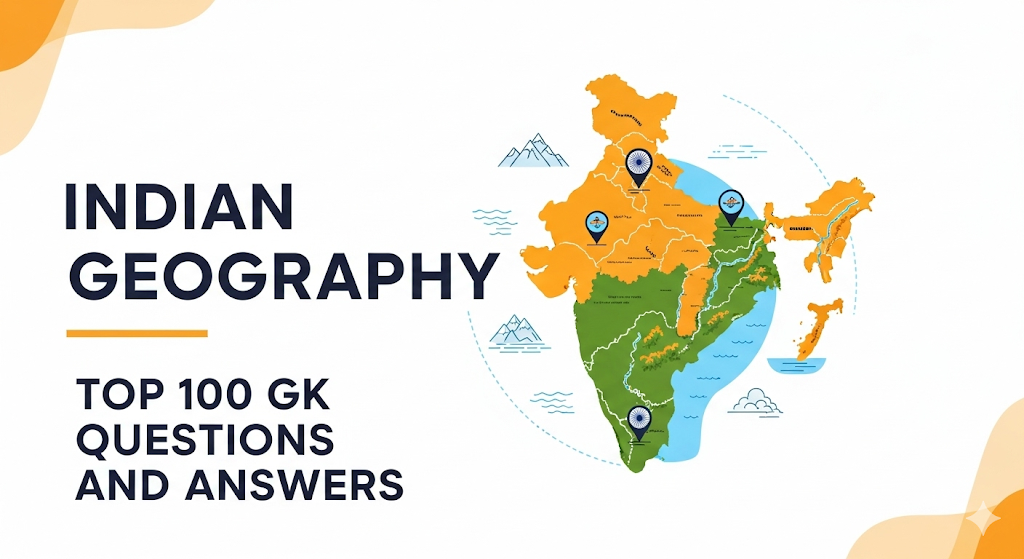
    Indian Geography – Top 100 GK Questions and Answers

    Indian Geography is one of the most scoring sections in General Knowledge. From physical features to rivers, mountains, states, agriculture, and natural resources, many questions are repeatedly asked in UPSC, SSC, Railway, Banking, and State-level exams.
    Here we present the Top 100 Geography GK Questions with Answers for your exam preparation.

    Top 100 GK Questions on Indian Geography

    1–20: Physical Features

    Q1. What is the total geographical area of India?
    👉 3.287 million sq. km

    Q2. Which is the largest state of India by area?
    👉 Rajasthan

    Q3. Which is the smallest state of India by area?
    👉 Goa

    Q4. Which is the largest union territory of India by area?
    👉 Ladakh

    Q5. What is the southernmost point of India?
    👉 Indira Point (Nicobar Islands)

    Q6. Which is the northernmost point of India?
    👉 Indira Col, Siachen Glacier

    Q7. What is the latitudinal extent of India?
    👉 8°4′ N to 37°6′ N

    Q8. What is the longitudinal extent of India?
    👉 68°7′ E to 97°25′ E

    Q9. Which is the standard meridian of India?
    👉 82°30′ E (passes through Mirzapur, UP)

    Q10. Tropic of Cancer passes through how many states?
    👉 8 States (Rajasthan, MP, Chhattisgarh, Jharkhand, WB, Tripura, Mizoram, Gujarat)

    Q11. Which mountain range separates Northern India from Tibet?
    👉 The Himalayas

    Q12. Which is the highest peak in India?
    👉 Kanchenjunga (8,586 m)

    Q13. In which state is Kanchenjunga located?
    👉 Sikkim

    Q14. Which is the highest peak in the Himalayas?
    👉 Mount Everest (8,848 m, in Nepal)

    Q15. What is the average height of the Himalayas?
    👉 6,000 meters

    Q16. Which is the oldest mountain range of India?
    👉 Aravalli Range

    Q17. Which is the highest peak of Aravalli Range?
    👉 Guru Shikhar (1,722 m, Rajasthan)

    Q18. Which plateau is known as the ‘Mineral Storehouse of India’?
    👉 Chota Nagpur Plateau

    Q19. Which plateau is known as the ‘Deccan Trap’?
    👉 Deccan Plateau

    Q20. Which plain is formed by the Indus, Ganga, and Brahmaputra rivers?
    👉 Indo-Gangetic Plain

    21–40: Rivers and Water Bodies

    Q21. Which is the longest river of India?
    👉 Ganga (2,525 km)

    Q22. Which is the largest river in India by volume of water?
    👉 Brahmaputra

    Q23. Which river is known as Dakshin Ganga (Ganga of South)?
    👉 Godavari

    Q24. Which is the longest river in South India?
    👉 Godavari

    Q25. Which river is called the Lifeline of Madhya Pradesh?
    👉 Narmada

    Q26. On which river is the Sardar Sarovar Dam built?
    👉 Narmada

    Q27. Which river flows through a rift valley?
    👉 Narmada and Tapi

    Q28. Which river is known as the ‘Sorrow of Bihar’?
    👉 Kosi River

    Q29. Which river is known as the ‘Sorrow of Bengal’?
    👉 Damodar River

    Q30. Which river is known as the ‘Sorrow of Odisha’?
    👉 Mahanadi

    Q31. Which is the largest delta in the world?
    👉 Sundarbans Delta (Ganga-Brahmaputra Delta)

    Q32. Which lake is the largest freshwater lake in India?
    👉 Wular Lake (J&K)

    Q33. Which is the largest saltwater lake in India?
    👉 Chilika Lake (Odisha)

    Q34. Pulicat Lake is located in which state?
    👉 Andhra Pradesh and Tamil Nadu

    Q35. Which is the largest man-made lake in India?
    👉 Govind Ballabh Pant Sagar (Rihand Dam, UP)

    Q36. Loktak Lake is in which state?
    👉 Manipur

    Q37. Dal Lake is located in which city?
    👉 Srinagar

    Q38. Which river is known as the Lifeline of Kerala?
    👉 Periyar River

    Q39. Which river is called the Lifeline of Assam?
    👉 Brahmaputra

    Q40. Which is the only river in India that flows from East to West?
    👉 Narmada & Tapi

    41–60: States and Boundaries

    Q41. How many states and union territories are there in India?
    👉 28 States, 8 UTs (as of 2023)

    Q42. Which Indian state has the longest coastline?
    👉 Gujarat

    Q43. Which Indian state has the shortest coastline?
    👉 Goa

    Q44. Which state is known as the Land of Rising Sun in India?
    👉 Arunachal Pradesh

    Q45. Which state is known as the Land of Five Rivers?
    👉 Punjab

    Q46. Which is the largest state of South India by area?
    👉 Karnataka

    Q47. Which Indian state is known as the Spice Garden of India?
    👉 Kerala

    Q48. Which state is called the ‘Sugar Bowl of India’?
    👉 Uttar Pradesh

    Q49. Which state is the largest producer of tea in India?
    👉 Assam

    Q50. Which state is the largest producer of coffee in India?
    👉 Karnataka

    61–80: Climate, Soil, and Agriculture

    Q61. Which is the coldest place in India?
    👉 Dras (Ladakh)

    Q62. Which is the hottest place in India?
    👉 Phalodi (Rajasthan)

    Q63. Which state receives the highest rainfall in India?
    👉 Meghalaya

    Q64. Which place is the wettest place in India?
    👉 Mawsynram (Meghalaya)

    Q65. Which is the driest place in India?
    👉 Jaisalmer (Rajasthan)

    Q66. Which soil is called Regur Soil?
    👉 Black Cotton Soil

    Q67. Which soil is most suitable for cotton cultivation?
    👉 Black Soil

    Q68. Which is the most fertile soil in India?
    👉 Alluvial Soil

    Q69. Red soil is found mostly in?
    👉 Tamil Nadu, Karnataka, Andhra Pradesh

    Q70. Laterite soil is rich in?
    👉 Iron and Aluminum

    Q71. Which crop is known as Golden Fiber?
    👉 Jute

    Q72. Which crop is known as the King of Cereals?
    👉 Wheat

    Q73. Which crop is called the Poor Man’s Food?
    👉 Jowar

    Q74. Which state is the largest producer of rice in India?
    👉 West Bengal

    Q75. Which state is the largest producer of wheat in India?
    👉 Uttar Pradesh

    Q76. Which state is the largest producer of sugarcane in India?
    👉 Uttar Pradesh

    Q77. Which state is the largest producer of pulses in India?
    👉 Madhya Pradesh

    Q78. Which state is the largest producer of cotton in India?
    👉 Gujarat

    Q79. Which state is the largest producer of jute in India?
    👉 West Bengal

    Q80. Which state is the largest producer of maize in India?
    👉 Karnataka

    81–100: Natural Resources & Miscellaneous

    Q81. Which state is the largest producer of coal in India?
    👉 Jharkhand

    Q82. Which state is the largest producer of iron ore in India?
    👉 Odisha

    Q83. Which state is the largest producer of bauxite in India?
    👉 Odisha

    Q84. Which state is the largest producer of mica in India?
    👉 Andhra Pradesh

    Q85. Which state is the largest producer of petroleum in India?
    👉 Assam

    Q86. Which state is the largest producer of natural gas in India?
    👉 Assam & Gujarat

    Q87. Which state is the largest producer of gold in India?
    👉 Karnataka

    Q88. Which state is the largest producer of diamonds in India?
    👉 Madhya Pradesh (Panna Mines)

    Q89. Which state has the maximum forest cover in India?
    👉 Madhya Pradesh

    Q90. Which state has the highest percentage of forest cover?
    👉 Mizoram

    Q91. Which is the largest desert in India?
    👉 Thar Desert

    Q92. Which is the highest dam in India?
    👉 Tehri Dam (Uttarakhand)

    Q93. Which is the longest dam in India?
    👉 Hirakud Dam (Odisha)

    Q94. Bhakra Nangal Dam is built on which river?
    👉 Sutlej

    Q95. Which city is known as the Silicon Valley of India?
    👉 Bengaluru

    Q96. Which city is known as the Manchester of India?
    👉 Ahmedabad

    Q97. Which city is known as the Cotton City of India?
    👉 Coimbatore

    Q98. Which city is known as the City of Lakes?
    👉 Udaipur

    Q99. Which city is known as the Pink City of India?
    👉 Jaipur

    Q100. Which city is known as the City of Joy?
    👉 Kolkata

    These Top 100 GK Questions on Indian Geography cover India’s physical features, rivers, soils, states, climate, agriculture, and resources. Memorize them for UPSC, SSC, Railway, Bank, and other exams.

    Indian Freedom Struggle – Top 100 GK Questions and Answers

Enable Notifications OK No thanks