Category: Blog

Your blog category

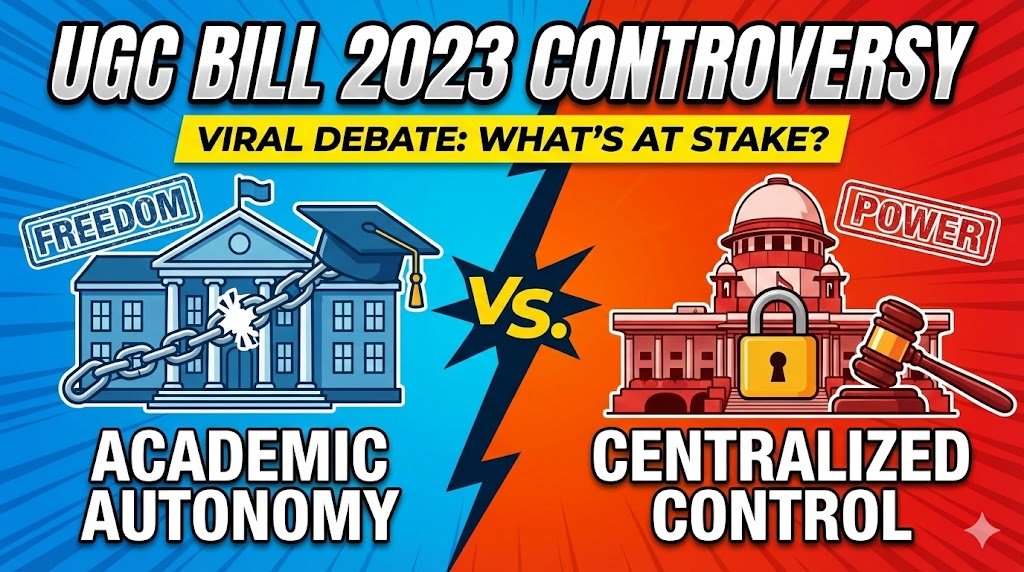
  • The UGC Bill 2023 Controversy: Academic Autonomy vs. Centralized Control

    The UGC Bill 2023 Controversy: Academic Autonomy vs. Centralized Control

    A Tectonic Shift in Indian Higher Education

    The University Grants Commission (UGC) has been the cornerstone of India’s higher education system since 1956, functioning as both a funding body and a regulatory authority. However, the proposed UGC Bill 2023 (officially titled “The University Grants Commission (Setting and Maintenance of Standards in Higher Education) Bill, 2023”) has ignited one of the most intense academic and political controversies in recent years. This legislation seeks to replace the UGC Act of 1956 with a completely new regulatory framework, potentially transforming the very architecture of India’s higher education landscape.

    The controversy represents a fundamental clash between two visions: one advocating for greater governmental control and standardization, and another fiercely defending institutional autonomy and academic freedom. With protests erupting across campuses, sharp divisions within Parliament, and international academic bodies expressing concern, the UGC Bill has become a lightning rod for debates about federalism, autonomy, and the future of knowledge production in India.


    Part 1: The Bill’s Key Provisions – What’s Changing?

    1.1 Centralization of Power

    The most contentious aspect is the proposed complete centralization of regulatory authority. The bill envisions:

    • Direct government appointment of the UGC chairperson and members (removing the collegium system)
    • Expanded ministerial control over commission functioning
    • Reduced representation of academicians in decision-making bodies
    • Increased bureaucratic oversight of university operations

    1.2 New Regulatory Mechanisms

    • Single regulatory regime for higher education (replacing multiple bodies)
    • Mandatory accreditation framework with potential funding consequences
    • Standardized curriculum development processes
    • Digital university initiatives under direct government control

    1.3 Changed Funding Paradigm

    • Performance-based funding replacing block grants
    • Greater conditionality attached to financial support
    • Enhanced power to withhold funds for non-compliance

    1.4 Governance Restructuring

    • Reconstituted executive bodies with increased government nominees
    • Modified autonomy frameworks for different categories of institutions
    • New compliance requirements for universities

    Part 2: The Core Controversies – Why the Opposition?

    2.1 Erosion of Federalism

    States’ Rights vs. Central Control
    The bill has triggered a major federalism debate, with several states accusing the central government of encroaching on their constitutional rights:

    • Education is on the Concurrent List (Entry 25 of List III), giving both center and states jurisdiction
    • Opposition-ruled states (particularly Kerala, Tamil Nadu, West Bengal) argue the bill violates the federal spirit
    • Financial implications: States fear loss of control over their own universities’ funding and policies

    Legal Challenge
    The Kerala Legislative Assembly passed a unanimous resolution opposing the bill, calling it “unconstitutional.” Legal experts debate whether the bill oversteps central government authority under the Constitution.

    2.2 Threat to Academic Autonomy

    “Government Knows Best” Approach
    Academic communities nationwide have raised alarm about potential micromanagement:

    • Curriculum interference: Fear of politically motivated syllabus changes
    • Research freedom: Concerns about “approved” and “unapproved” research areas
    • Appointment processes: Worries about political considerations overriding merit

    International Precedents
    Comparisons are being drawn with Hungary’s 2017 higher education law and Turkey’s post-2016 academic purges, though proponents deny any similarity.

    2.3 Exclusion of Academic Voices

    Demographic Shift in Governance
    The proposed composition of UGC has caused particular concern:

    • Current system: 10-12 members, majority being academicians
    • Proposed system: More government officials and “eminent persons” (often political appointees)
    • Reduced institutional representation: Fewer vice-chancellors and academic leaders

    Professor N. Sukumar (Delhi University) argues: “This bill transforms UGC from an academic body to a government department. The soul of higher education—academic expertise—is being systematically removed.”

    2.4 Quality vs. Standardization Paradox

    One-Size-Fits-All Approach
    Critics argue the bill prioritizes standardization over quality:

    • Regional diversity: Ignores varying needs across India’s linguistic and cultural landscape
    • Institutional diversity: Treats research universities, teaching colleges, and specialized institutions identically
    • Pedagogical freedom: Restricts innovative teaching methods and curriculum design

    The NEP 2020 Connection
    While the bill claims to implement the National Education Policy 2020, critics argue it contradicts NEP’s stated commitment to institutional autonomy and flexibility.


    Part 3: Political Dimensions and Ideological Battles

    3.1 Government’s Stated Position

    The Ministry of Education defends the bill as necessary for:

    • Eliminating regulatory fragmentation (over 15 different regulatory bodies currently)
    • Implementing NEP 2020 effectively
    • Ensuring “minimum standards” across the country
    • Promoting “Indian knowledge systems” and national values
    • Fighting “corruption and nepotism” in some universities

    Education Minister’s Assurance
    The minister has repeatedly stated: “Autonomy of serious academic institutions will not be affected. We’re only targeting mismanagement and quality deficits.”

    3.2 Opposition’s Counter-Narrative

    Opposition parties frame the bill as:

    • Political control mechanism: To install ideologically aligned leadership
    • Centralization agenda: Part of larger pattern undermining states’ rights
    • Privatization push: Through performance-based funding favoring certain institutions
    • Majoritarian project: To reshape education along particular ideological lines

    3.3 Student and Faculty Movements

    Nationwide Protests

    • #SavePublicEducation campaign across universities
    • Joint statements from multiple teachers’ associations
    • Student unions from Left to Ambedkarite groups finding common cause
    • International solidarity from global academic associations

    Part 4: Comparative Analysis – International Perspectives

    4.1 Global Regulatory Trends

    The controversy reflects a worldwide tension:

    • UK’s Research Excellence Framework: Performance-based funding criticized for bureaucratic burden
    • Australia’s TEQSA: Similar quality assurance body with its own controversies
    • European Bologna Process: Standardization efforts facing resistance

    4.2 Specific International Concerns

    • UNESCO has emphasized the need to protect academic freedom globally
    • Scholars at Risk network monitoring the situation
    • Comparative constitutional law experts analyzing federalism implications

    Part 5: The Way Forward – Potential Compromises

    5.1 Parliamentary Standing Committee Recommendations

    The bill was referred to the Standing Committee on Education, which suggested:

    • Greater state representation in UGC composition
    • Protection of regional languages in curriculum
    • Clearer autonomy safeguards for top institutions
    • Phased implementation rather than abrupt change

    5.2 Expert Committee Proposals

    Various academic bodies have proposed middle paths:

    1. Dual governance model: Separating funding and regulatory functions
    2. Category-based regulation: Different frameworks for different institution types
    3. Independent appellate mechanism: For dispute resolution
    4. Sunset clauses: For experimental provisions

    5.3 Constitutional Solutions

    Legal experts suggest:

    • Strengthening the Interstate Council for education matters
    • Clear division of subjects between center and states
    • Cooperative federalism model rather than hierarchical control

    Part 6: Historical Context – Evolution of UGC

    6.1 Original Vision (1956)

    • Radhakrishnan Commission (1948-49) recommended an independent grants commission
    • Original Act emphasized autonomy and academic leadership
    • Balanced representation from various stakeholders

    6.2 Gradual Erosion

    • Increasing governmental intervention over decades
    • Politicization of appointments across different governments
    • Bureaucratic expansion at expense of academic focus

    6.3 Current Crisis as Turning Point

    Many see this bill as the final transformation from an academic to a bureaucratic body.


    Part 7: Implications for Different Stakeholders

    7.1 For Universities

    • Central universities: Mixed impacts based on political alignment
    • State universities: Potential resource and autonomy losses
    • Private institutions: Possibly less affected but facing new compliance

    7.2 For Students

    • Curriculum changes: Possible ideological shifts in syllabus
    • Mobility issues: Credit transfer mechanisms
    • Quality concerns: Standardization vs. excellence debate

    7.3 For Faculty

    • Research constraints: Particularly in social sciences and humanities
    • Career progression: New evaluation parameters
    • Intellectual freedom: Self-censorship concerns

    7.4 For Indian Academia Globally

    • International rankings: Possible impact on perception
    • Collaboration networks: Foreign universities’ comfort levels
    • Brain drain/gain: Effect on academic migration patterns

    Conclusion: Democracy’s Classroom at a Crossroads

    The UGC Bill controversy represents more than a policy disagreement—it’s a fundamental debate about the role of education in a democracy. At stake are crucial questions:

    1. Who controls knowledge production in the world’s largest democracy?
    2. How is federalism balanced with national standards?
    3. What constitutes academic excellence—compliance or innovation?
    4. How does India position itself in global knowledge networks?

    The resolution of this controversy will shape Indian higher education for generations. The middle path—one that ensures quality without sacrificing diversity, maintains standards without crushing autonomy, and implements national vision while respecting federal principles—remains elusive but essential.

    As the parliamentary process continues, with the bill likely to be taken up in the upcoming session, all eyes are on whether amendments will address core concerns or whether the controversy will deepen. What’s clear is that the classroom has expanded beyond university walls into the public square, with the nation itself becoming both student and teacher in this critical lesson about democracy, education, and governance.

    read : Veteran Indian Politician Ajit Pawar Dies in Tragic Plane Crash, Nation in Shock

  • Veteran Indian Politician Ajit Pawar Dies in Tragic Plane Crash, Nation in Shock

    Veteran Indian Politician Ajit Pawar Dies in Tragic Plane Crash, Nation in Shock

    In a tragic incident that has sent shockwaves across the country, veteran Indian politician Ajit Pawar reportedly died after a private aircraft crashed near Baramati in Maharashtra. The aircraft, carrying senior leaders and crew members, met with a fatal accident during its landing attempt, resulting in the death of all passengers on board.

    According to reports, the aircraft was travelling from Mumbai to Baramati when it encountered technical difficulties while approaching the runway. Witnesses near the crash site said they heard a loud explosion followed by thick smoke rising from the area. Emergency services rushed to the location, but rescue teams confirmed that there were no survivors.

    Ajit Pawar, a prominent political figure known for his strong influence in Maharashtra politics, was among those on board. His sudden demise has left supporters, party workers, and political leaders deeply saddened.

    Authorities stated that preliminary investigations suggest possible technical failure combined with poor visibility as the cause of the crash. Aviation officials have recovered the flight’s black box, which will be examined to determine the exact sequence of events leading to the tragedy.

    Soon after the news broke, political reactions poured in from across the country. Leaders from different parties expressed condolences and described Ajit Pawar as a decisive administrator and mass leader with deep grassroots connect. Government offices in several regions observed moments of silence in his memory.

    Ajit Pawar had a long and impactful political career, holding several key positions over the years. Known for his sharp political strategies and administrative experience, he played a crucial role in shaping Maharashtra’s political landscape. His supporters often referred to him as a leader who combined strong decision-making with practical governance.

    The tragic incident has also raised serious questions about aviation safety, especially for chartered flights used by political leaders. Experts have called for stricter safety audits, improved weather monitoring systems, and better emergency response protocols to prevent such incidents in the future.

    Security around the crash site remains tight as officials continue their investigation. The government has announced compensation for the families of the victims and assured full support during this difficult time.

    Ajit Pawar’s last rites are expected to be performed with full state honours, with thousands of supporters anticipated to attend and pay their final respects. His death marks the end of an era in state politics and leaves behind a significant leadership void.

    As the nation mourns, investigations continue to uncover the truth behind the tragic crash, while memories of Ajit Pawar’s political legacy remain alive among the people he served.

    read : NEET 2026 Age Limit: Latest Official Update & Complete Analysis

  • Google AdSense Approval Kaise Le? 2026 का पूरा गाइड (100% Real टिप्स)

    Google AdSense Approval Kaise Le? 2026 का पूरा गाइड (100% Real टिप्स)

    पार्ट 1: AdSense Approval की Real Truth (2026 Update)

    Google AdSense 2026 में पहले से कठिन हो गया है। नए AI-algorithms, quality updates और strict policies के चलते 80% नए ब्लॉग reject हो रहे हैं। लेकिन सही strategy से आप 7-14 दिनों में approval ले सकते हैं।

    AdSense के नए 2026 Rules:

    1. Content Age: ब्लॉग कम से कम 2 महीने पुराना होना चाहिए (पहले 6 महीने था)
    2. Content Quantity: 30-40 हाई क्वालिटी आर्टिकल्स (1000+ words each)
    3. Traffic Requirement: कोई official requirement नहीं, लेकिन daily 50-100 organic visitors चाहिए
    4. User Experience: Core Web Vitals पास करना ज़रूरी

    पार्ट 2: ब्लॉग Setup – सही शुरुआत

    Step 1: Niche Selection (सबसे Important)

    ✅ Approve होने वाले Niches:

    • Health & Wellness (योग, आयुर्वेद)
    • Education (करियर, एजुकेशन टिप्स)
    • Technology (सॉफ्टवेयर रिव्यू)
    • Finance (पर्सनल फाइनेंस टिप्स)
    • Lifestyle (ट्रैवल, फूड)

    ❌ Reject होने वाले Niches:

    • Copyrighted content
    • Adult content
    • Hate speech
    • Casino/Gambling
    • Hacking/Cracking

    Step 2: Domain और Hosting

    • Domain: .com या .in लें (प्रोफेशनल लगता है)
    • Hosting: Hostinger, Bluehost या Bigrock (सस्ते और अच्छे)
    • Theme: GeneratePress या Astra (हल्के और फास्ट)

    Step 3: Legal पेज बनाएं

    ये 4 पेज्स जरूर बनाएं:

    1. About Us – अपने बारे में
    2. Contact Us – ईमेल और फोन नंबर
    3. Privacy Policy – Automatically generate करें
    4. Disclaimer – Affiliate disclaimer

    पार्ट 3: Content Strategy जो काम करती है

    Golden Formula for 2026:

    “3×30×1000 Rule”

    • 3 महीने पहले से ब्लॉग active
    • 30 articles minimum
    • 1000+ words each article

    Article Structure:

    text

    Title: [Keyword] - पूरी जानकारी हिंदी में
    Length: 1200-1500 words
    Images: 5-7 relevant images (self-clicked या free stock)
    Formatting: H2, H3 headings, bullet points
    Internal Links: 3-5 internal links
    External Links: 2-3 authoritative sites

    Top 10 Easy-to-Rank Topics:

    1. “How to” गाइड्स
    2. Product reviews (अपने experience से)
    3. Comparison articles (X vs Y)
    4. List articles (Top 10…)
    5. Problem-Solution articles
    6. News updates in your niche
    7. Case studies
    8. Tutorials
    9. FAQs
    10. Personal experiences

    पार्ट 4: Technical SEO Setup

    Essential Plugins:

    1. Rank Math SEO – SEO optimization
    2. WP Rocket – Speed optimization
    3. Akismet – Spam protection
    4. Imagify – Image optimization

    Speed Optimization:

    • PageSpeed Score: 90+ mobile, 95+ desktop
    • LCP: < 2.5 seconds
    • FID: < 100 ms
    • CLS: < 0.1

    Mobile Friendly:

    • Responsive theme
    • Clickable buttons (48×48 px)
    • Readable font (16px minimum)

    पार्ट 5: Approval से पहले की Checklist

    Content Checklist:

    ✅ सभी articles 100% original
    ✅ No plagiarism (Copyscape pass)
    ✅ No grammatical errors
    ✅ Proper images with alt text
    ✅ Contact information visible
    ✅ About page complete
    ✅ Privacy policy page
    ✅ 30+ articles published

    Technical Checklist:

    ✅ SSL certificate installed
    ✅ Website speed optimized
    ✅ Mobile responsive
    ✅ No broken links
    ✅ Sitemap submitted to Google Search Console
    ✅ Robots.txt properly configured
    ✅ Favicon installed
    ✅ Social media links

    Design Checklist:

    ✅ Professional logo
    ✅ Clean navigation menu
    ✅ Search bar available
    ✅ Related posts section
    ✅ Comment section enabled
    ✅ Footer with copyright info
    ✅ Proper categories and tags

    **पार्ट 6: AdSense Apply करने का Step-by-Step Process

    Day 1-7: Preparation Phase

    1. Complete all 30 articles
    2. Fix technical issues
    3. Submit sitemap to Google
    4. Get some initial traffic (social media से)

    Day 8: Application Process

    1. AdSense website पर जाएं: adsense.google.com
    2. Get Started बटन पर क्लिक करें
    3. अपना email डालें (Gmail use करें)
    4. Website URL डालें
    5. Country select करें (India)
    6. Payment method add करें (बाद में भी कर सकते हैं)

    Application Form में क्या भरें:

    • Account type: Individual
    • Address: Complete postal address (यहीं पिन कोड भेजा जाएगा)
    • Phone verification: Indian number
    • Content: अपने niche के बारे में सही जानकारी

    Important Tips for Application:

    1. Website language: हिंदी ब्लॉग के लिए हिंदी select करें
    2. Content description: 3-4 लाइन में अपने ब्लॉग का description दें
    3. Additional websites: अभी नहीं, बाद में add कर सकते हैं
    4. Promotion methods: Organic SEO, social media लिखें

    पार्ट 7: Approval के बाद क्या करें

    AdSense Approval Time:

    • Normal time: 1-2 weeks
    • Fast track: 2-5 days (अगर सब कुछ परफेक्ट है)
    • Rejection: 24-48 hours में (अगर कुछ गड़बड़ है)

    Approval मिलने पर:

    1. PIN verification: 2-4 weeks में PIN आएगा
    2. Ad placement: Auto ads enable करें
    3. Monitoring: 48 hours में ads show होने लगेंगे
    4. Payment threshold: ₹7500 जमा होने पर payment

    First Month Strategy:

    1. Daily 1 article publish करें
    2. Social media promotion करें
    3. Email newsletter शुरू करें
    4. Related niches में guest posting

    **पार्ट 8: Common Rejection Reasons और Solutions

    2026 के Top Rejection Reasons:

    1. “Low value content” – Solution: और डिटेल्ड content लिखें
    2. “Not enough content” – Solution: 40+ articles तक बढ़ाएं
    3. “Poor user experience” – Solution: Website speed बढ़ाएं
    4. “Copyrighted material” – Solution: सभी images replace करें

    Rejection मिलने पर क्या करें:

    1. Rejection reason पढ़ें
    2. 15-20 दिन इंतज़ार करें
    3. Problems fix करें
    4. दोबारा apply करें

    पार्ट 9: 2026 के Smart Tricks

    Fast Approval Tricks:

    1. Social Media Traffic: Facebook groups में शेयर करें
    2. Guest Posting: Established ब्लॉग्स पर guest post लिखें
    3. Email Signups: Newsletter subscribers बढ़ाएं
    4. Comments Engagement: Readers से comments लें

    Content Quality बढ़ाने के Tips:

    1. Video content: 2-3 minutes की videos बनाएं
    2. Infographics: Complex topics को आसान बनाएं
    3. PDF guides: Free PDF downloads दें
    4. Quizzes: Interactive content बनाएं

    पार्ट 10: Alternative Options

    अगर AdSense नहीं मिले:

    1. Media.net – Yahoo-Bing का network
    2. Propeller Ads – Pop-under ads
    3. InfoLinks – In-text advertising
    4. Ezoic – AI-based optimization (traffic चाहिए)
    5. Monumetric – 10K monthly visitors पर

    इनसे पहले earn करें:

    1. Affiliate Marketing – Amazon, Flipkart
    2. Sponsored Posts – Brands से direct deals
    3. Digital Products – Ebooks, courses
    4. Services – Consulting, freelancing

    पार्ट 11: Success Stories 2026

    Real Case Studies:

    Case 1: रवि, 24 (Education Niche)

    • Started: January 2026
    • Articles: 35 (1500 words each)
    • Approval: 9 days में
    • First month earning: ₹8,500

    Case 2: प्रिया, 29 (Health Niche)

    • Started: November 2025
    • Articles: 42 articles
    • Approval: 12 days में
    • First month earning: ₹12,000

    Case 3: अमित, 32 (Tech Niche)

    • Started: October 2025
    • Articles: 50+ articles
    • Approval: 5 days में (fast track)
    • First month earning: ₹18,000

    Conclusion: आपकी Success की Guarantee

    Google AdSense 2026 में भी possible है, बस पैटर्न्स बदल गए हैं। पहले quantity mattered, अब quality matters। पहले traffic mattered, अब user experience matters।

    Final Action Plan:

    1. Today: Domain और hosting लें
    2. Week 1: 10 articles publish करें
    3. Month 1: 30 articles complete करें
    4. Month 2: Technical SEO fix करें
    5. Month 3: Apply करें और approve हो जाएं

    Most Important बातें:

    1. Never copy content – 100% original लिखें
    2. Never use fake traffic – Organic growth करें
    3. Never try shortcuts – Google समझ जाता है
    4. Never give up – Reject होने पर improve करके फिर apply करें

    याद रखें: AdSense approval एक process है, overnight success नहीं। जो bloggers इसमें सफल होते हैं, वो consistent रहते हैं। आपका पहला ₹1000 कमाने में 2-3 महीने लग सकते हैं, लेकिन एक बार system setup हो गया, तो passive income शुरू हो जाता है।

    शुरुआत आज ही करें। एक article लिखें, फिर दूसरा, फिर तीसरा… 30 articles पूरे होते-होते आप expert बन चुके होंगे और AdSense approve भी हो चुका होगा।

    “2026 में भी AdSense approval मुश्किल नहीं, बस थोड़ा स्मार्ट काम करने की ज़रूरत है।”

    Also Read : 10 Best Ways to Make Money Online in 2025 (No Investment Required)

  • Top 5 Free AI Tools for Absolute Beginners: Unlock Your Potential in 2025

    Top 5 Free AI Tools for Absolute Beginners: Unlock Your Potential in 2025

    Feeling curious about AI but worried it’s too complex or expensive? You’re not alone. The good news is that the most powerful AI revolution is happening on platforms that are incredibly user-friendly and, best of all, free.

    You don’t need a technical background. You just need a web browser and a sense of curiosity. This list isn’t for data scientists; it’s for you—the student, the small business owner, the creative, the lifelong learner.

    We’ve tested and vetted the crowded field of AI tools to bring you the five that are the easiest to start with, the most powerful for their price (free!), and the most versatile for your daily life. Let’s dive in.

    1. ChatGPT: The All-Purpose Conversational Genius

    Best For: Writing, brainstorming, learning, and getting answers to any question.

    What It Is: Developed by OpenAI, ChatGPT is the tool that brought AI into the mainstream. Think of it as a incredibly knowledgeable and patient conversation partner that can help you with virtually any text-based task.

    Why It’s Perfect for Beginners:

    • Incredibly Intuitive: The simple chat interface feels exactly like texting a smart friend.
    • No Learning Curve: You ask a question in plain English, and it answers. It’s that simple.
    • Versatile: It can draft emails, write stories, explain complex concepts, summarize long articles, and even help you plan a vacation.

    How to Get Started for Free:

    1. Go to chat.openai.com.
    2. Click “Sign Up” and create an account using your email, Google, or Microsoft account.
    3. You’ll have immediate access to the free GPT-3.5 model, which is more than powerful enough for all beginner tasks.

    Your First Mission:
    In the chat box, type:

    “Hello! I’m new to AI. Can you help me draft a friendly email to my neighbor about organizing a block party? Keep it short and cheerful.”

    Watch as it creates a perfectly serviceable draft in seconds. Now you’re using AI!

    2. Microsoft Copilot (with Image Creator): Your AI Assistant & Artist Combo

    Best For: Getting answers with web sources and creating stunning images from text.

    What It Is: Microsoft Copilot (powered by GPT-4) is a strong ChatGPT alternative with a killer feature: it can search the web to give you current information. Even better, it comes bundled with Image Creator, a powerful tool that generates images from your descriptions using DALL-E technology.

    Why It’s Perfect for Beginners:

    • Two Tools in One: A world-class chatbot and a world-class image generator in a single, clean interface.
    • Access to Current Info: Unlike the free version of ChatGPT, Copilot can tell you about recent news and events.
    • Generous Free Access: Image Creator gives you a set number of “boosts” for faster image generation, which replenish regularly.

    How to Get Started for Free:

    1. Go to copilot.microsoft.com.
    2. Sign in with your free Microsoft account (if you use Outlook or Hotmail, you already have one).
    3. To find the image creator, look for the “Create” icon (a paint palette) in the menu or simply type “Create an image of…” in the main chat.

    Your First Mission:
    In the chat box, type:

    “What are the top 3 trending news stories in tech today?”
    Then, click on the Image Creator icon and type:
    “A photorealistic image of a tiny astronaut reading a map in a lush, enchanted forest, cinematic lighting.”

    You’ll get both updated news summaries and four unique, generated images to choose from.

    3. Canva AI: Magic for Your Everyday Designs

    Best For: Creating social media graphics, presentations, and documents with AI-powered ease.

    What It Is: You might know Canva as the drag-and-drop design tool. It has now baked AI directly into its platform, making it absurdly easy to create professional-looking visuals. Its “Magic Studio” suite includes tools for generating images, writing text, and even creating short videos.

    Why It’s Perfect for Beginners:

    • No Design Skills Needed: If you can click a button, you can use Canva AI.
    • Context-Aware: The AI works inside your designs. It can write text for your Facebook post, suggest a color palette, or generate a background image that fits your theme.
    • All-In-One Platform: You can go from a blank page to a finished, AI-generated design without ever leaving your browser.

    How to Get Started for Free:

    1. Go to canva.com and create a free account.
    2. Start a new design (e.g., an “Instagram Post”).
    3. On the left-hand toolbar, look for the “Magic Studio” tools, including Magic Write (for text) and Magic Media (for images/video).

    Your First Mission:
    Create a new Instagram post. Click “Magic Write” and type:

    “Give me 5 catchy captions for a photo of a homemade chocolate chip cookie.”
    Then, click “Magic Media” and type:
    “A perfectly baked, gooey chocolate chip cookie on a rustic wooden table, food photography.”

    In under a minute, you’ll have both captions and a custom image for your post.

    4. Grammarly: Your Invisible Writing Coach

    Best For: Improving your writing everywhere—from emails and documents to social media.

    What It Is: Grammarly is more than a spell-checker. Its free AI-powered version acts as a real-time writing coach, checking for clarity, conciseness, tone, and punctuation. It works directly in your browser, Google Docs, and even on your phone.

    Why It’s Perfect for Beginners:

    • Works Where You Work: You don’t have to go to a separate website. It integrates seamlessly into the tools you already use.
    • Instant, Actionable Feedback: It doesn’t just highlight errors; it explains why something is unclear and suggests a better way to phrase it.
    • Builds Confidence: For anyone who worries about their writing, Grammarly is a supportive partner that helps you communicate more effectively.

    How to Get Started for Free:

    1. Go to grammarly.com.
    2. Create a free account and download the browser extension.
    3. The next time you’re writing an email in Gmail or a post on LinkedIn, you’ll see the Grammarly icon pop up, ready to help.

    Your First Mission:
    Compose a new email. As you type, watch Grammarly’s icon. If it shows a number, click on it to see its suggestions for improving your clarity and correctness. It’s like having an editor looking over your shoulder.

    5. Claude.ai: The Thoughtful and Conversational Reader

    Best For: Analyzing long documents and having nuanced, thoughtful conversations.

    What It Is: Created by Anthropic, Claude is a direct competitor to ChatGPT that excels at two things: maintaining long, coherent conversations and processing large amounts of text. You can upload PDFs, Word documents, and text files, and Claude can summarize, answer questions, and analyze the content.

    Why It’s Perfect for Beginners:

    • Massive Context Window: The free version can handle conversations and documents that are much longer than most other free tools.
    • Thoughtful and Detailed: Many users find Claude’s responses to be more nuanced and thorough, especially for complex topics.
    • Easy Document Upload: The simple upload button makes it a breeze to analyze reports, articles, or meeting notes.

    How to Get Started for Free:

    1. Go to claude.ai.
    2. Sign up for a free account.
    3. Look for the paper clip icon to upload a document, or just start chatting.

    Your First Mission:
    Find a long online article you’ve been meaning to read. Copy and paste the URL or the entire text into Claude and ask:

    “Please summarize this article in three key bullet points. Also, what is the author’s main argument?”

    You’ll get a concise summary in seconds, saving you valuable time.


    Your “Start Today” Action Plan

    Feeling inspired? Don’t just read—do! Here’s a simple plan to get you started in the next 10 minutes:

    1. Pick Your First Tool: Choose one from this list that solves an immediate problem. Need to write better emails? Start with Grammarly. Want to create a fun social media post? Try Canva.
    2. Create Your Account: It takes 60 seconds. Use an existing Google/Microsoft account to make it even faster.
    3. Complete the “Your First Mission” Task: We’ve given you a specific, low-pressure task for each tool. This will build your confidence instantly.
    4. Explore One New Feature: Once you’ve done the first task, click around. Try a different prompt or button. The best way to learn is by playing.

    Conclusion: The Future is Free (to Start)

    These five tools have demolished the barriers to entering the world of AI. They prove that you don’t need a big budget or a tech degree to harness this transformative technology. You just need a willingness to try something new.

    The gap between those who use AI and those who don’t is widening. By starting with these free, beginner-friendly tools today, you’re not just playing with a fun gadget—you’re future-proofing your skills, boosting your productivity, and unlocking a new level of creative potential.

  • How to Start Using AI Tools: The Complete Beginner’s Guide (2025)

    How to Start Using AI Tools: The Complete Beginner’s Guide (2025)

    Let’s be honest. “AI” can feel intimidating. The headlines make it sound like you need a PhD in computer science just to get started. You see people generating stunning art or writing complex code with a single sentence, and you think, “How? Where do I even begin?”

    What if I told you that you’ve probably already used AI today?

    That movie recommendation on Netflix? AI. The map that rerouted you around traffic? AI. Your phone’s camera adjusting for a perfect portrait? AI.

    You’re not starting from scratch. You’re just learning to shift from being a passive user to an active driver of this incredible technology.

    This guide is your friendly co-pilot. We’re going to demystify AI, walk you through your first steps with the most powerful and accessible tools, and give you a practical action plan to weave AI into your daily life. No complex theory, no confusing code—just clear, actionable steps.

    Ready to unlock your potential? Let’s begin.

    Part 1: Demystifying AI – What Are You Actually Using?

    Before we log in, let’s clear up the basics. When we talk about “AI tools” for beginners, we’re primarily talking about two powerful types:

    1. Generative AI (The Creative Brain)
    This is the AI that creates new, original content from a simple instruction (called a prompt). It’s the rockstar of the moment.

    • What it does: Writes text, creates images, composes music, generates code.
    • Think of it as: An incredibly fast, creative, and knowledgeable intern who never sleeps.
    • Examples: ChatGPT, DALL-E, Midjourney, Claude.

    2. AI Assistants & Copilots (The Productivity Partner)
    These are AI tools baked into the software you already use, designed to help you work smarter.

    • What it does: Summarizes long emails, drafts documents, organizes data, suggests code.
    • Think of it as: A helpful colleague who’s always there to give you a starting point or handle a tedious task.
    • Examples: Microsoft Copilot (in Word, Excel), Google Gemini (in Docs, Sheets), Grammarly.

    The Golden Rule for Beginners: You don’t need to understand how the AI works. You just need to learn how to talk to it. This skill is called prompting, and it’s your new superpower.


    Part 2: Your First Steps – Getting Started with Text-Based AI

    The best place to start is with a text-based Generative AI. It’s the most versatile and easiest to grasp.

    Choosing Your First Tool

    For 99% of beginners, the best starting point is ChatGPT.

    • Why? It’s the most well-known, user-friendly, and powerful all-purpose chatbot. The free version (GPT-3.5) is more than capable for getting started.
    • The Alternative: Google Gemini is another excellent option, especially if you live in the Google ecosystem.

    Your Mission: Create an Account

    1. Go to chat.openai.com or gemini.google.com.
    2. Create a free account using your email, or sign up easily with your Google/Microsoft account.
    3. That’s it! You’re in. You’ll see a simple chat box. This is your playground.

    The Art of the Prompt: Your Key to Unlocking AI

    A prompt is simply the instruction or question you give the AI. A good prompt gets a great answer. A bad prompt gets a mediocre one. It’s like giving directions—the more precise you are, the less likely you’ll get lost.

    Let’s go from a bad prompt to a great one.

    • Bad Prompt:"Write about marketing."
      • Why it’s bad: It’s too vague. The AI has no idea what kind of marketing, for who, or in what format.
    • Better Prompt:"Write a blog post about social media marketing."
      • Better, but… It’s still missing a specific angle and audience.
    • Great Prompt (Using a Framework):“Act as a seasoned digital marketing expert.
      Write a 500-word beginner’s guide blog post for small business owners in the USA who are new to social media.
      The topic is ‘The Top 3 Benefits of Using Instagram for Local Businesses.’
      The tone should be encouraging, professional, and easy-to-understand.
      Include a call-to-action at the end encouraging them to post their first Reel.”

    See the difference? The “great prompt” uses a simple framework:

    1. Role: (Act as a...) This gives the AI context and tells it what expertise to draw from.
    2. Task: (Write a...) Be specific about what you want it to create.
    3. Context & Audience: (for small business owners...) This tailors the content.
    4. Format & Tone: (500-word blog post... encouraging, professional) This defines the style.
    5. Details: (Include a call-to-action...) These are the finishing touches.

    Your First Practice:

    1. Open your chosen AI tool.
    2. Copy and paste the “Great Prompt” above and see what it creates.
    3. Now, change it! Swap “Instagram” for “Facebook” or change the audience to “teenagers.” See how the output changes.

    You’ve just had your first successful conversation with AI.


    Part 3: Branching Out – An Introduction to AI Image Generators

    Once you’re comfortable with text, the next stop is pure magic: creating images from your imagination.

    Choosing Your First Image Generator

    • Best for Beginners:Microsoft Copilot (with Image Creator) or Canva AI
      • Why? They are incredibly easy to use and often free. Copilot is built into Bing and has a very straightforward image generator powered by DALL-E. Canva lets you generate images directly inside its design tool.
    • For Advanced Hobbyists:Midjourney
      • Why? It often produces the most artistic and high-quality images, but it operates through Discord, which has a slightly steeper learning curve.

    Your Mission: Generate Your First AI Image

    Let’s use Microsoft’s Image Creator as our example.

    1. Go to bing.com/create.
    2. Sign in with your Microsoft account (if you have Windows or Outlook, you already have one).
    3. You’ll see a search bar. This is where you write your image prompt.

    Crafting a Powerful Image Prompt

    Just like with text, specificity is key. A good image prompt often includes:

    • Subject: What is the main focus? (e.g., a calico cat)
    • Action/Scene: What is it doing? Where is it? (e.g., wearing a tiny pirate hat, sailing a wooden boat)
    • Style: Do you want a photo, painting, cartoon, 3D render? (e.g., digital art, stylized)
    • Details & Lighting: Colors, mood, time of day, etc. (e.g., vibrant colors, sunny day, cinematic lighting)

    Let’s try it:

    • Vague Prompt: "a cat in a boat."
    • Detailed, “Magic” Prompt: "Digital art of a fluffy calico cat wearing a tiny pirate hat and an eye patch, proudly sailing a small wooden boat on a calm, sparkling blue ocean. Sunny day, vibrant colors, Pixar style, cinematic, joyful."

    Type the detailed prompt into Image Creator and watch the magic happen. You’ll get four generated images to choose from.

    Your First Practice:

    1. Generate the cat image above.
    2. Now, remix it. Change “calico cat” to “golden retriever.” Change “Pixar style” to “watercolor painting.” The world is your oyster.

    Part 4: Weaving AI into Your Daily Life – A Practical Playbook

    Theory is great, but let’s get practical. Here’s how you can use these tools right now.

    For Work & Productivity:

    • Tame Your Inbox: Use ChatGPT or Gemini to “Draft a polite and professional email to [Colleague’s Name] following up on the [Project Name] report, asking for an update by end of week.”
    • Conquer Writer’s Block: Stuck on a report? “Create an outline for a quarterly report on [Your Project]. Include sections for achievements, challenges, key metrics, and next quarter’s goals.”
    • Analyze Data (Yes, Really!): Copy and paste a chunk of data or a complex article into ChatGPT and ask: “Summarize the key points of this text” or “Identify the main trends in this data.”

    For Learning & Personal Growth:

    • Your Personal Tutor: “Explain how quantum computing works as if I’m a 10-year-old.” Or, “Create a 30-day learning plan for a beginner to understand the basics of Python programming.”
    • The Ultimate Debate Partner: “Act as a devil’s advocate and challenge my idea that [Your Idea]. Point out potential flaws and weaknesses.”

    For Creativity & Fun:

    • Plan Your Next Trip: “I’m planning a 5-day trip to Tokyo. Suggest a detailed itinerary that includes major temples, great food districts, and off-the-beaten-path neighborhoods.”
    • Brainstorm Gift Ideas: “Suggest unique gift ideas for my father who loves woodworking, classic rock, and grilling. Budget is under $100.”
    • Write a Poem or Song: “Write a short, funny poem about my cat, Luna, who is obsessed with knocking things off tables.”

    Part 5: Leveling Up – Intermediate Tips & Tricks

    Once you’re comfortable with the basics, these tips will make you a power user.

    1. Provide Context with “The Paper Clip Test”: Imagine you’re telling a smart person what they need to know to complete a task. Don’t assume they have the background info.
    2. Use “Chain of Thought” Prompting: For complex problems, ask the AI to think step-by-step. “We need to reduce household expenses by 15%. First, analyze our monthly spending [paste data]. Then, suggest the top 3 areas to cut back, and finally, draft a new monthly budget.”
    3. Iterate and Refine: Your first result is rarely your last. Treat the AI like a conversation. If you get a good but not perfect output, just tell it: “That’s a good start, but make the tone more formal and add two more bullet points about [specific topic].”
    4. Fact-Check Everything: AI can “hallucinate”—meaning it can make up facts, quotes, or statistics with total confidence. Always double-check important information. AI is a fantastic starting point and a creativity engine, but it is not an infallible database.

    Part 6: Navigating the Pitfalls – A Responsible Beginner’s Mindset

    With great power comes great responsibility. Here’s how to use AI wisely from day one.

    • Privacy is Paramount: Never paste sensitive personal information (phone numbers, addresses, financial data), confidential work documents, or anyone else’s private information into a public AI tool.
    • Bias is a Reality: AI models are trained on data from the internet, which contains human biases. Be aware that outputs can sometimes reflect stereotypes. Critically evaluate everything it produces.
    • You Are the Boss: The AI is a tool, not a replacement for your own judgment and expertise. The final output is your responsibility. Edit, refine, and add your own human touch to everything it creates.

    Conclusion: Your Journey Starts Now

    You’ve made it. You now know what AI tools are, how to talk to them, and how to use them to save time, boost your creativity, and learn new things.

    The biggest mistake you can make now is to close this tab and do nothing.

    Your Final Mission, Should You Choose to Accept It:

    1. Open ChatGPT or Gemini.
    2. Type this prompt (or your own variation):“Hello! I am brand new to using AI tools. I work as a [Your Job/Hobby] and I’m interested in [Your Interest]. Can you suggest three specific, practical ways I could use you to save time or be more creative in my daily life this week?”

    The AI will now become your personal guide. It’s a fitting start to your new journey as an active, empowered user of the most transformative technology of our time.

    Welcome to the future. You’ve got this.

  • What is AI and Why Every American Needs It in 2025?

    What is AI and Why Every American Needs It in 2025?

    If you’re an American in 2025, you’ve felt it. The headlines swing from utopian promises to dystopian warnings. Your phone finishes your sentences, your car warns you of a collision you didn’t see, and your doctor might be using a tool that can spot diseases with superhuman accuracy.

    This isn’t science fiction. This is Artificial Intelligence, and it’s the defining technological shift of our generation. Much like the advent of the personal computer in the 80s or the internet in the 90s, AI is reshaping the very fabric of our society.

    But amidst the hype and fear, a critical question remains: What exactly is AI, and why should I, as an everyday American, genuinely care?

    The answer is simple yet profound: AI is not a distant trend; it’s the new bedrock of global competition, national security, and personal opportunity. To ignore it, to fear it without understanding it, is to risk being left behind. This isn’t about becoming a programmer; it’s about becoming an informed citizen, a savvy consumer, and a resilient professional in the new American economy.

    Let’s pull back the curtain.

    Part 1: What Exactly Is AI? Cutting Through the Hype

    At its core, Artificial Intelligence (AI) is a branch of computer science dedicated to creating machines capable of performing tasks that typically require human intelligence. This includes things like learning, reasoning, problem-solving, perception, and understanding language.

    Think of it this way: if traditional software is a meticulously written recipe a computer follows step-by-step, AI is like teaching a computer to taste and create its own recipes.

    To truly get it, let’s break down the key terms you’re hearing:

    • Machine Learning (ML): This is the engine of most modern AI. Instead of being explicitly programmed for every scenario, ML algorithms are fed vast amounts of data. They identify patterns, learn from them, and make predictions or decisions. When Netflix recommends your next binge-watch, that’s ML at work, learning your viewing habits.
    • Deep Learning & Neural Networks: This is a more advanced, powerful subset of ML, loosely inspired by the human brain. It uses complex “neural networks” with many layers to process data. It’s the technology behind the truly astonishing AI feats:
      • Computer Vision: Enabling self-driving cars to “see” a stop sign or a medical AI to spot a tumor on an X-ray.
      • Natural Language Processing (NLP): Allowing tools like ChatGPT to understand and generate human-like text, or your smart speaker to comprehend your voice commands.
    • Generative AI: This is the rockstar of the moment. This type of AI doesn’t just analyze data; it creates new content. It can write marketing copy, generate photorealistic images from a text description, compose music, or even write computer code. It’s a powerful tool for creativity and productivity.

    Crucial Takeaway: AI is not a single, sentient robot. It’s a collection of powerful technologies, mostly powered by data and pattern recognition, that are augmenting human capabilities in unprecedented ways.

    Part 2: The American Crossroads: Why 2025 is the Pivotal Year

    We are at a national inflection point. The early-adoption phase is over. AI is now moving into the mainstream, and the decisions we make as a country—and as individuals—in 2025 will set our trajectory for decades.

    Here’s why this year is different:

    1. Ubiquity and Accessibility: AI is no longer locked in Silicon Valley R&D labs. User-friendly platforms are putting immense power into the hands of small business owners, students, and creatives. You can leverage AI today without writing a single line of code.
    2. Global Competition is Intensifying: Nations around the world, particularly China, are investing trillions to dominate the AI landscape. This isn’t just a tech race; it’s a race for economic supremacy, military advantage, and geopolitical influence. American leadership in AI is not guaranteed. To remain competitive, we must lead in innovation.
    3. The Productivity Imperative: With an aging population and economic headwinds, the U.S. needs a productivity boom. AI is the most powerful tool we have to automate routine tasks, optimize complex systems, and unlock new levels of efficiency across every sector, from manufacturing to healthcare.

    In 2025, embracing AI is synonymous with embracing American competitiveness and resilience.

    Part 3: Why Every American Needs AI: A Sector-by-Sector Breakdown

    This is where the abstract becomes personal. Let’s explore how AI is directly impacting the core pillars of American life.

    1. For Your Wallet & Career: The New World of Work

    The biggest fear is job displacement. It’s a valid concern, but the complete picture is more nuanced and ultimately optimistic.

    • Automation of Tasks, Not Necessarily Jobs: AI excels at automating repetitive, mundane tasks (data entry, scheduling, initial customer service queries). This doesn’t mean your job disappears; it means you are freed up to focus on the more “human” aspects of your work: strategy, creativity, empathy, and complex problem-solving. An accountant using AI for data reconciliation can spend more time on strategic financial planning for clients.
    • The Creation of New Industries: Just as the internet created jobs like “social media manager” and “app developer,” AI is birthing entirely new career paths: AI Ethicist, Prompt Engineer, Machine Learning Operations Specialist, and more.
    • Leveling the Playing Field for Small Businesses: A local bakery can use AI for hyper-targeted social media ads, a freelance writer can use generative AI to brainstorm and draft content faster, and a family-run logistics company can use AI to optimize delivery routes, saving on fuel and time. This gives Main Street a fighting chance against corporate giants.

    The Bottom Line: The American worker of 2025 needs to be AI-literate. You don’t have to build it, but understanding how to use AI tools in your field will be as fundamental as knowing how to use email or a spreadsheet. It’s the key to staying relevant, valuable, and employed.

    2. For Your Health: A Revolution in Healthcare

    AI is poised to create a more proactive, personalized, and accessible American healthcare system.

    • Early and Accurate Diagnosis: AI algorithms can analyze medical images (MRIs, CT scans, mammograms) with a speed and accuracy that can surpass human radiologists, catching diseases like cancer at their earliest, most treatable stages.
    • Personalized Medicine: AI can analyze your genetics, lifestyle, and medical history to help doctors tailor prevention strategies and treatments specifically for you, moving away from the one-size-fits-all model.
    • Accelerating Drug Discovery: The process of discovering new drugs is incredibly slow and expensive. AI can analyze vast databases of molecular structures to predict potential new drug candidates, slashing development time from years to months and bringing life-saving treatments to market faster.
    • Administrative Relief: AI can handle prior authorizations, billing codes, and patient scheduling, reducing the massive administrative burden on our healthcare providers and allowing them to spend more time with patients.

    For every American, this translates to longer, healthier lives and a healthcare system that works for us, not against us.

    3. For Your Community: Smarter, Safer, and More Efficient

    AI is the brain behind the “smart city” concept, making our communities better places to live.

    • Public Safety: AI-powered cameras can help law enforcement identify real-time threats or find missing persons faster. Predictive analytics can help direct patrols to areas with a higher statistical likelihood of crime, acting as a deterrent.
    • Infrastructure & Traffic: AI can optimize traffic light timing to reduce congestion, predict when a bridge or power grid needs maintenance before it fails, and manage energy consumption across a city for a smaller carbon footprint.
    • Personalized Education: AI tutors can provide customized learning paths for students, helping them with subjects they struggle with and challenging them in areas where they excel. This helps address the “one-size-fits-all” problem in our classrooms.

    4. For Your National Security and Prosperity

    On a macro level, AI is fundamental to America’s place in the world.

    • Economic Growth: AI-driven innovation is the primary catalyst for the next wave of economic growth. From optimizing supply chains to creating new products and services, AI will be a major driver of U.S. GDP.
    • National Defense: The U.S. Department of Defense uses AI for everything from cybersecurity, to analyze satellite imagery for threats, to training simulations. Maintaining a technological edge is critical for national security in the 21st century.
    • Climate & Agricultural Innovation: AI models are helping us predict extreme weather events with greater accuracy. In agriculture, AI helps farmers monitor crop health from the air, use water and pesticides more efficiently, and increase yields to feed a growing population.

    Part 4: Addressing the Elephant in the Room: Ethical Concerns & Responsible AI

    It would be irresponsible to discuss AI’s potential without acknowledging its real risks: data privacy, algorithmic bias, and job displacement. A “move fast and break things” approach is not acceptable. As a nation, we must champion Responsible AI.

    • Bias and Fairness: AI systems learn from data created by humans, which can contain our own biases. We must be vigilant in auditing AI for racial, gender, or socioeconomic bias, especially in critical areas like hiring, lending, and criminal justice.
    • Privacy and Surveillance: The data-hungry nature of AI raises serious privacy concerns. We need clear legal and ethical frameworks, potentially new federal legislation, to govern how personal data is collected and used.
    • Transparency and Accountability: When an AI system makes a decision that affects someone’s life, we must be able to understand why. The “black box” problem is a real challenge that researchers are working to solve.

    The solution isn’t to halt progress, but to guide it with strong American values of fairness, transparency, and individual liberty.

    Part 5: Your Personal AI Action Plan for 2025

    Feeling overwhelmed? Don’t be. Embracing AI starts with small, manageable steps.

    1. Get Curious, Not Anxious: Shift your mindset from fear to curiosity. Follow reputable tech news sources. Ask questions.
    2. Try It Yourself: The best way to learn is by doing.
      • For Writing & Creativity: Experiment with free tiers of tools like ChatGPT or Claude.
      • For Images: Try DALL-E or Midjourney to see how text can become art.
      • For Productivity: Use AI-powered features already in your Microsoft 365 or Google Workspace subscription.
    3. Upskill Strategically: Identify one or two tasks in your current job that are repetitive. Research if there’s an AI tool that can automate or assist with it. Online platforms like Coursera, Udemy, and LinkedIn Learning offer countless courses on AI literacy for non-technical professionals.
    4. Engage in the Conversation: Talk to your colleagues about it. Discuss the ethics with your friends. Be an informed voice in your community. The future of AI should be shaped by all of us, not just a handful of tech executives.

    Conclusion: The American Future is an AI-Augmented One

    The narrative that AI will replace humanity is a myth. The far more likely and empowering future is one of collaboration.

    AI will be the most powerful tool we have ever created—a tool that can amplify our intelligence, cure our diseases, secure our nation, and solve our most pressing challenges. It is not a replacement for human judgment, empathy, or creativity; it is a partner that can handle the computational heavy lifting, freeing us to be more human.

    In 2025, the question is not if you will interact with AI, but how. Will you be a passive bystander, overwhelmed by change? Or will you be an active participant, shaping and leveraging this technology to build a better career, a healthier life, and a more prosperous America?

    The future isn’t something that happens to us. It’s something we build. And in 2025, we will build it with AI.

  • Best Chicken Zinger Burger in Lucknow – Order from Chickzilla on Zomato Now!

    Best Chicken Zinger Burger in Lucknow – Order from Chickzilla on Zomato Now!

    Are you craving something crispy, juicy, and bursting with flavor? Your search ends here! Chickzilla brings you the most delicious Chicken Zinger Burger in Lucknow, loved by thousands for its perfect blend of crunch and spice.

    🍔 What Makes Chickzilla’s Zinger Burger Special?

    Our Chicken Zinger Burger is not just food — it’s an experience!

    Premium boneless chicken fillet
    ✅ Double-marinated in our secret spice mix
    ✅ Deep-fried to crispy golden perfection
    ✅ Served with fresh lettuce, soft bun & signature mayo
    ✅ Optional add-ons: cheese slice, double patty, or combo with fries & mojito

    One bite is enough to tell the difference. Fresh, hot, and packed with flavor — just like you love it!

    📍 We Deliver Across Lucknow

    Get Chickzilla’s crispy Zinger Burger delivered to your doorstep in 30 minutes or less!

    🛵 Areas we cover:

    • Gomti Nagar
    • Indira Nagar
    • Hazratganj
    • Rajajipuram
    • Sarvodaya Nagar
    • Alambagh
    • And more!

    💡 Orders via Zomato only – fast, safe, and easy!

    💸 Limited Time Offer: Only ₹129/-

    Yes, just ₹129 for the classic Chicken Zinger Burger!

    🔗 👉 ORDER NOW ON ZOMATO

  • Maruti Suzuki WagonR 2025: A Perfect Blend of Practicality, Comfort, and Efficiency

    Maruti Suzuki WagonR 2025: A Perfect Blend of Practicality, Comfort, and Efficiency

    The Maruti Suzuki WagonR, fondly called the “Tall Boy,” has been a household name in India since its launch in 1999. With every generation, the WagonR has evolved to meet the changing preferences of consumers while maintaining its core appeal: practicality, efficiency, and affordability. The latest iteration is no exception, offering modern technology and upgraded features, making it one of the most popular choices in the compact hatchback segment.

    This blog explores how the WagonR continues to be a top contender in its category and why it remains a favorite among Indian families, first-time buyers, and fleet operators alike.

    A Distinctive Design That Stands Out

    The 2025 Maruti WagonR builds upon its iconic tall-boy stance, combining a modern look with functional elements:

    • Front Fascia: A bold grille with chrome accents and sleek headlamps enhance its road presence.
    • Side Profile: Character lines and a floating roof design give it a sophisticated touch.
    • Rear Design: Vertically stacked taillights and a wide tailgate emphasize practicality.
    • Wheels: 14-inch steel wheels for lower variants and 15-inch alloy wheels for higher trims.

    The WagonR’s unique vertical design not only provides excellent interior space but also ensures superior visibility, making it ideal for city driving and tight spaces.

    Spacious and Comfortable Interiors

    The WagonR’s cabin design focuses on comfort and space optimization. Its tall architecture offers significant advantages, such as ample headroom and better legroom.

    • Seating: Elevated seating positions provide easy entry and exit, ideal for elderly passengers.
    • Boot Space: With 341 liters of boot capacity, expandable to 710 liters, it accommodates both daily commutes and long trips.
    • Dashboard Layout: A user-friendly design with all controls within easy reach.

    The premium upholstery and thoughtful storage options make every journey enjoyable for passengers.

    Powertrain Options and Performance

    The WagonR caters to diverse consumer needs with multiple engine options:

    Engine VariantPower OutputTorqueTransmissionDrivetrainMileage (ARAI)
    1.0L K10C Petrol67 PS89 Nm5-Speed Manual / AMTFWD24.35 km/l
    1.2L K12N Petrol89 PS113 Nm5-Speed Manual / AMTFWD23.56 km/l
    CNG (Factory-Fitted)57 PS (CNG Mode)82 Nm5-Speed ManualFWD34.05 km/kg

    The introduction of a powerful yet fuel-efficient 1.2L engine variant appeals to drivers seeking more spirited performance, while the CNG option continues to attract environmentally conscious buyers.

    Fuel Efficiency and Environmental Consciousness

    Fuel efficiency remains a key selling point for the WagonR:

    • Petrol Variants: Up to 24.35 km/l for the 1.0L engine.
    • CNG Variant: A remarkable 34.05 km/kg.

    Maruti Suzuki’s engines now comply with BS6 Phase II norms and come equipped with technologies like idle start-stop and dual jet injectors, reducing emissions and enhancing fuel economy.

    Smart Features and Technology

    The WagonR boasts modern technology that caters to tech-savvy customers:

    • Infotainment System: A 7-inch SmartPlay Studio touchscreen with Android Auto and Apple CarPlay.
    • Voice Commands: For hands-free control of navigation and entertainment.
    • Rear Parking Sensors: Assist with safe and easy parking.
    • Power Features: Including power windows, keyless entry, and electronically adjustable ORVMs.
    • Climate Control: Automatic system for passenger comfort.
    • Steering Controls: Mounted buttons for audio and call functions.

    These tech upgrades make the WagonR a well-rounded vehicle for urban and highway drives.

    Safety Features: Prioritizing Passenger Protection

    The 2025 Maruti WagonR ensures peace of mind with enhanced safety features:

    • Dual front airbags as standard.
    • ABS (Anti-lock Braking System) with EBD (Electronic Brakeforce Distribution).
    • Electronic Stability Program (ESP) and Hill Hold Assist (in AMT variants).
    • Rear parking sensors and camera for added convenience.
    • ISOFIX child seat anchors for enhanced child safety.

    Built on Maruti’s HEARTECT platform, the WagonR offers improved structural rigidity without compromising on weight efficiency.

    Driving Experience and Handling

    The suspension system (MacPherson strut at the front and torsion beam at the rear) ensures a comfortable ride, even on bumpy Indian roads.

    Key driving advantages include:

    • High Ground Clearance: 170mm for easy handling of speed bumps and rough roads.
    • Turning Radius: A compact 4.7 meters, making U-turns and parking in narrow spaces easy.
    • Steering: Light and responsive, perfect for urban driving conditions.

    Competitive Edge and Market Positioning

    The Maruti WagonR holds a strong position in the highly competitive compact hatchback segment, rivaling models such as:

    • Tata Tiago
    • Hyundai Santro
    • Renault Kwid

    Its unmatched combination of fuel efficiency, interior space, and affordability gives it a distinct edge over competitors.

    Why Buy the WagonR? Target Audience

    The WagonR appeals to a diverse set of buyers, including:

    • Small families needing practical transportation.
    • First-time buyers seeking reliable and economical options.
    • Fleet operators appreciating low maintenance costs.
    • Environmentally conscious consumers opting for the CNG variant.

    Ownership Experience and After-Sales Support

    Maruti Suzuki’s extensive service network across India (with over 3,500 centers) ensures seamless after-sales service and affordable maintenance costs.

    Key benefits:

    • Competitive service charges.
    • Easy availability of spare parts.
    • Extended warranty options and Maruti Suzuki service packages.

    Looking Ahead: Future Prospects

    Maruti Suzuki is exploring electrification possibilities across its lineup, hinting at potential hybrid or electric variants of the WagonR in the future.

    With its adaptability and strong brand reputation, the WagonR is expected to remain a front-runner in India’s evolving automotive market.

    Conclusion: A Perfect Companion for Indian Roads

    The 2025 Maruti WagonR proves that practicality, technology, and efficiency can coexist in a compact package. Whether you’re navigating busy urban streets or embarking on a long journey, the WagonR delivers unmatched comfort and convenience.

    Its enduring appeal, combined with Maruti Suzuki’s trusted brand value, ensures that the WagonR continues to be an aspirational yet practical choice for millions of Indian consumers.

    Also Read:- Toyota Fortuner 2025 Facelift: A Bold Evolution of India’s Iconic SUV

Enable Notifications OK No thanks