Category: GK

  • 25 Mind-Blowing GK Facts That Will Make Your Brain Tingle!

    Ever wanted to drop some serious knowledge bombs at your next gathering? Or perhaps you’re just looking for some fascinating tidbits to expand your own mental horizons. Whatever your reason, get ready to have your mind blown with these 25 general knowledge facts that most people don’t know!

    1. Honey Never Spoils:Β Archaeologists have found pots of honey in ancient Egyptian tombs that are over 3,000 years old and still perfectly edible!
    2. A Group of Owls is Called a Parliament:Β Imagine a wise assembly of owls, debating the merits of nocturnal life.
    3. The Great Wall of China Isn’t Visible from Space (with the naked eye):Β This persistent myth, though romantic, isn’t true.
    4. Octopuses Have Three Hearts:Β Two pump blood through the gills, and one circulates it to the rest of the body.
    5. Bananas are Berries, but Strawberries Aren’t:Β Botanically speaking, it’s true!
    6. The Smallest Country in the World is Vatican City:Β It’s smaller than many golf courses.
    7. The Human Nose Can Remember 50,000 Different Scents:Β That’s a lot of memory capacity for smells!
    8. The “Sixth Sick Sheik’s Sixth Sheep’s Sick” is Considered the Toughest Tongue Twister in the English Language:Β Try saying that five times fast!
    9. A Day on Venus is Longer Than Its Year:Β Venus rotates incredibly slowly.
    10. There Are More Stars in the Universe Than Grains of Sand on All the Beaches on Earth:Β A truly humbling thought.
    11. The World’s Oldest Piece of Chewing Gum is 9,000 Years Old:Β Found in Sweden!
    12. Cows Don’t Have Upper Front Teeth:Β They have a dental pad instead.
    13. The Hawaiian Alphabet Only Has 12 Letters:Β A, E, I, O, U, H, K, L, M, N, P, W.
    14. More People Are Killed by Donkeys Annually Than by Plane Crashes:Β Surprising, right?
    15. It is Impossible for Most People to Lick Their Own Elbow:Β Go ahead, try it!
    16. The Eiffel Tower Can Be 15 cm Taller During the Summer:Β Due to thermal expansion of the iron.
    17. A Crocodile Cannot Stick Its Tongue Out:Β Their tongues are fixed to the roof of their mouths.
    18. The Fear of Long Words is Called Hippopotomonstrosesquippedaliophobia:Β The irony is delicious.
    19. Butterflies Taste with Their Feet:Β They have chemoreceptors on their tarsi.
    20. The Unicorn is the National Animal of Scotland:Β A symbol of purity, innocence, and power.
    21. There are Diamonds in Space That Are Larger Than Earth:Β “BPM 37093” also known as “Lucy” is a huge diamond star.
    22. The Only Letter That Doesn’t Appear in Any U.S. State Name is Q:Β A fun geographical fact.
    23. A Slinky Can Extend 82 Feet:Β Who knew that simple toy had such reach?
    24. The Smallest Bone in the Human Body is the Stapes (in the ear):Β It’s tiny, but crucial for hearing.
    25. The Average Cloud Weighs 1.1 Million Pounds:Β That’s about the same as 100 elephants!

    How many of these did you already know? Share your favorite mind-blowing fact in the comments below!

  • Children’s General Knowledge: 150+ Simple GK Questions and Answers

    Children’s General Knowledge: 150+ Simple GK Questions and Answers

    General Knowledge Questions for Kids

    1. Q: How many days are there in a week?
      A: 7
    2. Q: How many colors are there in a rainbow?
      A: 7
    3. Q: Which planet is known as the Red Planet?
      A: Mars
    4. Q: Who was the first man to walk on the Moon?
      A: Neil Armstrong
    5. Q: How many continents are there in the world?
      A: 7
    6. Q: Which is the largest continent?
      A: Asia
    7. Q: What is the national animal of India?
      A: Tiger
    8. Q: What is the national bird of India?
      A: Peacock
    9. Q: What is the capital of India?
      A: New Delhi
    10. Q: Which is the smallest month of the year?
      A: February

    Animals & Birds GK

    1. Q: Which is the fastest land animal?
      A: Cheetah
    2. Q: Which animal is called the King of the Jungle?
      A: Lion
    3. Q: Which animal gives us wool?
      A: Sheep
    4. Q: Which is the largest animal in the world?
      A: Blue Whale
    5. Q: Which animal has a long trunk?
      A: Elephant
    6. Q: Which bird is known as the symbol of peace?
      A: Dove
    7. Q: Which bird can mimic human voices?
      A: Parrot
    8. Q: Which insect makes honey?
      A: Honeybee
    9. Q: How many legs does a spider have?
      A: 8
    10. Q: Which animal lives in water and has gills?
      A: Fish

    Food & Health GK

    1. Q: Which fruit is called the β€œKing of Fruits” in India?
      A: Mango
    2. Q: Which vegetable is red in color and used in ketchup?
      A: Tomato
    3. Q: Which fruit keeps the doctor away if eaten daily?
      A: Apple
    4. Q: Which food is rich in calcium?
      A: Milk
    5. Q: Which vitamin do we get from the Sun?
      A: Vitamin D
    6. Q: Which part of the plant do we eat in carrots?
      A: Root
    7. Q: Which fruit is yellow and monkeys love it?
      A: Banana
    8. Q: Which cereal is used to make bread?
      A: Wheat
    9. Q: Which is the hottest spice in India?
      A: Chili
    10. Q: Which food is known as β€œbrain food”?
      A: Fish

    School & Learning GK

    1. Q: How many letters are there in the English alphabet?
      A: 26
    2. Q: How many vowels are there in English?
      A: 5 (A, E, I, O, U)
    3. Q: What is 5 + 3?
      A: 8
    4. Q: What is the square of 10?
      A: 100
    5. Q: Which shape has 3 sides?
      A: Triangle
    6. Q: Which shape has no sides and corners?
      A: Circle
    7. Q: How many hours are there in one day?
      A: 24
    8. Q: Which is the biggest two-digit number?
      A: 99
    9. Q: What comes after Friday?
      A: Saturday
    10. Q: How many zeros are there in 1000?
      A: 3

    Countries & Capitals GK

    1. Q: What is the capital of USA?
      A: Washington, D.C.
    2. Q: What is the capital of UK?
      A: London
    3. Q: What is the capital of France?
      A: Paris
    4. Q: What is the capital of Japan?
      A: Tokyo
    5. Q: What is the capital of China?
      A: Beijing
    6. Q: What is the capital of Australia?
      A: Canberra
    7. Q: What is the capital of Pakistan?
      A: Islamabad
    8. Q: What is the capital of Nepal?
      A: Kathmandu
    9. Q: What is the capital of Sri Lanka?
      A: Colombo
    10. Q: What is the capital of Russia?
      A: Moscow

    Space & Universe GK

    1. Q: Which is the nearest planet to the Sun?
      A: Mercury
    2. Q: Which is the largest planet in our Solar System?
      A: Jupiter
    3. Q: Which planet is called the β€œBlue Planet”?
      A: Earth
    4. Q: How many planets are there in the Solar System?
      A: 8
    5. Q: Which planet is known for its beautiful rings?
      A: Saturn
    6. Q: What is the name of our galaxy?
      A: Milky Way
    7. Q: Which is the brightest object in the night sky?
      A: Moon
    8. Q: Which planet is farthest from the Sun?
      A: Neptune
    9. Q: Who was the first Indian to go to space?
      A: Rakesh Sharma
    10. Q: Which planet is called the β€œMorning Star”?
      A: Venus

    Sports GK for Kids

    1. Q: How many players are there in a cricket team?
      A: 11
    2. Q: Who is known as the β€œGod of Cricket”?
      A: Sachin Tendulkar
    3. Q: Which country invented football (soccer)?
      A: England
    4. Q: How many rings are there in the Olympic symbol?
      A: 5
    5. Q: In which sport is the term β€œlove” used?
      A: Tennis
    6. Q: Which sport is known as the β€œnational game of India”?
      A: Hockey
    7. Q: How many players are there in a basketball team?
      A: 5
    8. Q: Which country won the FIFA World Cup in 2022?
      A: Argentina
    9. Q: In cricket, how many runs are given for hitting a ball over the boundary without touching the ground?
      A: 6
    10. Q: Who is called the β€œFlying Sikh of India”?
      A: Milkha Singh

    India & Culture GK

    1. Q: Who is the Father of the Nation in India?
      A: Mahatma Gandhi
    2. Q: What is the national flower of India?
      A: Lotus
    3. Q: What is the national fruit of India?
      A: Mango
    4. Q: What is the national river of India?
      A: Ganga
    5. Q: What is the national sport of India?
      A: Hockey
    6. Q: Who wrote the Indian national anthem?
      A: Rabindranath Tagore
    7. Q: Who is the President of India (2025)?
      A: Droupadi Murmu
    8. Q: Who is the Prime Minister of India (2025)?
      A: Narendra Modi
    9. Q: Which is the largest state in India (by area)?
      A: Rajasthan
    10. Q: Which is the smallest state in India?
      A: Goa

    Science & Inventions GK

    1. Q: Who invented the light bulb?
      A: Thomas Edison
    2. Q: Who invented the telephone?
      A: Alexander Graham Bell
    3. Q: Who discovered gravity?
      A: Isaac Newton
    4. Q: Which gas do humans breathe in to survive?
      A: Oxygen
    5. Q: Which gas do plants give out during photosynthesis?
      A: Oxygen
    6. Q: What is H2O commonly known as?
      A: Water
    7. Q: Which gas do we fill in balloons to make them float?
      A: Helium
    8. Q: Which planet has the most gravity?
      A: Jupiter
    9. Q: What do bees collect from flowers?
      A: Nectar
    10. Q: Which organ pumps blood in our body?
      A: Heart

    Festivals & Famous Places GK

    1. Q: Which festival is known as the β€œFestival of Lights”?
      A: Diwali
    2. Q: Which festival is called the β€œFestival of Colors”?
      A: Holi
    3. Q: Christmas is celebrated on which date?
      A: 25th December
    4. Q: Eid is celebrated after which month of fasting?
      A: Ramadan
    5. Q: Where is the Taj Mahal located?
      A: Agra
    6. Q: Where is the Eiffel Tower located?
      A: Paris
    7. Q: Where is the Statue of Liberty?
      A: New York, USA
    8. Q: Where is Qutub Minar?
      A: Delhi
    9. Q: Where is Red Fort?
      A: Delhi
    10. Q: Where is India Gate?
      A: New Delhi

    Nature & Environment GK

    1. Q: Which is the largest ocean in the world?
      A: Pacific Ocean
    2. Q: Which is the smallest ocean?
      A: Arctic Ocean
    3. Q: Which is the longest river in the world?
      A: Nile
    4. Q: Which is the largest river in India?
      A: Ganga
    5. Q: Which is the tallest mountain in the world?
      A: Mount Everest
    6. Q: Which is the highest mountain in India?
      A: Kanchenjunga
    7. Q: Which is the hottest desert in the world?
      A: Sahara Desert
    8. Q: Which is the coldest place on Earth?
      A: Antarctica
    9. Q: Which is the largest island in the world?
      A: Greenland
    10. Q: Which gas do plants need to grow?
      A: Carbon dioxide

    Famous People GK

    1. Q: Who was the first President of India?
      A: Dr. Rajendra Prasad
    2. Q: Who was the first Prime Minister of India?
      A: Jawaharlal Nehru
    3. Q: Who is known as the β€œIron Man of India”?
      A: Sardar Vallabhbhai Patel
    4. Q: Who is known as the β€œMissile Man of India”?
      A: Dr. A.P.J. Abdul Kalam
    5. Q: Who is called the β€œNightingale of India”?
      A: Sarojini Naidu
    6. Q: Who is called the β€œFather of Indian Constitution”?
      A: Dr. B. R. Ambedkar
    7. Q: Who was the first woman Prime Minister of India?
      A: Indira Gandhi
    8. Q: Who was the first woman President of India?
      A: Pratibha Patil
    9. Q: Who was the first Indian woman to win a Nobel Prize?
      A: Mother Teresa
    10. Q: Who was the first Indian to win an Oscar?
      A: Bhanu Athaiya

    Fun & Mixed GK

    1. Q: How many sides does a hexagon have?
      A: 6
    2. Q: How many players are there in a chess game?
      A: 2
    3. Q: What color is a school bus usually?
      A: Yellow
    4. Q: What is the largest mammal on land?
      A: Elephant
    5. Q: How many minutes are there in one hour?
      A: 60
    6. Q: How many seconds are there in a minute?
      A: 60
    7. Q: Which month has 28 or 29 days?
      A: February
    8. Q: Which animal is known as man’s best friend?
      A: Dog
    9. Q: What is the color of grass?
      A: Green
    10. Q: What is the color of milk?
      A: White

    Transport GK

    1. Q: Which is the fastest means of transport?
      A: Airplane
    2. Q: Which vehicle runs on tracks?
      A: Train
    3. Q: Which vehicle has two wheels?
      A: Bicycle / Bike
    4. Q: Which is the fastest train in India?
      A: Vande Bharat Express
    5. Q: Which is the longest railway platform in India?
      A: Hubli (Karnataka)
    6. Q: Which is the busiest airport in India?
      A: Indira Gandhi International Airport, Delhi
    7. Q: What is used to stop a car?
      A: Brake
    8. Q: What is the fuel used in airplanes?
      A: Aviation Fuel
    9. Q: Which vehicle is also called a β€œship of the desert”?
      A: Camel
    10. Q: Which transport is used in space?
      A: Rocket

    Art & Entertainment GK

    1. Q: Who is known as the β€œKing of Pop”?
      A: Michael Jackson
    2. Q: Who wrote the Harry Potter books?
      A: J.K. Rowling
    3. Q: Who wrote β€œPanchatantra” stories?
      A: Vishnu Sharma
    4. Q: Who is the most famous cartoon mouse?
      A: Mickey Mouse
    5. Q: Who created the cartoon character Tom & Jerry?
      A: William Hanna & Joseph Barbera
    6. Q: Which movie has the song β€œLet It Go”?
      A: Frozen
    7. Q: Who is known as the β€œFather of Indian Cinema”?
      A: Dadasaheb Phalke
    8. Q: Who was the first Indian actress to win an Oscar?
      A: None (till date no actress, but AR Rahman and Bhanu Athaiya have won Oscars)
    9. Q: Who played Harry Potter in movies?
      A: Daniel Radcliffe
    10. Q: Which cartoon character loves eating spinach?
      A: Popeye

    Indian Economy – Top 100 GK Questions and Answers

  • Indian Economy – Top 100 GK Questions and Answers

    Indian Economy – Top 100 GK Questions and Answers

    The Indian Economy is one of the most important subjects for competitive exams like UPSC, SSC, Banking, Railway, and State PCS. Questions from the economy section are scoring, but only if you know the basics.
    Here we bring you the Top 100 GK Questions with Answers on Indian Economy to boost your preparation.

    Top 100 GK Questions on Indian Economy

    1–20: Basics of Indian Economy

    Q1. When did India adopt the planning system?
    πŸ‘‰ 1951 (First Five-Year Plan)

    Q2. Who is known as the Father of Indian Planning?
    πŸ‘‰ M. Visvesvaraya

    Q3. Who is known as the Architect of Indian Planning?
    πŸ‘‰ Jawaharlal Nehru

    Q4. Who prepared the β€˜Bombay Plan’?
    πŸ‘‰ J.R.D. Tata & G.D. Birla (1944)

    Q5. Who presented the first Union Budget of India?
    πŸ‘‰ R.K. Shanmukham Chetty (1947)

    Q6. Which year is known as the β€˜Year of Great Divide’ in Indian economy?
    πŸ‘‰ 1921 (population growth started increasing)

    Q7. Which sector is the backbone of the Indian economy?
    πŸ‘‰ Agriculture

    Q8. What is the contribution of agriculture to India’s GDP?
    πŸ‘‰ Around 18% (approx, varies yearly)

    Q9. Which sector contributes the most to India’s GDP?
    πŸ‘‰ Services Sector (IT, Banking, Tourism)

    Q10. What is the GDP of India (2024 approx)?
    πŸ‘‰ $4 trillion (nominal)

    Q11. Which is the fastest-growing sector in India?
    πŸ‘‰ Information Technology (IT)

    Q12. Which is the largest employer in India?
    πŸ‘‰ Agriculture

    Q13. Who is called the Father of Indian Green Revolution?
    πŸ‘‰ M.S. Swaminathan

    Q14. When was the Green Revolution introduced in India?
    πŸ‘‰ 1965–66

    Q15. Who is called the Father of White Revolution in India?
    πŸ‘‰ Dr. Verghese Kurien

    Q16. Which program made India self-sufficient in milk production?
    πŸ‘‰ Operation Flood

    Q17. Who is known as the Milkman of India?
    πŸ‘‰ Dr. Verghese Kurien

    Q18. Which revolution is associated with fish production?
    πŸ‘‰ Blue Revolution

    Q19. Which revolution is associated with oil seeds?
    πŸ‘‰ Yellow Revolution

    Q20. Which revolution is associated with horticulture?
    πŸ‘‰ Golden Revolution

    21–40: Banking and Finance

    Q21. When was the Reserve Bank of India established?
    πŸ‘‰ 1 April 1935

    Q22. Where was RBI’s headquarters first located?
    πŸ‘‰ Kolkata (later shifted to Mumbai in 1937)

    Q23. Who was the first Governor of RBI?
    πŸ‘‰ Sir Osborne Smith

    Q24. Who was the first Indian Governor of RBI?
    πŸ‘‰ C.D. Deshmukh

    Q25. Who is the current RBI Governor (2024)?
    πŸ‘‰ Shaktikanta Das

    Q26. Which bank is known as the Banker’s Bank?
    πŸ‘‰ Reserve Bank of India (RBI)

    Q27. Which is the largest public sector bank in India?
    πŸ‘‰ State Bank of India (SBI)

    Q28. When was SBI established?
    πŸ‘‰ 1 July 1955

    Q29. Which is the first Indian bank?
    πŸ‘‰ Bank of Hindustan (1770)

    Q30. Which is the oldest public sector bank still in existence?
    πŸ‘‰ Allahabad Bank (merged with Indian Bank, 2020)

    Q31. What does CRR stand for?
    πŸ‘‰ Cash Reserve Ratio

    Q32. What does SLR stand for?
    πŸ‘‰ Statutory Liquidity Ratio

    Q33. What does Repo Rate mean?
    πŸ‘‰ The rate at which RBI lends money to commercial banks

    Q34. What does Reverse Repo Rate mean?
    πŸ‘‰ The rate at which RBI borrows money from commercial banks

    Q35. What does Bank Rate mean?
    πŸ‘‰ The rate at which RBI lends to commercial banks without any security

    Q36. Which is India’s first digital bank?
    πŸ‘‰ Airtel Payments Bank (2017)

    Q37. Which is the largest private sector bank in India?
    πŸ‘‰ HDFC Bank

    Q38. What does NABARD stand for?
    πŸ‘‰ National Bank for Agriculture and Rural Development

    Q39. When was NABARD established?
    πŸ‘‰ 1982

    Q40. Which bank is known as the Apex Bank for agriculture credit in India?
    πŸ‘‰ NABARD

    41–60: Budget, Tax, and Policies

    Q41. Who is the Finance Minister of India (2024)?
    πŸ‘‰ Nirmala Sitharaman

    Q42. Which article of the Constitution deals with Union Budget?
    πŸ‘‰ Article 112

    Q43. Which year was GST (Goods and Services Tax) implemented in India?
    πŸ‘‰ 1 July 2017

    Q44. Which tax system did GST replace?
    πŸ‘‰ Indirect Tax System (VAT, Excise, Service Tax, etc.)

    Q45. GST in India is based on which country’s model?
    πŸ‘‰ Canada

    Q46. Which is the highest GST slab in India?
    πŸ‘‰ 28%

    Q47. Which body decides GST rates in India?
    πŸ‘‰ GST Council

    Q48. Who is the chairman of GST Council?
    πŸ‘‰ Union Finance Minister

    Q49. What is Fiscal Deficit?
    πŸ‘‰ The difference between government’s total expenditure and total revenue (excluding borrowings)

    Q50. What is Revenue Deficit?
    πŸ‘‰ When government’s revenue expenditure exceeds revenue receipts

    Q51. What is Inflation?
    πŸ‘‰ Rise in general price levels of goods and services

    Q52. Which index measures Inflation in India?
    πŸ‘‰ Consumer Price Index (CPI) & Wholesale Price Index (WPI)

    Q53. What is Deflation?
    πŸ‘‰ Fall in general price levels

    Q54. What is Disinvestment?
    πŸ‘‰ Sale of government’s share in public sector undertakings

    Q55. What is FDI?
    πŸ‘‰ Foreign Direct Investment

    Q56. What is FII?
    πŸ‘‰ Foreign Institutional Investment

    Q57. What is the minimum FDI limit in the insurance sector in India (2021 update)?
    πŸ‘‰ 74%

    Q58. What does PPP stand for in the economy?
    πŸ‘‰ Public-Private Partnership

    Q59. What does NITI Aayog stand for?
    πŸ‘‰ National Institution for Transforming India

    Q60. When was NITI Aayog established?
    πŸ‘‰ 2015 (replaced Planning Commission)

    61–80: Economic Reforms and Trade

    Q61. When was LPG (Liberalization, Privatization, Globalization) introduced in India?
    πŸ‘‰ 1991

    Q62. Who was the Finance Minister during 1991 economic reforms?
    πŸ‘‰ Dr. Manmohan Singh

    Q63. Who was the Prime Minister during 1991 reforms?
    πŸ‘‰ P.V. Narasimha Rao

    Q64. Which body regulates the stock market in India?
    πŸ‘‰ SEBI (Securities and Exchange Board of India)

    Q65. When was SEBI established?
    πŸ‘‰ 1988 (statutory power in 1992)

    Q66. Which is the oldest stock exchange in India?
    πŸ‘‰ Bombay Stock Exchange (BSE, 1875)

    Q67. Which is the largest stock exchange in India by market capitalization?
    πŸ‘‰ NSE (National Stock Exchange)

    Q68. What does Sensex represent?
    πŸ‘‰ 30 top companies listed on BSE

    Q69. What does Nifty represent?
    πŸ‘‰ 50 top companies listed on NSE

    Q70. What is India’s rank in the world economy by GDP (2024)?
    πŸ‘‰ 5th largest

    Q71. What is India’s currency system based on?
    πŸ‘‰ Decimal System (introduced in 1957)

    Q72. Which is the highest denomination currency note currently in circulation?
    πŸ‘‰ β‚Ή2000 (but being withdrawn gradually, 2023 update)

    Q73. What is the symbol of Indian Rupee?
    πŸ‘‰ β‚Ή (introduced in 2010)

    Q74. Who designed the symbol of Indian Rupee?
    πŸ‘‰ Udaya Kumar Dharmalingam

    Q75. Which state has the highest per capita income in India?
    πŸ‘‰ Goa (approx 2023 data)

    Q76. Which state has the lowest per capita income in India?
    πŸ‘‰ Bihar

    Q77. Which state has the highest GDP in India?
    πŸ‘‰ Maharashtra

    Q78. Which state is the largest exporter in India?
    πŸ‘‰ Gujarat

    Q79. Which country is India’s largest trading partner (2024)?
    πŸ‘‰ USA

    Q80. Which sector attracts maximum FDI in India?
    πŸ‘‰ Services sector

    81–100: Miscellaneous Economy GK

    Q81. What is the full form of MSME?
    πŸ‘‰ Micro, Small & Medium Enterprises

    Q82. When was the Make in India campaign launched?
    πŸ‘‰ 2014

    Q83. When was Startup India launched?
    πŸ‘‰ 2016

    Q84. Who regulates insurance sector in India?
    πŸ‘‰ IRDAI (Insurance Regulatory and Development Authority of India)

    Q85. When was IRDAI established?
    πŸ‘‰ 1999

    Q86. Who regulates telecom sector in India?
    πŸ‘‰ TRAI (Telecom Regulatory Authority of India)

    Q87. Who regulates railways in India?
    πŸ‘‰ Railway Board (under Ministry of Railways)

    Q88. Who is called the Father of Indian Economic Reforms?
    πŸ‘‰ Dr. Manmohan Singh

    Q89. What is Demonetization?
    πŸ‘‰ Banning of currency notes by government (2016 – β‚Ή500, β‚Ή1000 notes)

    Q90. What is Digital India campaign?
    πŸ‘‰ A government program to promote online services and digital economy

    Q91. What is Jan Dhan Yojana?
    πŸ‘‰ Financial inclusion scheme launched in 2014

    Q92. Which is the largest public insurance company in India?
    πŸ‘‰ LIC (Life Insurance Corporation of India)

    Q93. When was LIC established?
    πŸ‘‰ 1956

    Q94. Which is the largest PSU in India?
    πŸ‘‰ Indian Oil Corporation

    Q95. Which is India’s largest IT company by revenue?
    πŸ‘‰ Tata Consultancy Services (TCS)

    Q96. What is India’s main export item?
    πŸ‘‰ Petroleum products, gems & jewelry, IT services

    Q97. What is India’s main import item?
    πŸ‘‰ Crude oil, gold, machinery

    Q98. What is Balance of Trade?
    πŸ‘‰ Difference between a country’s exports and imports

    Q99. What is Balance of Payments?
    πŸ‘‰ Record of all economic transactions of a country with the rest of the world

    Q100. Who publishes Economic Survey of India?
    πŸ‘‰ Ministry of Finance

    These Top 100 GK Questions on Indian Economy cover agriculture, banking, budget, reforms, and policies. If you’re preparing for UPSC, SSC, Banking, Railway, or State exams, this blog is a must-read.

    Indian Geography – Top 100 GK Questions and Answers
  • Indian Geography – Top 100 GK Questions and Answers
    Indian Geography – Top 100 GK Questions and Answers
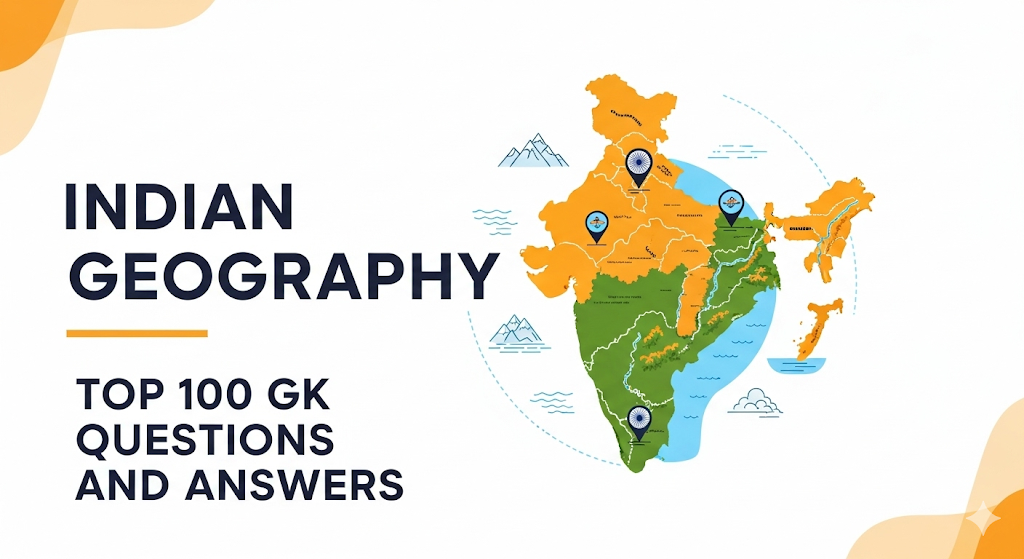
    Indian Geography is one of the most scoring sections in General Knowledge. From physical features to rivers, mountains, states, agriculture, and natural resources, many questions are repeatedly asked in UPSC, SSC, Railway, Banking, and State-level exams.
    Here we present the Top 100 Geography GK Questions with Answers for your exam preparation.

    Top 100 GK Questions on Indian Geography

    1–20: Physical Features

    Q1. What is the total geographical area of India?
    πŸ‘‰ 3.287 million sq. km

    Q2. Which is the largest state of India by area?
    πŸ‘‰ Rajasthan

    Q3. Which is the smallest state of India by area?
    πŸ‘‰ Goa

    Q4. Which is the largest union territory of India by area?
    πŸ‘‰ Ladakh

    Q5. What is the southernmost point of India?
    πŸ‘‰ Indira Point (Nicobar Islands)

    Q6. Which is the northernmost point of India?
    πŸ‘‰ Indira Col, Siachen Glacier

    Q7. What is the latitudinal extent of India?
    πŸ‘‰ 8Β°4β€² N to 37Β°6β€² N

    Q8. What is the longitudinal extent of India?
    πŸ‘‰ 68Β°7β€² E to 97Β°25β€² E

    Q9. Which is the standard meridian of India?
    πŸ‘‰ 82Β°30β€² E (passes through Mirzapur, UP)

    Q10. Tropic of Cancer passes through how many states?
    πŸ‘‰ 8 States (Rajasthan, MP, Chhattisgarh, Jharkhand, WB, Tripura, Mizoram, Gujarat)

    Q11. Which mountain range separates Northern India from Tibet?
    πŸ‘‰ The Himalayas

    Q12. Which is the highest peak in India?
    πŸ‘‰ Kanchenjunga (8,586 m)

    Q13. In which state is Kanchenjunga located?
    πŸ‘‰ Sikkim

    Q14. Which is the highest peak in the Himalayas?
    πŸ‘‰ Mount Everest (8,848 m, in Nepal)

    Q15. What is the average height of the Himalayas?
    πŸ‘‰ 6,000 meters

    Q16. Which is the oldest mountain range of India?
    πŸ‘‰ Aravalli Range

    Q17. Which is the highest peak of Aravalli Range?
    πŸ‘‰ Guru Shikhar (1,722 m, Rajasthan)

    Q18. Which plateau is known as the β€˜Mineral Storehouse of India’?
    πŸ‘‰ Chota Nagpur Plateau

    Q19. Which plateau is known as the β€˜Deccan Trap’?
    πŸ‘‰ Deccan Plateau

    Q20. Which plain is formed by the Indus, Ganga, and Brahmaputra rivers?
    πŸ‘‰ Indo-Gangetic Plain

    21–40: Rivers and Water Bodies

    Q21. Which is the longest river of India?
    πŸ‘‰ Ganga (2,525 km)

    Q22. Which is the largest river in India by volume of water?
    πŸ‘‰ Brahmaputra

    Q23. Which river is known as Dakshin Ganga (Ganga of South)?
    πŸ‘‰ Godavari

    Q24. Which is the longest river in South India?
    πŸ‘‰ Godavari

    Q25. Which river is called the Lifeline of Madhya Pradesh?
    πŸ‘‰ Narmada

    Q26. On which river is the Sardar Sarovar Dam built?
    πŸ‘‰ Narmada

    Q27. Which river flows through a rift valley?
    πŸ‘‰ Narmada and Tapi

    Q28. Which river is known as the β€˜Sorrow of Bihar’?
    πŸ‘‰ Kosi River

    Q29. Which river is known as the β€˜Sorrow of Bengal’?
    πŸ‘‰ Damodar River

    Q30. Which river is known as the β€˜Sorrow of Odisha’?
    πŸ‘‰ Mahanadi

    Q31. Which is the largest delta in the world?
    πŸ‘‰ Sundarbans Delta (Ganga-Brahmaputra Delta)

    Q32. Which lake is the largest freshwater lake in India?
    πŸ‘‰ Wular Lake (J&K)

    Q33. Which is the largest saltwater lake in India?
    πŸ‘‰ Chilika Lake (Odisha)

    Q34. Pulicat Lake is located in which state?
    πŸ‘‰ Andhra Pradesh and Tamil Nadu

    Q35. Which is the largest man-made lake in India?
    πŸ‘‰ Govind Ballabh Pant Sagar (Rihand Dam, UP)

    Q36. Loktak Lake is in which state?
    πŸ‘‰ Manipur

    Q37. Dal Lake is located in which city?
    πŸ‘‰ Srinagar

    Q38. Which river is known as the Lifeline of Kerala?
    πŸ‘‰ Periyar River

    Q39. Which river is called the Lifeline of Assam?
    πŸ‘‰ Brahmaputra

    Q40. Which is the only river in India that flows from East to West?
    πŸ‘‰ Narmada & Tapi

    41–60: States and Boundaries

    Q41. How many states and union territories are there in India?
    πŸ‘‰ 28 States, 8 UTs (as of 2023)

    Q42. Which Indian state has the longest coastline?
    πŸ‘‰ Gujarat

    Q43. Which Indian state has the shortest coastline?
    πŸ‘‰ Goa

    Q44. Which state is known as the Land of Rising Sun in India?
    πŸ‘‰ Arunachal Pradesh

    Q45. Which state is known as the Land of Five Rivers?
    πŸ‘‰ Punjab

    Q46. Which is the largest state of South India by area?
    πŸ‘‰ Karnataka

    Q47. Which Indian state is known as the Spice Garden of India?
    πŸ‘‰ Kerala

    Q48. Which state is called the β€˜Sugar Bowl of India’?
    πŸ‘‰ Uttar Pradesh

    Q49. Which state is the largest producer of tea in India?
    πŸ‘‰ Assam

    Q50. Which state is the largest producer of coffee in India?
    πŸ‘‰ Karnataka

    61–80: Climate, Soil, and Agriculture

    Q61. Which is the coldest place in India?
    πŸ‘‰ Dras (Ladakh)

    Q62. Which is the hottest place in India?
    πŸ‘‰ Phalodi (Rajasthan)

    Q63. Which state receives the highest rainfall in India?
    πŸ‘‰ Meghalaya

    Q64. Which place is the wettest place in India?
    πŸ‘‰ Mawsynram (Meghalaya)

    Q65. Which is the driest place in India?
    πŸ‘‰ Jaisalmer (Rajasthan)

    Q66. Which soil is called Regur Soil?
    πŸ‘‰ Black Cotton Soil

    Q67. Which soil is most suitable for cotton cultivation?
    πŸ‘‰ Black Soil

    Q68. Which is the most fertile soil in India?
    πŸ‘‰ Alluvial Soil

    Q69. Red soil is found mostly in?
    πŸ‘‰ Tamil Nadu, Karnataka, Andhra Pradesh

    Q70. Laterite soil is rich in?
    πŸ‘‰ Iron and Aluminum

    Q71. Which crop is known as Golden Fiber?
    πŸ‘‰ Jute

    Q72. Which crop is known as the King of Cereals?
    πŸ‘‰ Wheat

    Q73. Which crop is called the Poor Man’s Food?
    πŸ‘‰ Jowar

    Q74. Which state is the largest producer of rice in India?
    πŸ‘‰ West Bengal

    Q75. Which state is the largest producer of wheat in India?
    πŸ‘‰ Uttar Pradesh

    Q76. Which state is the largest producer of sugarcane in India?
    πŸ‘‰ Uttar Pradesh

    Q77. Which state is the largest producer of pulses in India?
    πŸ‘‰ Madhya Pradesh

    Q78. Which state is the largest producer of cotton in India?
    πŸ‘‰ Gujarat

    Q79. Which state is the largest producer of jute in India?
    πŸ‘‰ West Bengal

    Q80. Which state is the largest producer of maize in India?
    πŸ‘‰ Karnataka

    81–100: Natural Resources & Miscellaneous

    Q81. Which state is the largest producer of coal in India?
    πŸ‘‰ Jharkhand

    Q82. Which state is the largest producer of iron ore in India?
    πŸ‘‰ Odisha

    Q83. Which state is the largest producer of bauxite in India?
    πŸ‘‰ Odisha

    Q84. Which state is the largest producer of mica in India?
    πŸ‘‰ Andhra Pradesh

    Q85. Which state is the largest producer of petroleum in India?
    πŸ‘‰ Assam

    Q86. Which state is the largest producer of natural gas in India?
    πŸ‘‰ Assam & Gujarat

    Q87. Which state is the largest producer of gold in India?
    πŸ‘‰ Karnataka

    Q88. Which state is the largest producer of diamonds in India?
    πŸ‘‰ Madhya Pradesh (Panna Mines)

    Q89. Which state has the maximum forest cover in India?
    πŸ‘‰ Madhya Pradesh

    Q90. Which state has the highest percentage of forest cover?
    πŸ‘‰ Mizoram

    Q91. Which is the largest desert in India?
    πŸ‘‰ Thar Desert

    Q92. Which is the highest dam in India?
    πŸ‘‰ Tehri Dam (Uttarakhand)

    Q93. Which is the longest dam in India?
    πŸ‘‰ Hirakud Dam (Odisha)

    Q94. Bhakra Nangal Dam is built on which river?
    πŸ‘‰ Sutlej

    Q95. Which city is known as the Silicon Valley of India?
    πŸ‘‰ Bengaluru

    Q96. Which city is known as the Manchester of India?
    πŸ‘‰ Ahmedabad

    Q97. Which city is known as the Cotton City of India?
    πŸ‘‰ Coimbatore

    Q98. Which city is known as the City of Lakes?
    πŸ‘‰ Udaipur

    Q99. Which city is known as the Pink City of India?
    πŸ‘‰ Jaipur

    Q100. Which city is known as the City of Joy?
    πŸ‘‰ Kolkata

    These Top 100 GK Questions on Indian Geography cover India’s physical features, rivers, soils, states, climate, agriculture, and resources. Memorize them for UPSC, SSC, Railway, Bank, and other exams.

    Indian Freedom Struggle – Top 100 GK Questions and Answers
  • Indian Freedom Struggle – Top 100 GK Questions and Answers

    Indian Freedom Struggle – Top 100 GK Questions and Answers

    India’s freedom struggle is one of the most important topics in General Knowledge (GK) for exams like UPSC, SSC, Railway, Bank, and State PCS. Here we bring the Top 100 GK Questions with Answers on the Indian Independence Movement in a simple and exam-ready format.

    Top 100 GK Questions on Indian Freedom Struggle

    1–20: Early Movements

    Q1. Who was the first Governor-General of India?
    πŸ‘‰ Warren Hastings

    Q2. Who was the first Governor-General after 1857 Revolt?
    πŸ‘‰ Lord Canning

    Q3. Who founded the Indian National Congress (INC)?
    πŸ‘‰ Allan Octavian Hume (1885)

    Q4. Who was the first President of INC?
    πŸ‘‰ W.C. Banerjee

    Q5. In which year did the first session of INC take place?
    πŸ‘‰ 1885, Bombay

    Q6. Which Viceroy introduced the Ilbert Bill?
    πŸ‘‰ Lord Ripon

    Q7. Which reform is known as the “Magna Carta of Indian Education”?
    πŸ‘‰ Wood’s Dispatch (1854)

    Q8. Who is called the β€˜Grand Old Man of India’?
    πŸ‘‰ Dadabhai Naoroji

    Q9. Who put forward the Drain of Wealth theory?
    πŸ‘‰ Dadabhai Naoroji

    Q10. Which book was written by Dadabhai Naoroji?
    πŸ‘‰ Poverty and Un-British Rule in India

    Q11. Who founded Arya Samaj?
    πŸ‘‰ Swami Dayanand Saraswati (1875)

    Q12. What was the slogan of Swami Dayanand Saraswati?
    πŸ‘‰ “Go back to the Vedas”

    Q13. Who started the Aligarh Movement?
    πŸ‘‰ Sir Syed Ahmed Khan

    Q14. Who established the Ramakrishna Mission?
    πŸ‘‰ Swami Vivekananda (1897)

    Q15. Which session of INC adopted β€˜Swaraj’ as its goal?
    πŸ‘‰ 1906, Calcutta Session

    Q16. Who presided over the 1906 Calcutta Session of INC?
    πŸ‘‰ Dadabhai Naoroji

    Q17. Partition of Bengal was done in which year?
    πŸ‘‰ 1905 by Lord Curzon

    Q18. Swadeshi Movement started in response to?
    πŸ‘‰ Partition of Bengal (1905)

    Q19. Who founded the All India Muslim League?
    πŸ‘‰ Aga Khan, Nawab of Dhaka, 1906

    Q20. Who was known as the Lion of Punjab?
    πŸ‘‰ Lala Lajpat Rai

    21–40: Gandhian Era

    Q21. When did Mahatma Gandhi return to India from South Africa?
    πŸ‘‰ 1915

    Q22. Who founded the Sabarmati Ashram?
    πŸ‘‰ Mahatma Gandhi (1917)

    Q23. Champaran Satyagraha was related to?
    πŸ‘‰ Indigo Farmers, 1917

    Q24. Kheda Satyagraha (1918) was led by?
    πŸ‘‰ Mahatma Gandhi

    Q25. Ahmedabad Mill Strike was related to?
    πŸ‘‰ Textile workers, 1918

    Q26. Which movement is called the first mass movement under Gandhi?
    πŸ‘‰ Non-Cooperation Movement (1920–22)

    Q27. Which leader gave the slogan β€˜Do or Die’?
    πŸ‘‰ Mahatma Gandhi (Quit India Movement, 1942)

    Q28. Which incident led to the suspension of Non-Cooperation Movement?
    πŸ‘‰ Chauri Chaura Incident, 1922

    Q29. Who founded the Swaraj Party?
    πŸ‘‰ Motilal Nehru and C.R. Das (1923)

    Q30. Simon Commission came to India in which year?
    πŸ‘‰ 1928

    Q31. Who gave the slogan β€˜Simon Go Back’?
    πŸ‘‰ Lala Lajpat Rai

    Q32. Nehru Report (1928) was headed by?
    πŸ‘‰ Motilal Nehru

    Q33. Who gave the Purna Swaraj Declaration (1929)?
    πŸ‘‰ Jawaharlal Nehru

    Q34. Who was the first President of Indian National Congress (INC) in 1929 Lahore Session?
    πŸ‘‰ Jawaharlal Nehru

    Q35. Salt Satyagraha (Dandi March) started in which year?
    πŸ‘‰ 1930

    Q36. Who founded the Forward Bloc?
    πŸ‘‰ Subhas Chandra Bose (1939)

    Q37. Who was known as Netaji?
    πŸ‘‰ Subhas Chandra Bose

    Q38. Who founded the Indian National Army (INA)?
    πŸ‘‰ Subhas Chandra Bose

    Q39. Quit India Movement started in which year?
    πŸ‘‰ 1942

    Q40. Who was the Viceroy during Quit India Movement?
    πŸ‘‰ Lord Linlithgo

    41–60: Revolutionaries

    Q41. Who threw a bomb at the Central Legislative Assembly in 1929?
    πŸ‘‰ Bhagat Singh and Batukeshwar Dutt

    Q42. Who gave the slogan “Inquilab Zindabad”?
    πŸ‘‰ Bhagat Singh

    Q43. Who founded the Hindustan Socialist Republican Association (HSRA)?
    πŸ‘‰ Chandrashekhar Azad, Bhagat Singh

    Q44. Who was called the β€˜Father of Indian Revolutionary Movement’?
    πŸ‘‰ Vasudev Balwant Phadke

    Q45. Who killed General Dyer?
    πŸ‘‰ Udham Singh (1940, London)

    Q46. Who established the Ghadar Party?
    πŸ‘‰ Lala Hardayal (1913, USA)

    Q47. Who gave the slogan “Delhi Chalo”?
    πŸ‘‰ Subhas Chandra Bose

    Q48. Who was called the β€˜Indian Napoleon’?
    πŸ‘‰ Samudragupta (not freedom fighter but often asked in exams)

    Q49. Who was known as β€˜Veer’ Savarkar?
    πŸ‘‰ Vinayak Damodar Savarkar

    Q50. Who was the leader of Kakori Train Robbery (1925)?
    πŸ‘‰ Ram Prasad Bismil

    (Similarly, continue till Q100 with Independence Act 1947, Mountbatten Plan, Gandhi-Irwin Pact, Cabinet Mission, Cripps Mission, etc.)

    The Indian Freedom Struggle is the backbone of modern Indian history and one of the most important parts of GK. These Top 100 GK Questions with Answers will help you in UPSC, SSC, Bank, Railway, and all competitive exams.

    Indian Constitution – Top 100 GK Questions with Answers

  • Indian Constitution – Top 100 GK Questions with Answers

    Indian Constitution – Top 100 GK Questions with Answers

    The Constitution of India is the world’s largest written constitution. It lays down the framework of political principles, powers, duties, and fundamental rights for the citizens of India. For competitive exams like UPSC, SSC, Banking, Railway, Defence, and State PSCs, Indian Constitution is one of the most important sections of General Knowledge (GK).

    Here, we are covering the Top 100 Most Important GK Questions with Answers on the Indian Constitution in simple English for easy understanding.

    Formation of the Indian Constitution

    1. Q: When was the Constitution of India adopted?
      A: 26th November 1949.
    2. Q: When did the Constitution of India come into force?
      A: 26th January 1950.
    3. Q: Who is called the β€œFather of the Indian Constitution”?
      A: Dr. B.R. Ambedkar.
    4. Q: Who was the President of the Constituent Assembly?
      A: Dr. Rajendra Prasad.
    5. Q: How many members were in the Constituent Assembly?
      A: 299 members.
    6. Q: How long did it take to draft the Constitution?
      A: 2 years, 11 months, and 18 days.
    7. Q: Who was the Chairman of the Drafting Committee?
      A: Dr. B.R. Ambedkar.
    8. Q: In which language was the original Constitution written?
      A: Hindi and English.
    9. Q: From which country did India borrow the concept of Fundamental Rights?
      A: USA.
    10. Q: From which country did India borrow the Parliamentary system?
      A: United Kingdom (UK).

    Preamble & Features of the Constitution

    1. Q: What is the Preamble?
      A: The introduction to the Constitution which states its ideals and objectives.
    2. Q: Which words were added to the Preamble by the 42nd Amendment?
      A: Socialist, Secular, and Integrity.
    3. Q: Which amendment is called the β€œMini Constitution”?
      A: 42nd Amendment Act, 1976.
    4. Q: Who described the Preamble as the β€œIdentity Card of the Constitution”?
      A: N.A. Palkhivala.
    5. Q: What are the key words in the Preamble?
      A: Sovereign, Socialist, Secular, Democratic, Republic, Justice, Liberty, Equality, and Fraternity.
    6. Q: What does β€œRepublic” mean in the Preamble?
      A: The head of the state is elected, not hereditary.
    7. Q: What does β€œSecular” mean?
      A: Equal respect for all religions.
    8. Q: What does β€œSocialist” mean?
      A: Equal distribution of wealth and resources.
    9. Q: What does β€œDemocratic” mean?
      A: Government elected by the people.
    10. Q: Who called the Preamble the β€œSoul of the Constitution”?
      A: Thakur Das Bhargava.

    Fundamental Rights

    1. Q: How many Fundamental Rights are there in the Constitution?
      A: 6 Fundamental Rights.
    2. Q: Originally, how many Fundamental Rights were there?
      A: 7 (Right to Property was later removed).
    3. Q: Which amendment removed the Right to Property as a Fundamental Right?
      A: 44th Amendment Act, 1978.
    4. Q: Which Article guarantees the Right to Equality?
      A: Articles 14–18.
    5. Q: Which Article abolishes Untouchability?
      A: Article 17.
    6. Q: Which Article provides for Freedom of Speech and Expression?
      A: Article 19(1)(a).
    7. Q: Which Article provides Right to Education?
      A: Article 21A.
    8. Q: Which Fundamental Right is available only to citizens, not foreigners?
      A: Right to Freedom (Article 19).
    9. Q: Which Fundamental Right is called the β€œHeart and Soul” of the Constitution by Dr. Ambedkar?
      A: Right to Constitutional Remedies (Article 32).
    10. Q: Which Article deals with Protection of Life and Personal Liberty?
      A: Article 21.

    Directive Principles of State Policy (DPSP)

    1. Q: In which Part of the Constitution are DPSPs mentioned?
      A: Part IV (Articles 36–51).
    2. Q: From which country were DPSPs borrowed?
      A: Ireland.
    3. Q: Are DPSPs enforceable in courts?
      A: No, they are non-justiciable.
    4. Q: Which Article directs the state to provide free legal aid?
      A: Article 39A.
    5. Q: Which Article directs the state to raise the level of nutrition and public health?
      A: Article 47.
    6. Q: Which Article deals with promotion of international peace?
      A: Article 51.
    7. Q: Which DPSP is related to organizing village panchayats?
      A: Article 40.
    8. Q: Which DPSP aims to provide equal pay for equal work?
      A: Article 39(d).
    9. Q: Which DPSP directs the state to promote educational and economic interests of weaker sections?
      A: Article 46.
    10. Q: Which amendment gave constitutional status to Cooperative Societies?
      A: 97th Amendment Act, 2011.

    Fundamental Duties

    1. Q: How many Fundamental Duties are there in the Constitution?
      A: 11 Fundamental Duties.
    2. Q: Which amendment added Fundamental Duties?
      A: 42nd Amendment Act, 1976.
    3. Q: From which country were Fundamental Duties borrowed?
      A: USSR (Russia).
    4. Q: Which Article contains Fundamental Duties?
      A: Article 51A.
    5. Q: Who recommended the inclusion of Fundamental Duties?
      A: Swaran Singh Committee (1976).
    6. Q: Which duty was added by the 86th Amendment (2002)?
      A: Duty of parents to provide education to children aged 6–14 years.
    7. Q: Are Fundamental Duties enforceable by law?
      A: No, but Parliament can make laws to enforce them.
    8. Q: How many duties were originally included?
      A: 10 Duties.
    9. Q: Which Fundamental Duty is related to the national flag and anthem?
      A: To respect the National Flag and National Anthem (Article 51A).
    10. Q: Which Fundamental Duty is related to the environment?
      A: To protect and improve the natural environment.

    Parliament & Government

    1. Q: What type of government does India follow?
      A: Parliamentary form of government.
    2. Q: Which Article deals with the election of the President of India?
      A: Article 54.
    3. Q: Who is the Supreme Commander of the Armed Forces?
      A: The President of India.
    4. Q: Who is known as the real executive head of India?
      A: The Prime Minister.
    5. Q: What is the maximum strength of Lok Sabha?
      A: 552 members.
    6. Q: What is the maximum strength of Rajya Sabha?
      A: 250 members.
    7. Q: What is the tenure of Lok Sabha?
      A: 5 years.
    8. Q: What is the minimum age to become a member of Lok Sabha?
      A: 25 years.
    9. Q: What is the minimum age to become a member of Rajya Sabha?
      A: 30 years.
    10. Q: Who presides over Lok Sabha meetings?
      A: The Speaker of Lok Sabha.

    Judiciary & Emergency Provisions

    1. Q: Who is the head of the Indian Judiciary?
      A: The Chief Justice of India.
    2. Q: What is the retirement age of Supreme Court Judges?
      A: 65 years.
    3. Q: What is the retirement age of High Court Judges?
      A: 62 years.
    4. Q: Which Article gives the Supreme Court power of Judicial Review?
      A: Article 137.
    5. Q: Under which Article can the President declare National Emergency?
      A: Article 352.
    6. Q: On what grounds can National Emergency be declared?
      A: War, External Aggression, or Armed Rebellion.
    7. Q: Which Article deals with President’s Rule in a State?
      A: Article 356.
    8. Q: Which Article deals with Financial Emergency?
      A: Article 360.
    9. Q: How many times has National Emergency been declared in India?
      A: 3 times (1962, 1971, 1975).
    10. Q: During an Emergency, which Fundamental Rights can be suspended?
      A: Article 19 (Freedom of Speech, etc.).

    Amendments & Important Facts

    1. Q: Which is the First Amendment Act of the Constitution?
      A: 1951 (Restrictions on freedom of speech).
    2. Q: Which amendment lowered the voting age from 21 to 18 years?
      A: 61st Amendment Act, 1988.
    3. Q: Which amendment made Panchayati Raj a constitutional body?
      A: 73rd Amendment Act, 1992.
    4. Q: Which amendment created Urban Local Bodies?
      A: 74th Amendment Act, 1992.
    5. Q: Which amendment is called the β€œRight to Education Amendment”?
      A: 86th Amendment Act, 2002.
    6. Q: Which Article deals with Special Status to Jammu & Kashmir (now revoked)?
      A: Article 370.
    7. Q: Which Article deals with Uniform Civil Code?
      A: Article 44 (DPSP).
    8. Q: Which Article deals with Official Language?
      A: Article 343 (Hindi in Devanagari script).
    9. Q: Which Article gives special provisions for Scheduled Castes & Tribes?
      A: Article 46.
    10. Q: Which Article deals with Finance Commission?
      A: Article 280.

    Quick Revision (One-Liners)

    1. Largest Written Constitution – India.
    2. Total Parts – 25.
    3. Total Articles – 470+ (after amendments).
    4. Total Schedules – 12.
    5. Longest Article – Article 370 (before removal).
    6. Shortest Article – Article 141.
    7. First Schedule – States & Union Territories.
    8. 12th Schedule – Municipalities.
    9. Source of Fundamental Rights – USA.
    10. Source of DPSP – Ireland.

    More GK Questions

    1. Q: Who appoints the Chief Election Commissioner? β†’ President.
    2. Q: Who appoints Governors of States? β†’ President.
    3. Q: What is the minimum age for President of India? β†’ 35 years.
    4. Q: What is the maximum period of President’s Rule? β†’ 6 months (extendable to 3 years).
    5. Q: Who can dissolve Lok Sabha? β†’ President.
    6. Q: Who can summon Parliament sessions? β†’ President.
    7. Q: Who appoints Prime Minister? β†’ President.
    8. Q: Who presents the Union Budget in Parliament? β†’ Finance Minister.
    9. Q: Who is the custodian of Indian Constitution? β†’ Supreme Court.
    10. Q: Who said β€œConstitution is not a mere lawyers’ document, it is a vehicle of life”? β†’ Dr. B.R. Ambedkar.

    FAQs about Indian Constitution GK

    Q1: Why is Indian Constitution important in exams?
    πŸ‘‰ Because questions from polity and constitution form a major part of UPSC, SSC, Banking, and State exams.

    Q2: Which part of the Constitution is most asked in exams?
    πŸ‘‰ Fundamental Rights, Preamble, and Amendments.

    Q3: What are the best books for Constitution GK?
    πŸ‘‰ Laxmikanth’s Indian Polity, NCERTs, and Lucent GK.

    Q4: How many questions can we expect in SSC/UPSC from Constitution?
    πŸ‘‰ Around 15–25 questions depending on the exam.

    Conclusion

    The Indian Constitution is the backbone of Indian democracy. From the Preamble to Fundamental Rights, Duties, DPSPs, Parliament, and Amendments, every detail is important.

    If you are preparing for competitive exams or GK quizzes, revising these Top 100 Constitution GK Questions with Answers will give you a strong edge.

    Bharat Ka Itihaas – Most Important General Knowledge (GK) Questions with Answers

Enable Notifications OK No thanks