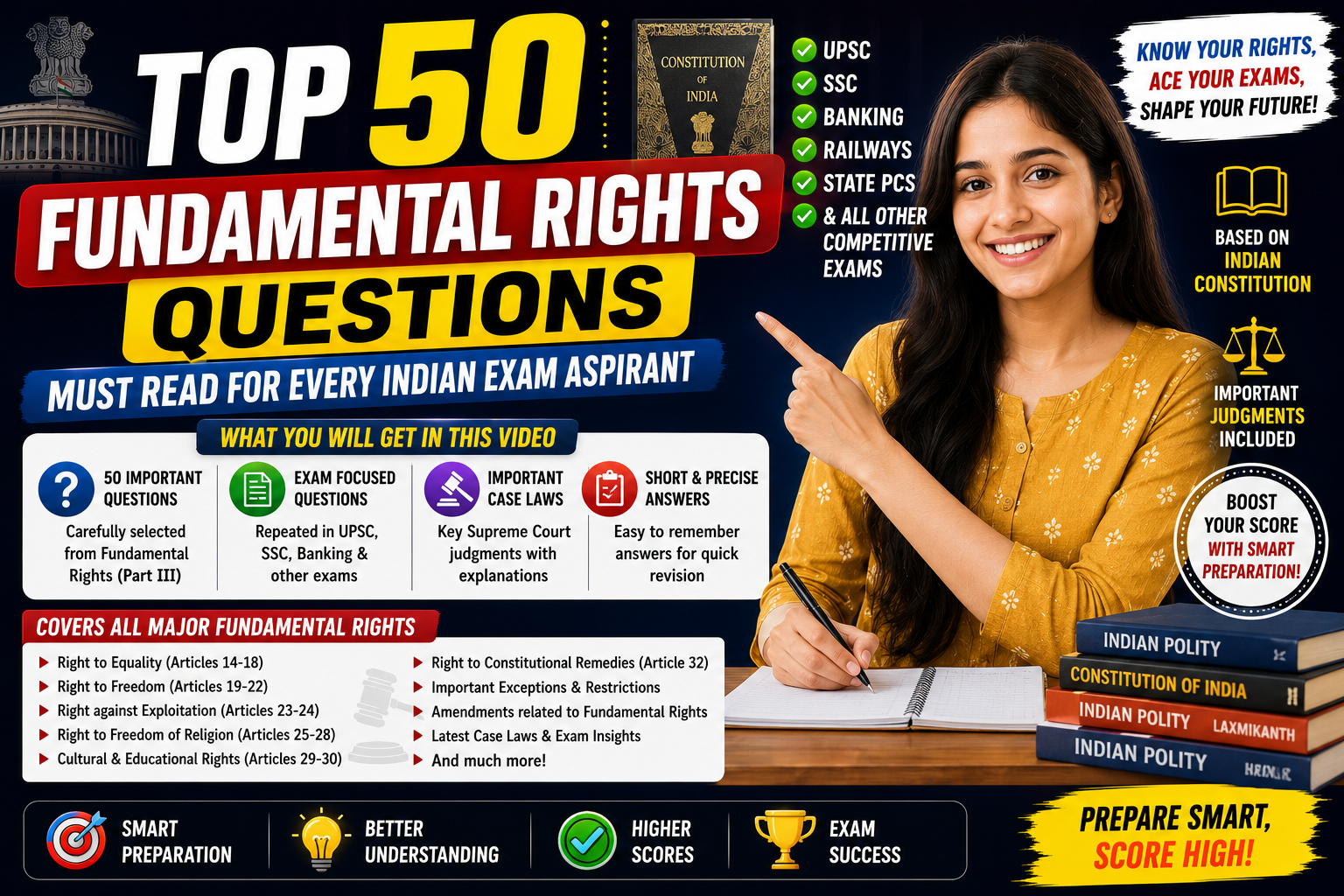
Fundamental Rights Are the Most Important Topic in Indian Polity
Let me ask you something.
How many questions from Fundamental Rights appear in competitive exams?
In UPSC Prelims: 3-5 questions every year.
In SSC CGL: 4-6 questions.
In State PSCs: 5-8 questions.
In Banking (IBPS, SBI): 2-4 questions.
No other topic in Indian Polity is asked more frequently.
Why? Because Fundamental Rights (Articles 12-35) are the backbone of Indian democracy. They are the wall between the citizen and the state. They protect you from the government. They are also the most litigated part of the Constitution.
Every serious aspirant knows: If you want to score high in Polity, you must master fundamental rights questions.
In this blog, I have created 50 original, high-quality, exam-relevant questions from scratch. These are not copied from any source. Each question is designed to test a unique aspect of Fundamental Rights – Articles, landmark cases, amendments, exceptions, and tricky concepts.
Use these questions as a self-test. Answer them honestly. Then check the answer key. The gaps you find will tell you exactly what to study next.
(Add Image with Alt Text: “Fundamental rights questions – Indian Constitution open showing Articles 12 to 35 with exam notes”)
Dofollow External Resource: Constitution of India – Official Government of India Website – always refer to the original text for accuracy.
2. How to Use These 50 Questions for Maximum Benefit
Do not just read these questions. Use them strategically.
| Step | Action | Time |
|---|---|---|
| 1 | Cover the answer key (hide it with paper) | 10 seconds |
| 2 | Attempt all 50 questions honestly | 45-60 minutes |
| 3 | Check your answers | 15 minutes |
| 4 | Mark the questions you got wrong | 5 minutes |
| 5 | Revise only those Articles and concepts | 30 minutes |
| 6 | Retest yourself after 3 days | 30 minutes |
Now let us begin.
Part 1: Basic Concepts (Questions 1-10)
These fundamental rights questions test your knowledge of the basics – which Articles, which rights, and who they apply to.
Question 1. Which Part of the Indian Constitution contains the Fundamental Rights?
Question 2. Fundamental Rights are borrowed from which country’s Constitution?
Question 3. Articles 12 to 35 of the Indian Constitution deal with which subject?
Question 4. How many Fundamental Rights were originally provided in the Constitution of India (at the time of commencement in 1950)?
Question 5. Currently, how many Fundamental Rights are there in the Indian Constitution? Which right was removed?
Question 6. Fundamental Rights are guaranteed to which category of people in India?
Question 7. Against whom are Fundamental Rights enforceable?
Question 8. Are Fundamental Rights absolute? If not, what allows the state to put reasonable restrictions?
Question 9. Who has the power to suspend Fundamental Rights during a national emergency?
Question 10. Which Article defines “State” for the purpose of Fundamental Rights? Name any four authorities included under this definition.
Part 2: Right to Equality – Article 14-18 (Questions 11-20)
This is the most frequently tested area in fundamental rights questions. Know every Article.
Question 11. Article 14 guarantees which two concepts together?
Question 12. What is the difference between “equality before law” and “equal protection of the law”?
Question 13. Which Article prohibits discrimination on grounds of religion, race, caste, sex, or place of birth?
Question 14. Name any three exceptions under Article 15 where the state can make special provisions for women and children.
Question 15. Which constitutional amendment added the provision for reservation in educational institutions for socially and educationally backward classes (SEBC) including OBCs?
Question 16. Article 16 guarantees equality of opportunity in matters relating to which specific area?
Question 17. Can the state make reservations for backward classes in promotions? Which landmark case said “no” and which constitutional amendment overruled it?
Question 18. Which Article abolishes untouchability? Is its enforcement civil or criminal?
Question 19. Which Articles abolish titles? Name any two titles which are still allowed under the Constitution.
Question 20. Can a citizen of India accept a title from a foreign country? Under what condition?
Part 3: Right to Freedom – Article 19-22 (Questions 21-30)
This is the most comprehensive right. These fundamental rights questions will test your understanding of each freedom.
Question 21. How many freedoms are guaranteed under Article 19(1) originally? How many remain today? Which freedom was removed and by which amendment?
Question 22. Name all six freedoms currently protected under Article 19(1).
Question 23. Under Article 19(2), on how many grounds can the state impose reasonable restrictions on freedom of speech and expression? Name any four.
Question 24. What is the difference between “freedom of speech” and “freedom of press”? Does the Constitution separately mention press freedom?
Question 25. Which landmark case established that the preamble is part of the Constitution and that freedom of speech cannot be curtailed arbitrarily?
Question 26. Article 21 is called the “heart of Fundamental Rights.” Why? What is the scope of “personal liberty” as interpreted by the Supreme Court?
Question 27. Which landmark case introduced the “due process of law” doctrine in India? How is it different from “procedure established by law”?
Question 28. Article 21A was added by which amendment? What fundamental right does it provide?
Question 29. Under Article 22, what are the safeguards available to a person who is arrested? Name any three.
Question 30. What is the difference between “preventive detention” and “punitive detention”? Which Article deals with preventive detention?
Part 4: Right Against Exploitation – Article 23-24 (Questions 31-35)
These articles are short but frequently asked.
Question 31. Article 23 prohibits which two practices?
Question 32. Can the state require citizens to do compulsory service? Under what condition is it allowed?
Question 33. Article 24 prohibits the employment of children below what age in what type of work? Are there any exceptions?
Question 34. What is the difference between “begar” and “forced labour”? Which Article specifically mentions “begar”?
Question 35. After the 86th Amendment, which right became a Fundamental Right for children between ages 6-14? Is this right absolute?
Part 5: Right to Freedom of Religion – Article 25-28 (Questions 36-40)
These fundamental rights questions test your understanding of secularism.
Question 36. According to Article 25, what does “freedom of conscience” mean? Who can restrict this right and on what grounds?
Question 37. Which Article gives religious denominations the right to manage their own religious affairs? What are the three things they can manage?
Question 38. Article 27 prohibits the state from compelling any person to pay taxes for what purpose?
Question 39. Article 28 completely prohibits religious instruction in which type of educational institutions?
Question 40. Can a Sikh wear a turban and carry a kirpan? Under which Article is this protected?
Part 6: Cultural and Educational Rights – Article 29-30 (Questions 41-44)
These rights protect minorities and cultural communities.
Question 41. Article 29 gives the right to conserve which three things?
Question 42. Which Article gives minorities the right to establish and administer educational institutions? Does this right apply only to religious minorities or also linguistic minorities?
Question 43. Can the state impose restrictions on minority educational institutions? Under what condition?
Question 44. What is the difference between Article 29(2) and Article 15(1)? Both prohibit discrimination, but on what different grounds?
Part 7: Right to Constitutional Remedies – Article 32 (Questions 45-48)
Dr. Ambedkar called this the “heart and soul” of the Constitution.
Question 45. Which Article is called the “heart and soul” of the Indian Constitution? Who gave it this name?
Question 46. Name the five writs that the Supreme Court can issue under Article 32.
Question 47. For which writs can a High Court issue under Article 226? Who has wider jurisdiction – Supreme Court under Article 32 or High Court under Article 226?
Question 48. Can the President suspend the right to move any court for the enforcement of Fundamental Rights? During which type of emergency?
Part 8: Miscellaneous & Landmark Cases (Questions 49-50)
Test your applied knowledge.
Question 49. Match the following landmark cases with the right or principle they established:
| Case Name | Established Principle |
|---|---|
| A. Kesavananda Bharati (1973) | 1. Right to privacy is a Fundamental Right |
| B. Maneka Gandhi (1978) | 2. Basic Structure Doctrine |
| C. Indira Gandhi vs Raj Narain (1975) | 3. Personal liberty under Article 21 is broad |
| D. K.S. Puttaswamy (2017) | 4. Article 329(b) is not above basic structure |
Question 50. Can a Fundamental Right be waived by a citizen? If a person voluntarily agrees to do something that violates their right, can they later complain? Support your answer with a landmark case.
9. Answer Key with Explanations
Here are the answers. Do not cheat. Attempt all questions first.
Answer 1. Part III (Articles 12-35)
Answer 2. USA (Bill of Rights)
Answer 3. Fundamental Rights
Answer 4. Seven Fundamental Rights
Answer 5. Currently six. Right to Property (Article 31) was removed by the 44th Constitutional Amendment Act, 1978. It is now a legal right under Article 300A.
Answer 6. All citizens, and in some cases (like Article 21), to all persons including non-citizens.
Answer 7. Against the State (as defined in Article 12) – including central government, state governments, local authorities, and other authorities.
Answer 8. No. Reasonable restrictions can be imposed by the state on grounds mentioned in the Constitution itself (like security, public order, morality, etc.).
Answer 9. The President of India under Article 359 (during proclamation of National Emergency under Article 352).
Answer 10. Article 12 defines “State” to include: (1) Government of India, (2) Parliament of India, (3) Government of each state, (4) Legislature of each state, (5) Local authorities, and (6) Other authorities.
Answer 11. Equality before law and equal protection of the laws.
Answer 12. Equality before law means no person is above the law (negative concept – absence of special privileges). Equal protection of the law means similarly situated persons should be treated similarly (positive concept – same law applies to all).
Answer 13. Article 15(1)
Answer 14. (1) Special provisions for women and children, (2) Reservations for SC/ST/OBC in educational institutions, (3) Special provisions for socially and educationally backward classes.
Answer 15. 93rd Constitutional Amendment Act, 2005 (added clause 5 to Article 15).
Answer 16. Public employment (appointment to any office under the State).
Answer 17. Yes, but with conditions. In Indira Sawhney (1992), the Supreme Court said no reservations in promotions. The 77th, 81st, 82nd, and 85th amendments partially overruled this, allowing reservation in promotions for SC/ST, subject to proof of backwardness.
Answer 18. Article 17 abolishes untouchability. Its enforcement is criminal – the Untouchability Offences Act, 1955 (renamed Protection of Civil Rights Act, 1955) provides punishment.
Answer 19. Article 18 abolishes titles. Military and academic distinctions (Padma awards, Bharat Ratna, Arjuna Award) are allowed, but they cannot be used as prefixes or suffixes.
Answer 20. No, without the permission of the President.
Answer 21. Originally seven freedoms. Today six. Right to acquire, hold and dispose of property (Article 19(1)(f)) was removed by 44th Amendment, 1978.
Answer 22. (a) Freedom of speech and expression, (b) Freedom to assemble peacefully without arms, (c) Freedom to form associations or unions, (d) Freedom to move freely throughout India, (e) Freedom to reside and settle anywhere in India, (f) Freedom to practice any profession or carry on any occupation, trade or business.
Answer 23. Eight grounds: (1) Sovereignty and integrity of India, (2) Security of the state, (3) Friendly relations with foreign states, (4) Public order, (5) Decency and morality, (6) Contempt of court, (7) Defamation, (8) Incitement to an offence.
Answer 24. Press freedom is not separately mentioned. It is included within freedom of speech and expression. The Supreme Court has repeatedly held that freedom of speech includes freedom of the press.
Answer 25. Kesavananda Bharati case, 1973 (Basic Structure Doctrine). Also relevant: Romesh Thappar vs State of Madras (1950) and Brij Bhushan vs State of Delhi (1950).
Answer 26. Article 21 says: “No person shall be deprived of his life or personal liberty except according to procedure established by law.” The Supreme Court has interpreted “personal liberty” broadly – including right to live with dignity, right to privacy, right to clean environment, right to speedy trial, right against handcuffing, etc.
Answer 27. Maneka Gandhi vs Union of India (1978). Under “procedure established by law” (Article 21), any procedure is valid if it is a law. “Due process of law” requires the procedure to be fair, just, and reasonable. Maneka Gandhi introduced due process elements into Article 21.
Answer 28. 86th Constitutional Amendment Act, 2002. Right to education (free and compulsory education to children between ages 6-14).
Answer 29. Under Article 22(1): (1) Right to be informed of the grounds of arrest, (2) Right to consult a legal practitioner, (3) Right to be produced before a magistrate within 24 hours (excluding travel time). Under Article 22(2): Right not to be detained beyond 24 hours without magistrate’s authority.
Answer 30. Punitive detention is after a crime is committed (punishment). Preventive detention is before a crime is committed (prevention). Article 22(3) and (4) deal with preventive detention. The person can be detained up to 3 months without judicial review (longer with advisory board approval).
Answer 31. Begar (forced labour without payment) and other forms of forced labour (trafficking).
Answer 32. Yes, compulsory service for public purposes is allowed, but the state cannot discriminate on grounds of religion, race, caste, or class.
Answer 33. Below age 14. Employment in any factory, mine, or hazardous occupation. The Child Labour (Prohibition and Regulation) Act, 1986 prohibits child labour, with exceptions for family-based work and certain non-hazardous occupations.
Answer 34. Begar is a specific type of forced labour practiced historically (usually without any payment). Article 23 specifically mentions “begar” as a practice that is prohibited.
Answer 35. Right to education (Article 21A). It is not absolute. The state has to provide free and compulsory education, but the right is available only to children 6-14 years. The Right to Education Act, 2009 operationalizes this right.
Answer 36. Freedom of conscience means the freedom to hold any belief – theist, atheist, or agnostic. The state can restrict this right on grounds of public order, morality, health, and other provisions of Part III.
Answer 37. Article 26 gives religious denominations the right to: (a) establish and maintain institutions for religious purposes, (b) manage their own religious affairs, (c) own and acquire property, (d) administer property in accordance with law.
Answer 38. For the promotion or maintenance of any particular religion or religious denomination.
Answer 39. Educational institutions wholly maintained by state funds. Institutions receiving aid from the state can have religious instruction but those receiving aid cannot compel students to attend.
Answer 40. Yes. Under Article 25, wearing and carrying of kirpan is a religious practice of Sikhs and is protected.
Answer 41. Language, script, and culture.
Answer 42. Article 30. Both religious and linguistic minorities have this right. The Supreme Court has held that “minority” is determined at the state level, not national level.
Answer 43. Yes. The state can impose reasonable regulations for maintaining academic standards, order, morality, and health. However, the state cannot impose regulations that destroy the minority character of the institution.
Answer 44. Article 15(1) prohibits discrimination on grounds of religion, race, caste, sex, place of birth – applies to all citizens. Article 29(2) prohibits denial of admission to educational institutions maintained by the state or receiving state aid – applies to all citizens regardless of religion, race, caste, language.
Answer 45. Article 32. Dr. B.R. Ambedkar called it the “heart and soul of the Constitution.”
Answer 46. (1) Habeas Corpus, (2) Mandamus, (3) Prohibition, (4) Certiorari, (5) Quo Warranto.
Answer 47. Same five writs under Article 226. High Courts have wider jurisdiction – they can issue writs for violation of ordinary legal rights as well, not only Fundamental Rights. High Courts also have territorial jurisdiction over their state, while the Supreme Court has all-India jurisdiction.
Answer 48. Yes, during National Emergency proclaimed under Article 352. The President can suspend the right to move any court for enforcement of Fundamental Rights under Article 359. However, Articles 20 and 21 cannot be suspended even during emergency (44th Amendment, 1978).
Answer 49. A-2, B-3, C-4, D-1
Answer 50. No. Fundamental Rights cannot be waived. In Basheshar Nath vs CIT (1959), the Supreme Court held that a citizen cannot voluntarily give up a Fundamental Right. The right is a matter of public policy and is available regardless of personal agreement.
10. Common Mistakes Aspirants Make in Fundamental Rights Questions
After analyzing thousands of student answers, here are the most common errors in fundamental rights questions:
| Mistake | Why It’s Wrong | Correct Understanding |
|---|---|---|
| Confusing Article 21 and 22 | Both deal with personal liberty | Article 21 is substantive (what liberty means), Article 22 is procedural (safeguards during arrest) |
| Forgetting 44th Amendment | Property was removed | Right to Property is now legal right under Article 300A |
| Thinking Article 32 is only for citizens | Writs are for all persons | Anyone, including foreigners, can approach Supreme Court under Article 32 for Fundamental Rights violation |
| Confusing Article 15 and 16 | Both deal with equality | Article 15 is general (education, public places), Article 16 is specifically for public employment |
| Applying Article 14 and 15 incorrectly | Not understanding “reasonable classification” | Article 14 allows classification if rational. Article 15(1) prohibits discrimination but 15(3) allows special provisions for women and children |
11. Pro Tips to Remember Articles Easily (Memory Tricks)
| Group | Article Numbers | Memory Trick |
|---|---|---|
| Right to Equality | 14, 15, 16, 17, 18 | “1+4=5, 1+5=6, 1+6=7, 1+7=8, 1+8=9” but remember 14 to 18 |
| Right to Freedom | 19, 20, 21, 21A, 22 | “19 freedoms, 20 no double jeopardy, 21 life, 21A school, 22 arrest” |
| Right against Exploitation | 23, 24 | “23 no trafficking, 24 no child labour” |
| Right to Religion | 25, 26, 27, 28 | “25 conscience, 26 manage, 27 no tax, 28 no religious instruction” |
| Cultural & Educational | 29, 30 | “29 language, 30 minority college” |
| Constitutional Remedies | 32 | “32 = heart and soul” |
12. Conclusion – Master Fundamental Rights and Crack Your Exam
Dosto, Fundamental Rights are not just an exam topic. They are the soul of Indian democracy. Every question you answer brings you closer to understanding how India protects its citizens.
These 50 fundamental rights questions cover:
- ✅ All Articles from 12 to 35
- ✅ All landmark Supreme Court cases
- ✅ All important amendments
- ✅ Exam tricks and common mistakes
- ✅ Memory aids and revision strategies
Your Action Plan for Next 7 Days:
| Day | Task |
|---|---|
| Day 1 | Revise Articles 12-18 (Right to Equality) |
| Day 2 | Revise Articles 19-22 (Right to Freedom) + write 5 questions of your own |
| Day 3 | Revise Articles 23-28 (Exploitation + Religion) |
| Day 4 | Revise Articles 29-32 (Cultural + Remedies) |
| Day 5 | Solve these 50 questions again (timed – 45 minutes) |
| Day 6 | Identify weak areas and re-read specific Articles |
| Day 7 | Take a full mock test on Fundamental Rights |
Do not just memorize. Understand. Fundamental Rights are logical. Once you understand why each right exists, you will never forget the Articles.
Comment below: Which question did you find most difficult? I will explain it in more detail.
Share this blog with your study group. Master Fundamental Rights together.
Also Check : Children’s General Knowledge: 150+ Simple GK Questions and Answers