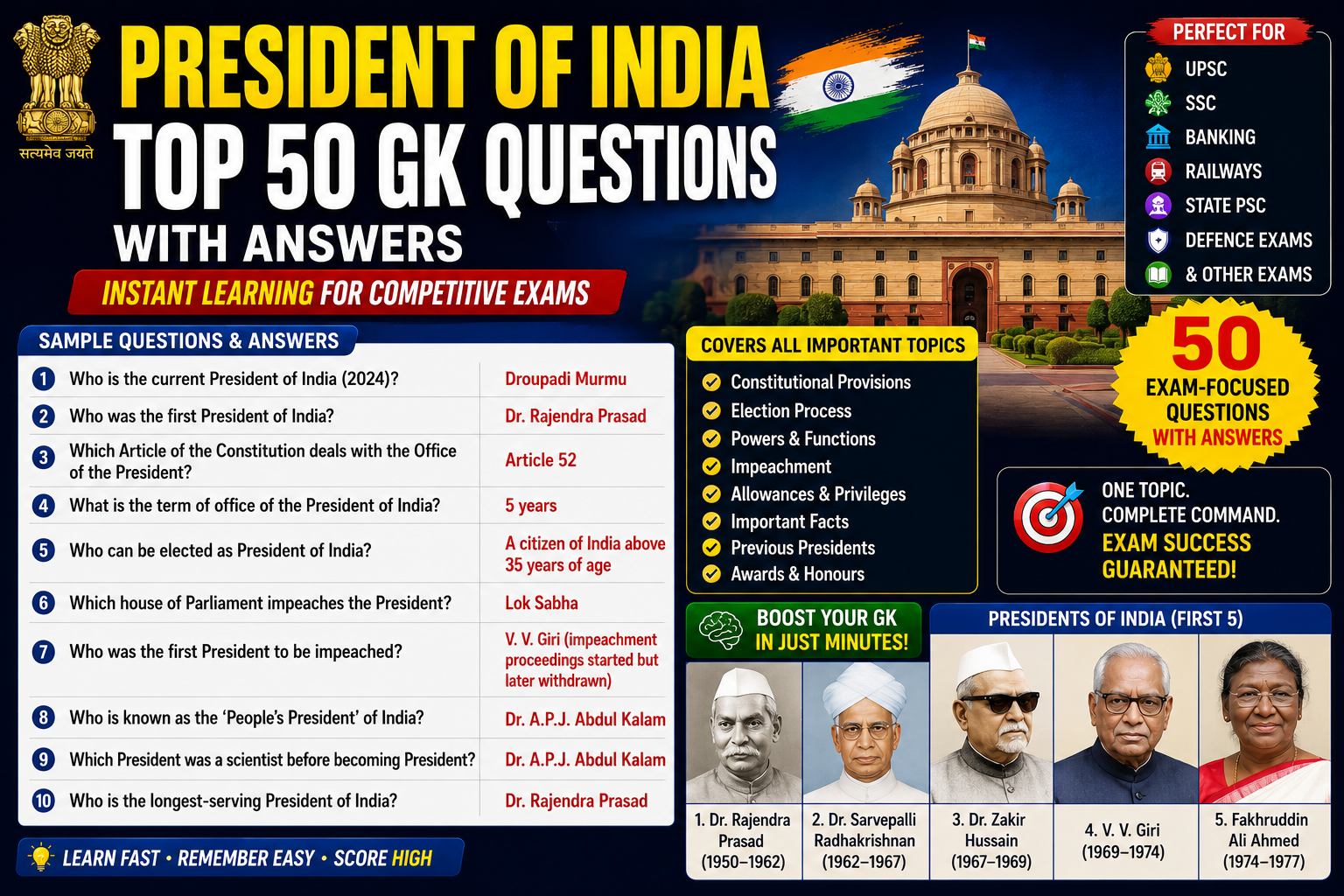
resident is a Favourite Exam Topic
Let me ask you a question.
How many questions from the President of India appear in competitive exams?
- UPSC Prelims: 2-3 questions every year
- SSC CGL/CHSL: 2-4 questions
- State PSCs: 3-5 questions
- Banking (IBPS, SBI): 1-2 questions
- Railways (RRB NTPC): 2-3 questions
The President is the constitutional head of the Indian Republic. Every important act of the government is done in the President’s name. Yet, the President is also a nominal executive – the real power lies with the Council of Ministers.
This unique position makes the President a favourite topic for examiners.
In this blog, I have created 50 original, exam-relevant GK questions on the President of India. Each question is immediately followed by its answer. No separate answer key. No flipping pages. Instant learning.
(Add Image with Alt Text: “President of India GK questions – Rashtrapati Bhavan with Indian flag and exam notes”)
Dofollow External Resource: President of India – Official Website – official source for all presidential facts.
Part 1 – Basic Facts and Qualifications (Questions 1 to 10)
Question 1. Who is the current President of India (as of 2026)?
Answer: Smt. Droupadi Murmu (the 15th President of India, assumed office on 25th July 2022).
Question 2. Under which Article of the Constitution is the President of India mentioned?
Answer: Article 52 (The President of India).
Question 3. Who is the constitutional head of the Indian Republic?
Answer: The President of India.
Question 4. Is the President of India the real or nominal executive?
Answer: The President is the nominal (titular or formal) executive. The real executive is the Council of Ministers headed by the Prime Minister.
Question 5. What are the three essential qualifications required for a person to become the President of India?
Answer:
- Must be a citizen of India.
- Must have completed 35 years of age.
- Must be qualified to become a member of the Lok Sabha.
Question 6. Can the President of India be a member of either house of Parliament?
Answer: No. The President cannot be a member of either house of Parliament. If a sitting MP is elected President, they are deemed to have vacated their parliamentary seat.
Question 7. What is the oath of office taken by the President?
Answer: The President swears to preserve, protect, and defend the Constitution and the law of India. The oath is administered by the Chief Justice of India (or in their absence, the senior-most judge of the Supreme Court).
Question 8. Who administers the oath of office to the President of India?
Answer: The Chief Justice of India. In their absence, the senior-most judge of the Supreme Court.
Question 9. What is the salary of the President of India (as of 2026)?
Answer: ₹5 lakh per month (increased from ₹1.5 lakh by the Finance Act, 2018). The salary is charged on the Consolidated Fund of India and is not subject to income tax.
Question 10. Does the President of India receive any pension after retirement?
Answer: Yes. The retired President receives a monthly pension of ₹5 lakh (revised in 2024-25 budget), along with free accommodation, staff, and travel facilities under the President’s (Pension) Act.
Part 2 – Election of the President (Questions 11 to 20)
Question 11. Who elects the President of India?
Answer: The President is elected by an Electoral College consisting of:
- Elected members of both houses of Parliament (Lok Sabha and Rajya Sabha)
- Elected members of all state legislative assemblies (Vidhan Sabhas)
Nominated members of Parliament or state assemblies do NOT vote.
Question 12. Are the nominated members of Parliament eligible to vote in the Presidential election?
Answer: No. Only elected members of Parliament can vote. Nominated members (Anglo-Indian – now discontinued, or nominated experts) cannot vote.
Question 13. Are the members of state legislative councils (Vidhan Parishads) eligible to vote in the Presidential election?
Answer: No. Only elected members of state legislative assemblies (Vidhan Sabhas) can vote. Legislative council members have no role.
Question 14. What is the system of voting used in the Presidential election?
Answer: The system of Proportional Representation by means of the Single Transferable Vote (STV). This ensures that the winning candidate has the support of a majority of the electoral college.
Question 15. Is the Presidential election conducted by secret ballot or open ballot?
Answer: Secret ballot. Members vote in secrecy to prevent any pressure from their party leadership.
Question 16. What is the value of the vote of an MP in the Presidential election?
Answer: The value of an MP’s vote is fixed. It is calculated as:
Value of MP’s vote = Total value of all MLAs’ votes ÷ Total number of elected MPs
Currently, the value of each MP’s vote is 708.
Question 17. What is the value of the vote of an MLA in the Presidential election?
Answer: The value of an MLA’s vote depends on the population of their state. The formula is:
Value of MLA’s vote = (Total population of the state ÷ Total elected MLAs of the state) ÷ 1000
Different states have different vote values. For example:
- Uttar Pradesh MLA: 208 value
- Sikkim MLA: 7 value (lowest)
- Uttar Pradesh has the highest number of total MLA votes.
Question 18. Which state has the highest number of votes in the Presidential Electoral College?
Answer: Uttar Pradesh – because it has the largest population and the highest number of MLAs.
Question 19. Who conducts the election of the President of India?
Answer: The Election Commission of India. The returning officer is the Secretary-General of either house of Parliament (by rotation).
Question 20. Who can dispute the election of the President? Where can the dispute be filed?
Answer: Any citizen of India can dispute the Presidential election. The dispute is filed in the Supreme Court of India. The Supreme Court’s decision is final and binding.
Part 3 – Powers and Functions of the President (Questions 21 to 35)
Question 21. How long is the term of office of the President of India?
Answer: 5 years from the date they assume office. The President continues in office even after 5 years until their successor takes charge.
Question 22. Can the President be re-elected?
Answer: Yes. There is no limit on how many times a person can become President. Dr. Rajendra Prasad served two full terms (1952-1962).
Question 23. What are the executive powers of the President?
Answer:
- Appoints the Prime Minister (leader of the majority party in Lok Sabha)
- Appoints other ministers on the advice of the PM
- Appoints the Attorney General, CAG, Chief Election Commissioner, UPSC Chairman and members
- Appoints Governors of states, Ambassadors, and Judges of the Supreme Court and High Courts
- All executive actions are taken in the President’s name
Question 24. What are the legislative powers of the President?
Answer:
- Summons, prorogues (discontinues without dissolving) the sessions of Parliament
- Dissolves the Lok Sabha (cannot dissolve Rajya Sabha)
- Addresses both houses of Parliament assembled together (first session after each general election and first session of each year)
- Nominates 12 members to the Rajya Sabha (from literature, science, art, social service)
- Nominates 2 members to the Lok Sabha from Anglo-Indian community (provision expired in 2020)
- Gives assent to bills passed by Parliament
- Can send messages to either house of Parliament
Question 25. Can the President address Parliament? How often?
Answer: Yes. The President addresses a joint sitting of both houses at the beginning of:
- The first session after each general election
- The first session of each calendar year
This address is written by the government and outlines the government’s legislative agenda.
Question 26. What are the financial powers of the President?
Answer:
- Causes the Budget (Annual Financial Statement) to be laid before Parliament
- No money bill can be introduced without the President’s prior recommendation
- Appoints the Finance Commission every 5 years
- Can make advances from the Contingency Fund of India to meet unforeseen expenses
Question 27. What are the judicial powers of the President?
Answer:
- Appoints the Chief Justice and other judges of the Supreme Court and High Courts
- Can grant pardon, reprieve, respite, remission, suspend, or commute punishment under Article 72
- Can seek the opinion of the Supreme Court on any question of law or fact (Advisory Jurisdiction – Article 143)
Question 28. Under which Article does the President have the power to grant pardon?
Answer: Article 72. The President can grant pardon in cases where:
- The punishment is by a court-martial (military court)
- The punishment is for an offence against a Union law
- The sentence is a death sentence (the President can commute, remit, or suspend a death sentence)
Question 29. What is the difference between the pardoning power of the President (Article 72) and the Governor (Article 161)?
Answer:
| Aspect | President (Article 72) | Governor (Article 161) |
|---|---|---|
| Death sentence | Can pardon | Cannot pardon (death sentence is under Union law) |
| Court-martial | Can pardon | Cannot pardon |
| Offence against Union law | Can pardon | Cannot pardon |
| Offence against state law | Can pardon | Can pardon |
Question 30. What are the emergency powers of the President?
Answer: The President can declare three types of emergencies under Articles 352, 356, and 360:
| Type | Article | Grounds |
|---|---|---|
| National Emergency | 352 | War, external aggression, or armed rebellion |
| President’s Rule (State Emergency) | 356 | Failure of constitutional machinery in a state |
| Financial Emergency | 360 | Threat to the financial stability of India |
Question 31. Who advises the President in the exercise of their powers?
Answer: The Council of Ministers headed by the Prime Minister. Under Article 74, the President must act according to the aid and advice of the Council of Ministers. The President can send back the advice for reconsideration once, but if the same advice is given again, the President is bound to accept it.
Question 32. Has a President ever exercised their discretion to send back advice for reconsideration? Give an example.
Answer: Yes. In 1986, President Giani Zail Singh returned the Indian Post Office (Amendment) Bill to the government for reconsideration. The government re-passed the bill with minor changes, and the President then signed it.
Question 33. What is the “Pocket Veto” of the President?
Answer: The pocket veto is when the President simply keeps a bill pending indefinitely without signing it, returning it, or rejecting it. Since the Constitution does not set a time limit for the President to act on a bill, the President can effectively kill a bill by not taking any action.
Example: President Zail Singh used pocket veto on the Indian Post Office (Amendment) Bill in 1986 (later returned after reconsideration).
Question 34. Can the President return a money bill for reconsideration?
Answer: No. The President cannot return a money bill (Article 111). The President can either give assent or withhold assent. There is no provision for returning a money bill.
Question 35. What is the diplomatic power of the President?
Answer: The President represents India in international affairs. The President:
- Appoints Indian Ambassadors and High Commissioners to other countries
- Receives credentials of foreign Ambassadors and High Commissioners
- All international treaties and agreements are concluded in the name of the President
Part 4 – Impeachment and Removal (Questions 36 to 40)
Question 36. Under which Article can the President be impeached?
Answer: Article 61 – The President can be removed from office for violation of the Constitution.
Question 37. Who can initiate impeachment proceedings against the President?
Answer: Either house of Parliament (Lok Sabha or Rajya Sabha) can initiate impeachment proceedings by bringing a resolution.
Question 38. What is the process of impeachment of the President?
Answer:
| Step | Process |
|---|---|
| 1 | A resolution to impeach must be moved with at least 14 days’ notice and signed by at least one-fourth of the members of that house |
| 2 | The resolution must be passed by a two-thirds majority of the total membership of that house |
| 3 | The charges are then investigated by the other house of Parliament |
| 4 | The other house investigates the charges. The President has the right to be heard and defend themselves |
| 5 | If the other house also passes the resolution by a two-thirds majority of its total membership, the President stands removed from the date of passing of the resolution |
Question 39. Has any President of India ever been impeached?
Answer: No. No President of India has ever faced impeachment proceedings.
Question 40. Can the President resign before completing the term? If yes, to whom?
Answer: Yes. The President can resign by writing to the Vice President of India. The resignation becomes effective from the date mentioned in the letter.
Part 5 – Veto Power and Ordinances (Questions 41 to 45)
Question 41. What are the three types of veto power available to the President regarding bills passed by Parliament?
Answer:
| Type of Veto | Meaning |
|---|---|
| Absolute Veto | The President completely rejects the bill. The bill does not become law. |
| Suspensive Veto | The President returns the bill to Parliament for reconsideration. If Parliament passes it again (with or without amendments), the President must give assent. |
| Pocket Veto | The President keeps the bill pending indefinitely without signing, returning, or rejecting it. |
Question 42. Under which Article does the President have the power to promulgate ordinances?
Answer: Article 123. The President can promulgate ordinances when both houses of Parliament are not in session.
Question 43. What is the maximum duration an ordinance can remain in force without Parliamentary approval?
Answer: An ordinance remains in force for 6 weeks from the date Parliament reassembles. If Parliament passes the ordinance within those 6 weeks, it becomes law. If not, it lapses.
Question 44. Can the President’s ordinance be challenged in court?
Answer: Yes. The Supreme Court has held that the President’s ordinance-making power is not absolute. An ordinance can be challenged on the ground that the President did not have “satisfaction” that immediate action was required (R.K. Garg vs Union of India, 1981).
Question 45. Which President promulgated the maximum number of ordinances?
Answer: Dr. A.P.J. Abdul Kalam (2002-2007) promulgated several ordinances, but record-keeping varies. During the COVID-19 period (2020-2021), several ordinances were promulgated, but no single President holds a significantly higher record than others.
Part 6 – Miscellaneous and Landmark Facts (Questions 46 to 50)
Question 46. Who was the first President of India?
Answer: Dr. Rajendra Prasad (1950-1962). He is the only President to have served two full terms.
Question 47. Who was the only President of India to be elected unanimously (without any opposition candidate)?
Answer: Dr. Neelam Sanjiva Reddy (1977-1982). He was elected unopposed after the opposition withdrew their candidate.
Question 48. Who was the youngest person to become the President of India?
Answer: Dr. Rajendra Prasad was 65 years old when he became President in 1950. More recently, Droupadi Murmu (2022) was 64. There is no “young” President in Indian history.
Question 49. Which President of India was also the Vice President first?
Answer: Multiple Presidents were Vice Presidents first:
- Dr. Sarvepalli Radhakrishnan (Vice President 1952-1962, President 1962-1967)
- Zakir Hussain (Vice President 1962-1967, President 1967-1969)
- V.V. Giri (Vice President 1967-1969, President 1969-1974)
- R. Venkataraman (Vice President 1984-1987, President 1987-1992)
- Dr. Shankar Dayal Sharma (Vice President 1987-1992, President 1992-1997)
- K.R. Narayanan (Vice President 1992-1997, President 1997-2002)
- M. Venkaiah Naidu (Vice President 2017-2022, did not become President)
Question 50. Who was the President of India at the time of the Emergency (1975-77)?
Answer: Fakhruddin Ali Ahmed (President from 1974-1977). He signed the proclamation of Emergency in 1975. He died in office in 1977.
8. Conclusion – Your Revision Checklist
Dosto, the President of India is a fascinating topic. Understanding the President means understanding the delicate balance between nominal and real executive in Indian democracy.
Quick Revision Checklist:
| Topic | Key Points to Remember |
|---|---|
| Basic Facts | Article 52, 5-year term, 35 years age, citizen of India |
| Election | Electoral College (elected MPs + elected MLAs), STV, secret ballot |
| Powers | Executive, legislative, financial, judicial, diplomatic, emergency |
| Veto | Absolute, suspensive, pocket – no veto on money bills |
| Ordinance | Article 123, 6 weeks after Parliament reassembles |
| Impeachment | Article 61, two-thirds majority of total membership of each house |
Your Action Plan:
| Day | Task |
|---|---|
| Day 1 | Read all 50 Q&As once |
| Day 2 | Cover the answer side, test yourself |
| Day 3 | Revise Articles (52, 53, 56, 61, 72, 74, 85, 111, 123, 143, 352, 356) |
| Day 4 | Solve a full mock test on the President |
| Day 5 | Revise any weak areas |
Comment below: Which question did you find most surprising?
Share this blog with your study group. Master the President together.
Also Check : 100 Indian Parliament MCQs – Ultimate Question Bank for Competitive Exams