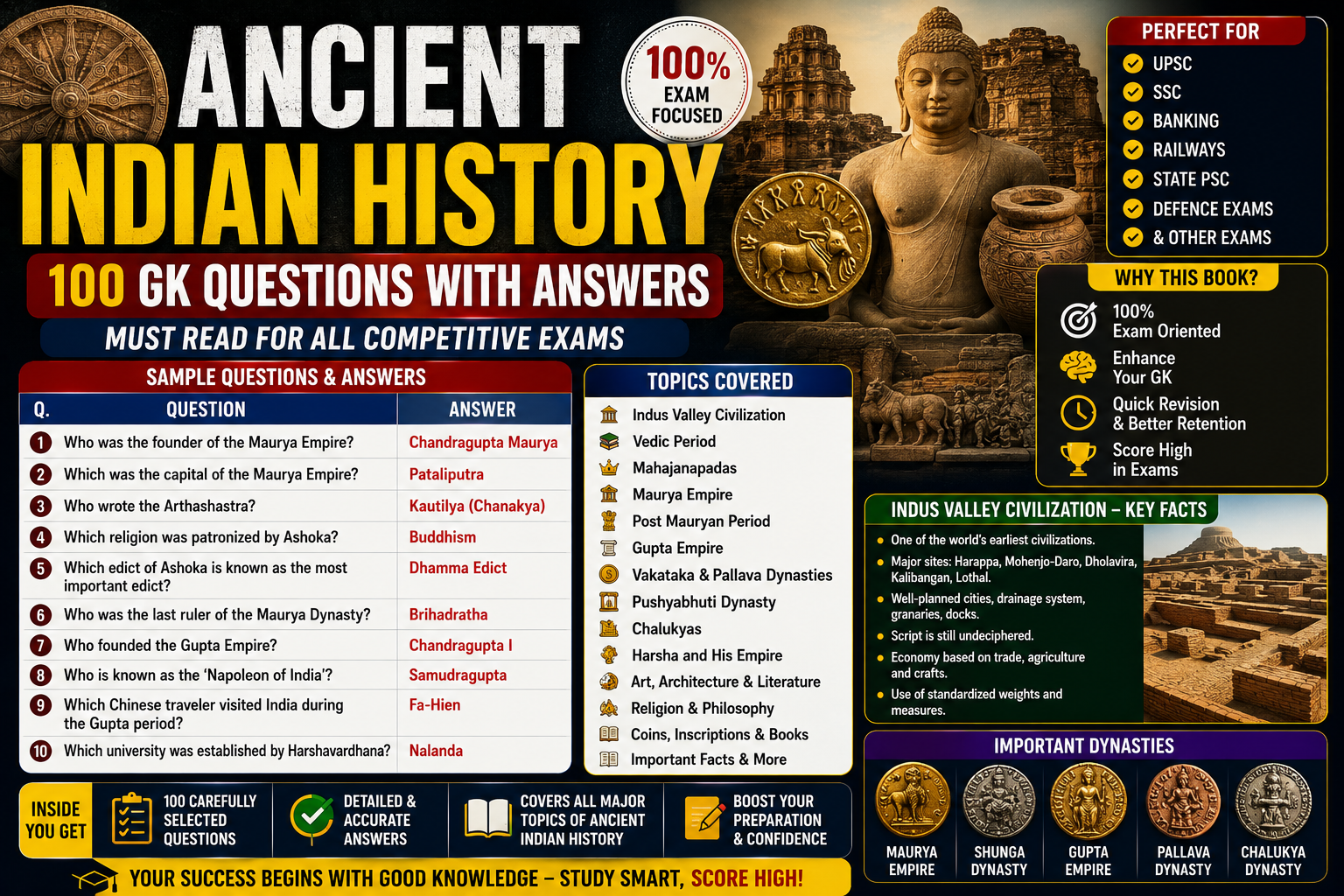
Ancient Indian History is a Goldmine for Exams
Let me ask you a question.
How many questions from Ancient Indian History appear in competitive exams?
- UPSC Prelims: 5-8 questions every year
- SSC CGL/CHSL: 4-6 questions
- State PSCs: 6-10 questions
- Banking (IBPS, SBI): 2-3 questions
- Railways (RRB NTPC): 4-5 questions
Ancient Indian History is not just about dates and kings. It is about the story of India – from the first human settlements to the golden age of the Guptas. It covers the rise and fall of great empires, the birth of world religions, and achievements in science, art, and literature that still amaze the world.
Every serious aspirant knows: Ancient Indian History is highly scoring if you know the right facts.
In this blog, I have created 100 original, exam-relevant GK questions on Ancient Indian History. Each question is immediately followed by its answer. No separate answer key. No flipping pages. Instant learning.
(Add Image with Alt Text: “Ancient Indian history GK questions – timeline from Indus Valley to Gupta Empire with key events”)
Dofollow External Resource: National Museum of India – Ancient Indian History Collection – official source for artifacts and historical evidence.
Part 1 – Stone Age and Prehistoric India (Questions 1 to 10)
Question 1. What are the three main periods of the Stone Age in India?
Answer: Paleolithic (Old Stone Age), Mesolithic (Middle Stone Age), and Neolithic (New Stone Age).
Question 2. Which is the oldest Stone Age site discovered in India?
Answer: Soan Valley (in present-day Punjab, Pakistan). The Soan culture is considered the earliest Paleolithic culture in India.
Question 3. What type of tools were used by Paleolithic man in India?
Answer: Hand axes, cleavers, choppers, and flake tools made of quartzite stone.
Question 4. Which famous site in Karnataka contains evidence of the Mesolithic Age?
Answer: Brahmagiri site in Karnataka (also associated with Neolithic and Megalithic cultures).
Question 5. What is the most distinctive feature of the Neolithic Age?
Answer: Domestication of animals, cultivation of crops, polished stone tools, and the beginning of settled village life.
Question 6. Which Neolithic site in India gives evidence of burial of dogs along with humans?
Answer: Burzahom in Kashmir. Dogs were buried in circular pits along with their masters.
Question 7. The Bhimbetka rock shelters (Madhya Pradesh) contain paintings from which periods?
Answer: Paleolithic, Mesolithic, and historic periods. Bhimbetka is a UNESCO World Heritage Site.
Question 8. What is the approximate time period of the Lower Paleolithic Age in India?
Answer: 2.5 million years ago to 1,00,000 years ago.
Question 9. Which river valley is associated with the Soan culture?
Answer: Soan River (a tributary of the Indus River).
Question 10. What is the difference between the Soan culture and the Acheulian culture in India?
Answer: Soan culture used chopper-chopping tools (pebble tools), while the Acheulian culture used hand axes and cleavers (bifacial tools).
Part 2 – Indus Valley Civilization (Questions 11 to 25)
Question 11. What is the other name of the Indus Valley Civilization?
Answer: Harappan Civilization (named after Harappa, the first site discovered).
Question 12. In which year and by whom was the Harappan Civilization discovered?
Answer: 1921 (Harappa) by Daya Ram Sahni. Mohenjo-Daro was discovered in 1922 by R.D. Banerjee.
Question 13. What is the time period of the Mature Harappan Civilization?
Answer: 2600 BCE to 1900 BCE (some scholars say 2500 BCE to 1750 BCE).
Question 14. What are the three most important sites of the Indus Valley Civilization?
Answer: Harappa (Pakistan), Mohenjo-Daro (Pakistan), and Dholavira (Gujarat, India).
Question 15. Which Indian site of the Indus Valley Civilization is famous for its water conservation system?
Answer: Dholavira (Gujarat). It had a series of water reservoirs and a sophisticated drainage system.
Question 16. What was the Great Bath of Mohenjo-Daro used for?
Answer: Probably for religious rituals and bathing. It was a large brick-lined pool with waterproofing using natural tar (bitumen).
Question 17. Did the Indus Valley people know the use of iron?
Answer: No. The Indus Valley Civilization was a Bronze Age civilization. They used copper, bronze, tin, and stone tools. Iron came later (Post-Harappan period).
Question 18. What was the most distinctive animal depicted on Indus Valley seals?
Answer: Unicorn (a single-horned bull). The humped bull (Zebu) was also common.
Question 19. Which Indus Valley site is famous for the “Dancing Girl” bronze statue?
Answer: Mohenjo-Daro. The statue is 4,500 years old and depicts a nude young woman wearing bangles.
Question 20. Which Indus Valley site is famous for the “Priest King” soapstone statue?
Answer: Mohenjo-Daro. The statue shows a bearded man wearing a robe with trefoil patterns.
Question 21. What type of script did the Indus Valley people use? Is it deciphered?
Answer: They used a pictographic script. It is not yet fully deciphered despite numerous attempts.
Question 22. Did the Indus Valley people build any temples or religious structures?
Answer: No. No definite temple structure has been found. Religious practices were likely household-based.
Question 23. What evidence suggests that the Indus Valley people worshipped a Mother Goddess?
Answer: Numerous terracotta female figurines have been found. One seal (Pasupati Seal) shows a figure seated in a yogic posture surrounded by animals.
Question 24. What is the “Pasupati Seal” and where was it found?
Answer: The Pasupati Seal (found at Mohenjo-Daro) depicts a seated figure with three faces, a horned headdress, surrounded by an elephant, tiger, rhinoceros, buffalo, and deer. Some scholars identify this as proto-Shiva.
Question 25. What are the four major theories about the decline of the Indus Valley Civilization?
Answer:
- Aryan invasion theory (now largely rejected)
- Climatic change and drying of the Ghaggar-Hakra River (Saraswati)
- Floods and earthquakes
- Ecological imbalance due to deforestation
Part 3 – Vedic Period and Later Vedic Period (Questions 26 to 35)
Question 26. What is the time period of the Early Vedic Period (Rig Vedic Period)?
Answer: Approximately 1500 BCE to 1000 BCE.
Question 27. What is the time period of the Later Vedic Period?
Answer: Approximately 1000 BCE to 600 BCE.
Question 28. Which is the oldest and most important of the four Vedas?
Answer: Rig Veda. It contains 1,028 hymns (suktas) divided into 10 mandalas.
Question 29. What are the four Vedas?
Answer: Rig Veda, Yajur Veda, Sama Veda, and Atharva Veda.
Question 30. What are the Brahmanas?
Answer: Prose texts attached to the Vedas that explain the meaning of hymns and provide instructions for performing rituals and sacrifices.
Question 31. What are the Upanishads? How many are there?
Answer: The Upanishads are philosophical texts that form the end part of the Vedas (Vedanta). They discuss concepts like Brahman (ultimate reality) and Atman (soul). There are 108 Upanishads, with 13 being the principal ones.
Question 32. Which Upanishad is known for the dialogue between Nachiketa and Yama (god of death)?
Answer: Katha Upanishad.
Question 33. What was the political unit of the Rig Vedic period called?
Answer: Jan (tribe or clan). The king was called Rajan, and the tribe was called Jana.
Question 34. What was the position of women in the Early Vedic period compared to the Later Vedic period?
Answer: In the Early Vedic period, women had higher status. They could attend assemblies (Sabha and Samiti) and compose hymns (e.g., Lopamudra, Ghosha, Apala). In the Later Vedic period, women’s status declined significantly.
Question 35. What is the term for the four-fold division of society mentioned in the Purusha Sukta hymn of the Rig Veda?
Answer: Varna system – Brahmins (priests, mouth), Kshatriyas (warriors, arms), Vaishyas (traders, thighs), Shudras (servants, feet).
Part 4 – Jainism and Buddhism (Questions 36 to 45)
Question 36. Who was the 23rd Tirthankara of Jainism?
Answer: Parshvanatha (also called Parshva). He lived around 900 BCE and is considered a historical figure.
Question 37. Who was the 24th and last Tirthankara of Jainism?
Answer: Vardhamana Mahavira (599 BCE – 527 BCE). He is considered the founder of Jainism as a formal religion.
Question 38. Where was Mahavira born?
Answer: Kundagrama (near Vaishali, present-day Bihar).
Question 39. What are the “Three Jewels” (Triratna) of Jainism?
Answer: Right Faith (Samyak Darshana), Right Knowledge (Samyak Jnana), and Right Conduct (Samyak Charitra).
Question 40. What are the five great vows (Pancha Mahavratas) of Jain monks?
Answer: Ahimsa (non-violence), Satya (truth), Asteya (non-stealing), Brahmacharya (celibacy), and Aparigraha (non-possession).
Question 41. Where was Gautama Buddha born?
Answer: Lumbini (present-day Nepal, near the Indian border).
Question 42. Under which tree did Buddha attain enlightenment?
Answer: Bodhi tree (a type of fig tree, Ficus religiosa) at Bodh Gaya, Bihar.
Question 43. Where did Buddha deliver his first sermon (Dhammachakkapavattana Sutta)?
Answer: Sarnath (near Varanasi, Uttar Pradesh). This event is called Dhammachakra Pravartana or “Turning of the Wheel of Law.”
Question 44. What are the “Four Noble Truths” of Buddhism?
Answer:
- Dukkha – Suffering exists
- Samudaya – There is a cause of suffering (desire/attachment)
- Nirodha – Suffering can end
- Marga – There is a path to end suffering (Eightfold Path)
Question 45. What are the “Three Jewels” (Triratna) of Buddhism?
Answer: Buddha (the enlightened one), Dhamma (the teachings), and Sangha (the monastic community).
Part 5 – Mahajanapadas and Magadha Empire (Questions 46 to 55)
Question 46. How many Mahajanapadas (great kingdoms) existed in the 6th century BCE?
Answer: 16 Mahajanapadas.
Question 47. Which text is the primary source of information about the 16 Mahajanapadas?
Answer: Anguttara Nikaya (a Buddhist text).
Question 48. Name any six of the 16 Mahajanapadas.
Answer: Magadha, Kosala, Vatsa, Avanti, Kashi, Gandhara, Vajji (confederation), Anga, Malla, Kuru, Panchala, Chedi, Matsya, Surasena, Ashmaka, Kamboja.
Question 49. Which Mahajanapada became the most powerful and eventually gave rise to the Mauryan Empire?
Answer: Magadha (present-day Bihar).
Question 50. Which were the four major kingdoms that fought for supremacy after the decline of the Mahajanapadas?
Answer: Magadha, Kosala, Vatsa, and Avanti.
Question 51. Which dynasty ruled Magadha after the Haryanka dynasty?
Answer: Shishunaga dynasty.
Question 52. Which dynasty of Magadha was overthrown by Chandragupta Maurya?
Answer: Nanda dynasty (the last Nanda king was Dhanananda).
Question 53. Which two powerful kingdoms were annexed by Magadha under Ajatashatru?
Answer: Kosala and Vajji (the Licchavi confederation of Vaishali).
Question 54. Who was the founder of the Nanda dynasty?
Answer: Mahapadma Nanda (also called the “first empire builder” of India).
Question 55. What was the capital of the Magadha kingdom during the Haryanka dynasty?
Answer: Rajagriha (present-day Rajgir, Bihar). Later, Udayin shifted the capital to Pataliputra (present-day Patna).
Part 6 – Mauryan Empire (Questions 56 to 70)
Question 56. Who founded the Mauryan Empire and in which year?
Answer: Chandragupta Maurya in 322 BCE (after defeating the Nanda dynasty).
Question 57. Who was the famous Greek ambassador who visited the court of Chandragupta Maurya?
Answer: Megasthenes. He wrote the book “Indica,” which is a valuable source of Mauryan history.
Question 58. Who was the last king of the Mauryan dynasty?
Answer: Brihadratha Maurya. He was assassinated by Pushyamitra Shunga, his general, who founded the Shunga dynasty.
Question 59. Who was the greatest ruler of the Mauryan Empire?
Answer: Ashoka the Great (ruled approximately 268 BCE – 232 BCE).
Question 60. Which war transformed Ashoka from a violent conqueror to a follower of Buddhism?
Answer: The Kalinga War (261 BCE) fought against the kingdom of Kalinga (present-day Odisha). The massive bloodshed led Ashoka to embrace Buddhism.
Question 61. What are the “Edicts of Ashoka”?
Answer: Inscriptions carved on rocks and pillars across the Mauryan Empire containing Ashoka’s messages about Dhamma (righteous living), non-violence, religious tolerance, and social welfare.
Question 62. Which pillar edict is considered the “National Emblem of India”?
Answer: The Lion Capital of Ashoka at Sarnath. It features four lions standing back to back on a circular abacus. Above them is the Ashoka Chakra. The Government of India adopted this as the national emblem in 1950.
Question 63. What is the name of the official script used in Ashokan inscriptions?
Answer: Brahmi script (most inscriptions). Kharoshthi script was used in the northwestern regions.
Question 64. Which Ashokan rock edict contains the famous line “All humans are my children”?
Answer: Rock Edict No. 1 of the 14 Major Rock Edicts (also known as the “Girnar Rock Edict”).
Question 65. Which Ashokan edict mentions the names of the five contemporary Hellenistic (Greek) kings?
Answer: The 13th Major Rock Edict. It mentions Antiochus II of Syria, Ptolemy II of Egypt, Antigonas II of Macedonia, Magas of Cyrene, and Alexander of Epirus.
Question 66. What was the capital city of the Mauryan Empire?
Answer: Pataliputra (present-day Patna, Bihar).
Question 67. Who was Chanakya (Kautilya or Vishnugupta)? Which famous book did he write?
Answer: Chanakya was the chief advisor of Chandragupta Maurya. He wrote the “Arthashastra,” a treatise on statecraft, economics, and military strategy.
Question 68. What was the name of Ashoka’s son who spread Buddhism to Sri Lanka?
Answer: Mahendra (also called Mahinda). Ashoka’s daughter Sanghamitra also went to Sri Lanka.
Question 69. What was the name of Ashoka’s personal physician who was also a famous Buddhist monk?
Answer: Nagarjuna (not to be confused with the later philosopher of the same name). He was a contemporary of Ashoka.
Question 70. Which Mauryan king abdicated the throne and became a Jain monk?
Answer: Chandragupta Maurya. According to Jain tradition, he became a monk and fasted to death at Shravanabelagola in Karnataka.
Part 7 – Post-Mauryan and Foreign Invasions (Questions 71 to 80)
Question 71. Which dynasty was founded by Pushyamitra Shunga after killing the last Mauryan king?
Answer: Shunga dynasty (185 BCE – 73 BCE).
Question 72. Which ruler of the Shunga dynasty is famous for reviving Brahmanical traditions and persecuting Buddhists?
Answer: Pushyamitra Shunga (though the extent of persecution is debated among historians).
Question 73. What is the famous Buddhist stupa built during the Shunga period?
Answer: The Great Stupa at Sanchi (Madhya Pradesh). The original stupa was built by Ashoka, but the Shungas enlarged and decorated it.
Question 74. Which foreign invaders (Indo-Greeks) ruled parts of northwestern India after the Mauryan decline?
Answer: The Indo-Greeks (also called Yavanas). The most famous Indo-Greek king was Menander (Milinda), who converted to Buddhism.
Question 75. Which king established the Indo-Parthian kingdom in northwestern India?
Answer: Gondophares (around 20 BCE). St. Thomas (the Apostle) is said to have visited his court.
Question 76. Which Central Asian nomadic tribe established the Kushan Empire in India?
Answer: The Yuezhi (who split into five clans, one of which was the Kushans).
Question 77. Who was the greatest ruler of the Kushan Empire?
Answer: Kanishka (reigned 127 CE – 150 CE approximately).
Question 78. Which Buddhist council was held during the reign of Kanishka? Where was it held?
Answer: The Fourth Buddhist Council was held at Kundalavana (near Srinagar, Kashmir). The council was presided over by Vasumitra, with Ashvaghosha as his deputy.
Question 79. Which famous Buddhist scholar and poet lived in Kanishka’s court?
Answer: Ashvaghosha. He wrote “Buddhacharita” (a biography of Buddha) and “Saundarananda.”
Question 80. What is the Kanishka Casket? Where was it found?
Answer: The Kanishka Casket is a gold reliquary (box containing Buddhist relics) found at Shahji-ki-Dheri (near Peshawar, Pakistan). It is now in the Peshawar Museum.
Part 8 – Gupta Empire (Questions 81 to 90)
Question 81. Who founded the Gupta Empire and in which year?
Answer: Sri Gupta (around 240 CE – 280 CE). However, the first powerful ruler was Chandragupta I.
Question 82. Who was the first independent Gupta ruler to adopt the title “Maharajadhiraja”?
Answer: Chandragupta I (reigned 320 CE – 335 CE). He started the Gupta Era in 320 CE.
Question 83. Who is considered the “Napoleon of India” and why?
Answer: Samudragupta (reigned 335 CE – 380 CE). He was a brilliant military commander and conquered nearly all of northern India. The Allahabad Pillar Inscription (composed by Harishena) describes his conquests.
Question 84. Which famous Chinese traveler visited India during the reign of Chandragupta II?
Answer: Fa-Hien (Faxian). He visited India between 399 CE and 414 CE and wrote a detailed account of Gupta society, religion, and administration.
Question 85. What is the time period often called the “Golden Age of Ancient India”?
Answer: The Gupta period (approximately 320 CE – 550 CE). This period witnessed remarkable achievements in literature, science, mathematics, astronomy, art, and architecture.
Question 86. Who was the famous Sanskrit poet and playwright in the court of Chandragupta II?
Answer: Kalidasa. He wrote famous works like “Abhijnana Shakuntalam,” “Meghaduta,” “Raghuvamsa,” and “Kumarasambhava.”
Question 87. Who was the famous astronomer and mathematician of the Gupta period? What did he calculate?
Answer: Aryabhata. He calculated:
- The value of pi (3.1416)
- That the Earth rotates on its axis
- The cause of solar and lunar eclipses
- The length of the solar year (365.358 days)
He wrote “Aryabhatiya” and “Arya Siddhanta.”
Question 88. Who was the other famous astronomer of the Gupta period who wrote “Pancha Siddhantika” and “Romaka Siddhanta”?
Answer: Varahamihira. He also wrote “Brihat Samhita” (an encyclopedic work on astrology, astronomy, and architecture).
Question 89. Who was the famous physician of the Gupta period who wrote the “Sushruta Samhita” (the original text was from an earlier period, but he updated it)?
Answer: Sushruta (the original Sushruta lived around 600 BCE). The Gupta period saw the preservation of ancient medical texts. Vagbhata was another famous Gupta-era physician.
Question 90. Which famous iron pillar is located in Delhi (Qutub Complex) and is known for not rusting for over 1,600 years?
Answer: The Iron Pillar of Delhi (erected during the Gupta period, possibly during the reign of Chandragupta II). It is a metallurgical marvel.
Part 9 – South Indian Kingdoms (Cholas, Cheras, Pandyas, Pallavas, Chalukyas, Rashtrakutas) (Questions 91 to 95)
Question 91. What are the three ancient kingdoms (Muvendars) mentioned in the Sangam literature?
Answer: The Cholas (from the Kaveri delta), the Cheras (from present-day Kerala), and the Pandyas (from present-day Tamil Nadu).
Question 92. Which Chola ruler was known as “Rajakesari”? Which famous Chola king built the Brihadeshwara Temple at Thanjavur?
Answer: The title “Rajakesari” was used by many Chola kings. The Brihadeshwara Temple (also called Rajarajeswaram) was built by Rajaraja Chola I (985 CE – 1014 CE).
Question 93. Which Pallava king built the famous Shore Temple at Mahabalipuram?
Answer: Narasimhavarman II (also called Rajasimha, ruled 700 CE – 728 CE). He also built the Kailasanatha Temple at Kanchipuram.
Question 94. Who was the most famous ruler of the Chalukya dynasty of Badami?
Answer: Pulakeshin II (reigned 609 CE – 642 CE). He defeated Harshavardhana and is described in the Aihole Inscription composed by Ravikirti.
Question 95. Who was the most famous ruler of the Rashtrakuta dynasty?
Answer: Amoghavarsha I (reigned 814 CE – 878 CE). He was a patron of literature, science, and the Jain religion. He wrote “Kavirajamarga,” the earliest surviving literary work in Kannada.
Part 10 – Miscellaneous and Landmark Facts (Questions 96 to 100)
Question 96. What is the oldest surviving university in the Indian subcontinent? When was it established?
Answer: Nalanda University (established during the Gupta period, around 427 CE). It flourished until 1197 CE when it was destroyed by Bakhtiyar Khilji.
Question 97. Which Indian scientist-philosopher (around 600 BCE) proposed the concept of “anu” (atom)?
Answer: Acharya Kanada (or Kashyapa). He wrote the “Vaisheshika Sutra” and is considered the father of atomic theory.
Question 98. Which famous Indian king composed the “Gita Govinda”?
Answer: King Jayadeva (though he was not a king – he was a poet in the court of a king). This is a trick question. Jayadeva was a poet (c. 1200 CE) who wrote “Gita Govinda,” a lyrical poem about Krishna and Radha.
Question 99. What is the name of the earliest known inscription in India that uses the term “Hindu”?
Answer: The Junagadh Rock Inscription of Rudradaman I (c. 150 CE). It mentions the “Hindu” people (though in a geographical sense, not religious).
Question 100. Which ancient Indian text is considered the world’s first treatise on statecraft, economics, and military strategy?
Answer: Arthashastra by Chanakya (Kautilya), written around 321 BCE – 300 BCE.
12. Conclusion – Your Revision Checklist
Dosto, Ancient Indian History is the foundation of our civilization. Every question you answer brings you closer to understanding where we come from.
Quick Revision Checklist:
| Topic | Key Points to Remember |
|---|---|
| Stone Age | Paleolithic (tools), Mesolithic (microliths), Neolithic (farming, polished tools) |
| Indus Valley | 2600-1900 BCE, Harappa, Mohenjo-Daro, Dholavira, Great Bath, seals, undeciphered script |
| Vedic Period | 1500-600 BCE, Rig Veda, Vedas, Upanishads, Varna system, Janapadas |
| Jainism & Buddhism | Mahavira (24th Tirthankara), Buddha (4 Noble Truths, 8-fold path), Triratna |
| Mahajanapadas | 16 kingdoms, Magadha most powerful, Haryanka, Shishunaga, Nanda dynasties |
| Mauryan Empire | 322-185 BCE, Chandragupta Maurya, Ashoka, Kalinga War, Edicts, Lion Capital |
| Post-Mauryan | Shunga, Indo-Greeks, Kushans, Kanishka, Fourth Buddhist Council |
| Gupta Empire | 320-550 CE, Chandragupta I, Samudragupta, Chandragupta II, Kalidasa, Aryabhata |
| South India | Cholas, Cheras, Pandyas, Pallavas (Shore Temple), Chalukyas, Rashtrakutas |
Your 10-Day Action Plan:
| Day | Task |
|---|---|
| Day 1 | Read all 100 Q&As once (2 hours) |
| Day 2 | Cover the answer side, test yourself on Q1-Q50 |
| Day 3 | Cover the answer side, test yourself on Q51-Q100 |
| Day 4 | Revise Indus Valley and Vedic Period |
| Day 5 | Revise Jainism, Buddhism, Mahajanapadas |
| Day 6 | Revise Mauryan and Gupta Empires |
| Day 7 | Revise South Indian Kingdoms and foreign invasions |
| Day 8 | Solve all 100 again (timed – 75 minutes) |
| Day 9 | Identify weak areas and re-read |
| Day 10 | Take a full mock test on Ancient Indian History |
Comment below: Which period of Ancient Indian History do you find most fascinating?
Share this blog with your study group. Master Ancient History together.
Also Check: President of India – Top 50 GK Questions with Answers (Instant Learning)