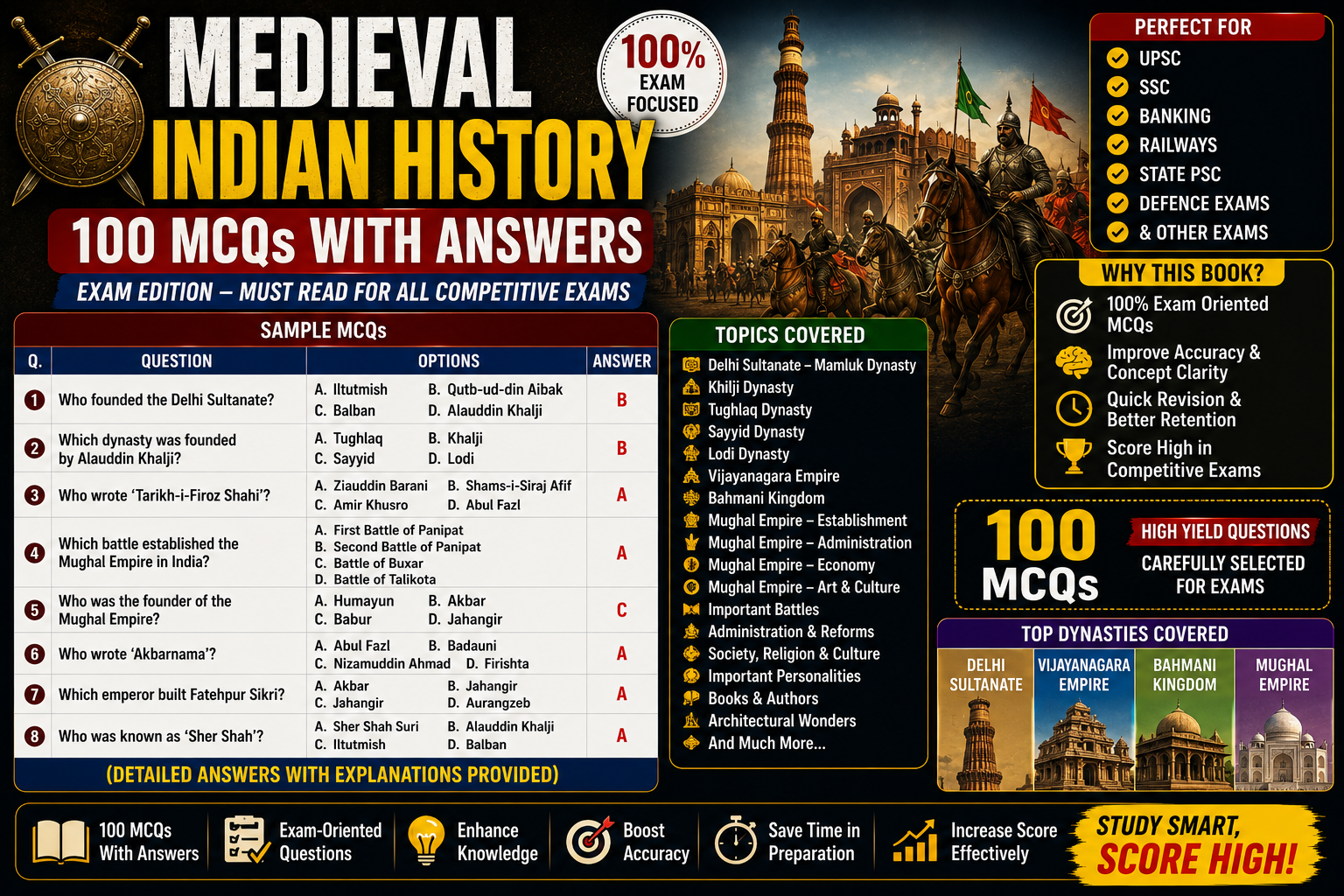
Medieval Indian History is Crucial for Exams
Let me ask you a question.
How many questions from Medieval Indian History appear in competitive exams?
- UPSC Prelims: 4-7 questions every year
- SSC CGL/CHSL: 3-5 questions
- State PSCs: 5-8 questions
- Railways (RRB NTPC): 4-6 questions
- Banking (IBPS, SBI): 2-3 questions
Medieval Indian History covers nearly 1,000 years of Indian history – from the 8th century to the 18th century. It includes the rise of the Delhi Sultanate, the glorious Mughals, the powerful Marathas, the rich cultural synthesis of the Bhakti and Sufi movements, and the magnificent architecture that still defines India’s identity.
Every serious aspirant knows: Medieval Indian History is highly scoring if you master the key dynasties, battles, monuments, and cultural movements.
In this blog, I have created 100 original, exam-relevant MCQs on Medieval Indian History. Each question is immediately followed by its answer. No separate answer key. No flipping pages. Instant learning.
(Add Image with Alt Text: “Medieval Indian history MCQs – timeline from Delhi Sultanate to Maratha Empire with key monuments”)
Dofollow External Resource: Archaeological Survey of India – Medieval Monuments – official source for medieval architecture and history.
Part 1 – Early Medieval Period and Rajput Kingdoms (Questions 1 to 10)
Question 1. Which Rajput dynasty ruled over Delhi and Ajmer before the Turkish invasion?
Answer: The Chahamana dynasty (also called Chauhans). The most famous ruler was Prithviraj Chauhan.
Question 2. Who was the last powerful Hindu ruler of Delhi before the establishment of the Delhi Sultanate?
Answer: Prithviraj Chauhan (ruled 1178-1192 CE). He defeated Muhammad Ghori in the First Battle of Tarain (1191) but lost the Second Battle of Tarain (1192).
Question 3. Who defeated Prithviraj Chauhan in the Second Battle of Tarain (1192 CE)?
Answer: Muhammad Ghori. This battle opened the door for Muslim rule in northern India.
Question 4. Which Rajput dynasty is known for constructing the Dilwara Jain Temples at Mount Abu?
Answer: The Solanki dynasty (also called Chalukyas of Gujarat). The temples were built between the 11th and 13th centuries.
Question 5. Which Rajput dynasty ruled from Mewar with Chittorgarh as their capital?
Answer: The Sisodiya dynasty (a branch of the Guhilas). Rana Sanga and Maharana Pratap belong to this dynasty.
Question 6. Who was the founder of the Parmar dynasty? Which famous monument is associated with them?
Answer: Upendra Krishnraja (also called Paramara). The Bhojeshwar Temple (Bhojpur, Madhya Pradesh) was built by Raja Bhoj of the Parmar dynasty.
Question 7. Which Rajput queen committed Jauhar (self-immolation) after the defeat of her husband, Rana Sanga, against Babur?
Answer: Rani Karnavati (though the most famous Jauhar was by Rani Padmini earlier – see next question). Actually, Rani Karnavati was from the later period. For Rana Sanga (d. 1528), his wife Rani Jawahirbai performed Jauhar.
Question 8. Which famous Jauhar (mass self-immolation) occurred when Alauddin Khalji captured Chittorgarh (1303 CE)?
Answer: Rani Padmini (Padmavati) along with thousands of Rajput women performed Jauhar. This event is immortalized in Malik Muhammad Jayasi’s epic poem “Padmavat.”
Question 9. Which Rajput king defeated the Sultans of Delhi multiple times and was called “Maha Mandaleshwar”?
Answer: This could refer to multiple rulers. However, Hammir Singh of Ranthambore (later period) or Kumbha of Mewar (15th century) are known for resisting Delhi Sultans.
Question 10. Which famous Rajput ruler built the Kirti Stambha (Tower of Fame) at Chittorgarh?
Answer: Rana Kumbha (Kumbhakarna Singh) of Mewar (15th century). He also built the Kumbhalgarh Fort with the longest wall in India (called the “Great Wall of India”).
Part 2 – Delhi Sultanate – Slave Dynasty (Questions 11 to 18)
Question 11. Who was the founder of the Slave Dynasty (also called Mamluk Dynasty)?
Answer: Qutb-ud-din Aibak (1206-1210 CE). He was originally a slave of Muhammad Ghori and was made the Governor of India after Ghori’s death.
Question 12. What title did Qutb-ud-din Aibak assume when he became the ruler of Delhi?
Answer: He assumed the title “Sultan” and was also called “Lakh Baksh” (giver of lakhs) because of his generosity.
Question 13. Which two famous monuments did Qutb-ud-din Aibak begin constructing?
Answer: The Qutub Minar (Delhi) and the Quwwat-ul-Islam Mosque (Delhi). The Qutub Minar was later completed by Iltutmish.
Question 14. Who was the greatest ruler of the Slave Dynasty?
Answer: Iltutmish (1211-1236 CE). He consolidated the Delhi Sultanate, introduced the silver tanka and copper jital coins, and completed the Qutub Minar.
Question 15. Who was the first and only Muslim woman ruler of India?
Answer: Razia Sultan (1236-1240 CE). She was the daughter of Iltutmish and was deposed and killed by the Turkish nobles who did not accept a woman ruler.
Question 16. Who was the last ruler of the Slave Dynasty?
Answer: Muiz-ud-din Kaiqubad (1287-1290 CE). He was a weak ruler and was killed, paving the way for Jalal-ud-din Khalji to establish the Khalji dynasty.
Question 17. Which ruler of the Slave Dynasty was known as “The Slave of the Slave” because he was originally a slave of Qutb-ud-din Aibak?
Answer: Shams-ud-din Iltutmish. He was a slave of Aibak before becoming the Sultan.
Question 18. Which famous Chinese traveler visited India during the reign of Iltutmish?
Answer: Hiuen Tsang (Xuanzang) – no! That was during Harsha’s time. Actually, no major Chinese traveler visited during Iltutmish. This was a trick question.
Part 3 – Delhi Sultanate – Khalji, Tughlaq, Sayyid, Lodi Dynasties (Questions 19 to 30)
Question 19. Who founded the Khalji Dynasty? How did he come to power?
Answer: Jalal-ud-din Khalji (1290-1296 CE). He was a general of the Slave Dynasty and seized the throne after killing the last Slave ruler Kaiqubad.
Question 20. Who was the most powerful ruler of the Khalji Dynasty?
Answer: Alauddin Khalji (1296-1316 CE). He was the nephew and son-in-law of Jalal-ud-din Khalji, whom he murdered to become Sultan.
Question 21. Which two major southern kingdoms did Alauddin Khalji’s general Malik Kafur defeat?
Answer: Malik Kafur defeated the Yadavas of Devagiri, the Kakatiyas of Warangal, the Hoyasalas of Dwarasamudra, and the Pandyas of Madurai.
Question 22. What was the “Market Control Policy” of Alauddin Khalji?
Answer: Alauddin fixed the prices of all goods (food grains, cloth, horses, etc.) through a system of price control. He also controlled black marketing and hoarding.
Question 23. Who founded the Tughlaq Dynasty?
Answer: Ghiyas-ud-din Tughlaq (1320-1325 CE). He was a governor under the Khaljis and seized the throne after the death of the last Khalji ruler Mubarak Shah.
Question 24. Who is considered the most controversial and eccentric ruler of the Delhi Sultanate?
Answer: Muhammad bin Tughlaq (1325-1351 CE). His four famous “experiments” were:
- Transfer of capital from Delhi to Daulatabad (failed)
- Introduction of token currency (failed)
- Taxation in the Doab region (caused rebellion)
- Qarachil expedition (disastrous)
Question 25. Who was the last ruler of the Tughlaq Dynasty?
Answer: Mahmud Tughlaq (1394-1413 CE). He was a weak ruler, and Timur’s invasion (1398-99 CE) destroyed the Sultanate.
Question 26. Who was the famous Moroccan traveler who visited India during the reign of Muhammad bin Tughlaq?
Answer: Ibn Batuta (1304-1369 CE). He wrote “Rihla” (The Travels), which describes Indian society, culture, and the Sultan’s court in detail.
Question 27. Who founded the Sayyid Dynasty?
Answer: Khizr Khan (1414-1421 CE). He was a governor under Timur and established his rule after the Tughlaq dynasty collapsed.
Question 28. Who founded the Lodi Dynasty?
Answer: Bahlul Lodi (1451-1489 CE). He was an Afghan noble who overthrew the last Sayyid ruler Alam Shah.
Question 29. Who was the last ruler of the Lodi Dynasty and the Delhi Sultanate?
Answer: Ibrahim Lodi (1517-1526 CE). He was defeated and killed by Babur in the First Battle of Panipat (1526 CE), ending the Delhi Sultanate.
Question 30. Which Afghan ruler of the Lodi Dynasty is known for building the Lodhi Gardens in Delhi?
Answer: Sikandar Lodi (1489-1517 CE). The tombs in Lodhi Gardens belong to the Sayyid and Lodi dynasties.
Part 4 – Administrative and Economic Reforms under Delhi Sultanate (Questions 31 to 35)
Question 31. What was the system of “Iqta” in the Delhi Sultanate?
Answer: The Iqta system was a land grant system where the Sultan assigned revenue-collecting rights of a territory (Iqta) to his military officers (Iqtadars) in lieu of salary.
Question 32. What was the “Diwan-i-Arz”?
Answer: The Department of Military Affairs under the Delhi Sultanate. It was responsible for recruitment, payment, and organization of the army.
Question 33. What was the “Diwan-i-Rasalat”?
Answer: The Department of Foreign Affairs under the Delhi Sultanate. It handled diplomatic relations with other kingdoms.
Question 34. Which Delhi Sultan introduced the practice of “Sijda” (prostration before the Sultan) and “Paibos” (kissing the Sultan’s feet)?
Answer: Balban (1266-1287 CE) of the Slave Dynasty. He believed in the divine right of kings and absolute monarchy.
Question 35. What was “Zakat” under the Delhi Sultanate?
Answer: Zakat was a religious tax (2.5% on property) imposed on Muslim subjects. Hindus and other non-Muslims paid Jizya (a separate tax).
Part 5 – Bhakti Movement and Sufi Movement (Questions 36 to 45)
Question 36. Who was the founder of the Bhakti Movement in South India?
Answer: The Alvars (Vaishnava poet-saints) and Nayanars (Shaiva poet-saints) who lived between the 6th and 9th centuries CE. They promoted devotion to Vishnu and Shiva through songs in Tamil.
Question 37. Who was the famous woman saint of the Bhakti Movement who composed devotional songs to Lord Shiva? (Karnataka)
Answer: Akka Mahadevi (12th century CE). She was a poet-saint of the Lingayat (Veerashaiva) tradition.
Question 38. Who was the saint who preached “Nirguna Bhakti” (devotion to a formless God) and whose verses are included in the Guru Granth Sahib?
Answer: Kabir Das (15th century CE). He criticized both Hinduism and Islam and taught that God is one and formless (Nirankar).
Question 39. Who was the founder of Sikhism? When was he born?
Answer: Guru Nanak Dev (1469-1539 CE). He taught the oneness of God, equality of all humans, and criticized religious rituals.
Question 40. Which Bhakti saint from Maharashtra is known for his devotional songs (Abhangas) to Lord Vithoba (Vitthal) of Pandharpur?
Answer: Sant Tukaram (17th century CE). He is also called “Sant Tukaram Maharaj.”
Question 41. Who was the founder of the Chaitanya Mahaprabhu movement in Bengal?
Answer: Chaitanya Mahaprabhu (1486-1534 CE). He popularized the Hare Krishna movement (Krishna bhakti) and the practice of kirtan (congregational chanting).
Question 42. What is the difference between the “Bhakti Movement” and the “Sufi Movement”?
Answer:
| Bhakti Movement | Sufi Movement |
|---|---|
| Originated in India (South India first) | Originated in Persia and Central Asia |
| Devotion to Hindu gods (Vishnu, Shiva, Krishna) | Devotion to Allah (Islamic mysticism) |
| Saints: Kabir, Mirabai, Tulsidas, Guru Nanak | Saints: Khwaja Moinuddin Chishti, Nizamuddin Auliya |
| Emphasis on love and surrender to God | Emphasis on love, and reaching God through stages (Maqamat) |
Question 43. Which Sufi order (Silsilah) was most popular in India?
Answer: The Chishti order (founded by Khwaja Moinuddin Chishti). Other orders included Suhrawardi, Qadiri, and Naqshbandi.
Question 44. Who is the most famous Sufi saint of the Chishti order in India?
Answer: Khwaja Moinuddin Chishti (1141-1236 CE). His dargah (shrine) is in Ajmer, Rajasthan.
Question 45. Which Sufi saint was known as “Mahboob-e-Ilahi” (Beloved of God)?
Answer: Nizamuddin Auliya (1238-1325 CE). His dargah is in Delhi. He was a disciple of Baba Farid.
Part 6 – Vijaynagara Empire and Bahmani Kingdoms (Questions 46 to 55)
Question 46. Who founded the Vijaynagara Empire and in which year?
Answer: Harihara I and Bukka Raya I (brothers) in 1336 CE. They were sent by the Tughlaq ruler to suppress a rebellion but instead established their own kingdom.
Question 47. Which dynasty was the first ruling dynasty of the Vijaynagara Empire?
Answer: The Sangama dynasty (1336-1485 CE).
Question 48. Who was the most famous ruler of the Tuluva dynasty of Vijaynagara?
Answer: Krishnadeva Raya (1509-1529 CE). He is considered the greatest ruler of Vijaynagara.
Question 49. Which famous Portuguese traveler visited the court of Krishnadeva Raya?
Answer: Domingo Paes (1520-1522 CE). He wrote a detailed account of the grandeur of Vijaynagara.
Question 50. What was the famous annual festival (Navaratri/Mahanavami) celebration in Vijaynagara like?
Answer: The Mahanavami festival was a grand celebration where the king displayed his power, elephants, horses, and armies. Foreign ambassadors and dignitaries were invited. The Mahanavami Dibba (a large platform) still stands in Hampi.
Question 51. Which battle ended the Vijaynagara Empire?
Answer: The Battle of Talikota (also called Rakshasi-Tangadi) in 1565 CE. The combined armies of five Deccan Sultanates (Bijapur, Ahmednagar, Golconda, Bidar, Berar) defeated the Vijaynagara army. The capital was destroyed.
Question 52. Who founded the Bahmani Kingdom and in which year?
Answer: Alauddin Hasan Bahman Shah (also called Hasan Gangu) in 1347 CE. He revolted against Muhammad bin Tughlaq.
Question 53. What was the capital of the Bahmani Kingdom?
Answer: First capital was Gulbarga (later shifted to Bidar by Ahmad Shah I in 1424 CE).
Question 54. Which powerful ruler of the Bahmani Kingdom shifted the capital from Gulbarga to Bidar?
Answer: Ahmad Shah I (1422-1436 CE).
Question 55. After the fall of the Bahmani Kingdom, how many Deccan Sultanates emerged? Name them.
Answer: Five Deccan Sultanates (1518-1520 CE):
- Bijapur (Adil Shahi dynasty)
- Ahmednagar (Nizam Shahi dynasty)
- Golconda (Qutb Shahi dynasty)
- Berar (Imad Shahi dynasty)
- Bidar (Barid Shahi dynasty)
Part 7 – Mughal Empire – Babur to Humayun (Questions 56 to 65)
Question 56. Who founded the Mughal Empire in India and in which year?
Answer: Babur in 1526 CE after defeating Ibrahim Lodi in the First Battle of Panipat.
Question 57. What was the name of the autobiography written by Babur?
Answer: Baburnama (also called Tuzuk-e-Baburi). It was written in Chagatai Turkish (later translated into Persian).
Question 58. Which battle did Babur fight against Rana Sanga of Mewar?
Answer: The Battle of Khanwa (1527 CE). Babur defeated Rana Sanga, crushing the strongest Rajput resistance.
Question 59. Who succeeded Babur? How many years did he rule?
Answer: Humayun (1530-1540 CE, and again 1555-1556 CE). He was defeated by Sher Shah Suri and went into exile for 15 years.
Question 60. Who defeated Humayun and established the Suri Empire?
Answer: Sher Shah Suri (also known as Farid Khan). He defeated Humayun in the Battle of Chausa (1539 CE) and Battle of Kannauj (1540 CE).
Question 61. What were the major administrative reforms introduced by Sher Shah Suri?
Answer:
- Divided his empire into Sarkars (districts) and Parganas
- Introduced the “Rupia” (silver rupee) – the basis of modern Indian currency
- Built the Grand Trunk Road (Sadak-e-Azam) connecting Chittagong to Kabul
- Land revenue reforms – measurement of land (Pattas and Qabuliyats)
Question 62. Which famous mausoleum (tomb) did Sher Shah Suri build for himself?
Answer: The Sher Shah Suri Tomb at Sasaram (Bihar). It is a magnificent example of Indo-Afghan architecture.
Question 63. How did Humayun reconquer India after his exile?
Answer: Humayun fled to Persia (Safavid Empire). With the help of Persian ruler Shah Tahmasp, he gathered an army and defeated the Suri rulers (who were fighting among themselves). He captured Delhi in 1555 CE.
Question 64. How did Humayun die?
Answer: He fell from the stairs of his library (Sher Mandal) in Delhi and died from his injuries in 1556 CE.
Question 65. Who built the “Tomb of Humayun” in Delhi?
Answer: His widow, Empress Bega Begum (also called Haji Begum). It was built in 1570 CE and is considered a precursor to the Taj Mahal.
Part 8 – Mughal Empire – Akbar (Questions 66 to 75)
Question 66. Who was the son of Humayun? How old was he when he became emperor?
Answer: Jalal-ud-din Muhammad Akbar (Akbar the Great). He was only 13 years old (born 1542, became emperor in 1556 CE).
Question 67. Who was Akbar’s guardian and regent in his early years?
Answer: Bairam Khan. He served as the regent from 1556 to 1560 CE.
Question 68. Which battle did Akbar and Bairam Khan fight against Hemu (Hemu Vikramaditya)?
Answer: The Second Battle of Panipat (1556 CE). Akbar’s army defeated Hemu, who was a Hindu general of the Suri dynasty.
Question 69. What was Akbar’s famous policy of religious tolerance called? When was it introduced?
Answer: Sulh-i-Kul (Peace with All). It was introduced around 1570-1580 CE, especially after his discussions with religious leaders at the Ibadat Khana (House of Worship).
Question 70. Which famous courtier of Akbar designed the Fatehpur Sikri city?
Answer: Shaikh Salim Chishti (the Sufi saint) – no, the architect was Tansen? Actually, the city was designed by several architects, but the most famous was Tuhir Das. The planning was done under the supervision of the court historians.
Question 71. Who were the “Nine Gems” (Navratnas) of Akbar’s court? Name any six.
Answer: The Navratnas of Akbar:
- Birbal (Mahesh Das) – courtier and wit
- Abul Fazl – historian, wrote Akbarnama and Ain-i-Akbari
- Faizi – poet, brother of Abul Fazl
- Tansen (Mia Tansen) – musician
- Raja Todar Mal – finance minister, introduced land revenue system (Dahsala system)
- Raja Man Singh – Rajput general of Amber (Jaipur)
- Fakir Aziao-Din – advisor
- Mulla Do Piyaza – advisor
- Abdur Rahim Khan-e-Khanan – poet and general
Question 72. What was the “Din-i-Ilahi” introduced by Akbar?
Answer: Din-i-Ilahi (Divine Faith) was a syncretic religion introduced by Akbar in 1582 CE. It combined elements of Islam, Hinduism, Jainism, Christianity, and Zoroastrianism. Very few people actually followed it (including Birbal).
Question 73. Which Rajput king was Akbar’s most powerful ally and the father of his wife Jodha Bai (Mariam-uz-Zamani)?
Answer: Raja Bharmal of Amber (Jaipur).
Question 74. What was the “Dahsala System” introduced by Akbar’s finance minister Todar Mal?
Answer: The Dahsala system was a land revenue system where the average produce of the last 10 years was calculated. One-third of the produce was fixed as tax. It was a measurement-based system (land measured, classified as good, medium, bad).
Question 75. Which famous Persian-style garden did Akbar create at Fatehpur Sikri?
Answer: The Anup Talao (not a garden). Actually, Akbar built the “Raja Birbal Garden” inside Fatehpur Sikri. The most famous garden of Akbar was the “Zari Bagh” (not widely known).
Part 9 – Mughal Empire – Jahangir, Shah Jahan, Aurangzeb (Questions 76 to 85)
Question 76. Who succeeded Akbar? What was his original name?
Answer: Jahangir (Salim). His original name was Salim. He assumed the title “Jahangir” (World Seizer) after becoming emperor in 1605 CE.
Question 77. What is the name of the autobiography written by Jahangir?
Answer: Tuzuk-i-Jahangiri (also called Jahangirnama). It is written in Persian and describes his reign, art, nature, and administration.
Question 78. Who was the famous Sikh Guru executed by Jahangir?
Answer: Guru Arjan Dev (the fifth Sikh Guru) was executed in 1606 CE. This led to the militarization of the Sikh community.
Question 79. Who built the Taj Mahal? In whose memory was it built?
Answer: Shah Jahan built the Taj Mahal (1632-1653 CE) in memory of his beloved wife Mumtaz Mahal (Arjumand Banu Begum), who died during childbirth.
Question 80. Which famous Peacock Throne (Takht-e-Taus) was built by Shah Jahan? Who took it away later?
Answer: The Peacock Throne was built for Shah Jahan. It was later taken to Persia by Nadir Shah (who invaded India in 1739 CE) and is now lost.
Question 81. Which famous mosque did Shah Jahan build in Delhi?
Answer: The Jama Masjid (1650-1656 CE) in Delhi. It is the largest mosque in India.
Question 82. Who was the last great Mughal emperor? What was his religious policy?
Answer: Aurangzeb (Alamgir) (1658-1707 CE). He reversed Akbar’s policy of tolerance. He re-imposed Jizya (poll tax on non-Muslims) in 1679 CE, destroyed some Hindu temples, and persecuted Sikhs and Marathas.
Question 83. Which famous Sufi saint wrote letters (Maktubat) to Aurangzeb criticizing his policies?
Answer: Khwaja Moinuddin Chishti is too early. The correct answer is Sheikh Ahmad Sirhindi (Mujaddid Alf Sani). He criticized Akbar’s policies and advised Aurangzeb to enforce Islamic law.
Question 84. How many years did Aurangzeb’s war in the Deccan last? Against which kingdom did he fight for decades?
Answer: Aurangzeb spent approximately 25 years (1681-1707 CE) in the Deccan. He fought against the Maratha Empire (led by Shivaji and later his son Sambhaji, then Rajaram and Tarabai).
Question 85. Who was the last Mughal emperor and in which year did the Mughal Empire officially end?
Answer: Bahadur Shah Zafar II (1837-1857 CE). The Mughal Empire ended after the Revolt of 1857, when the British exiled him to Rangoon (Burma).
Part 10 – Maratha Empire and Later Medieval Period (Questions 86 to 95)
Question 86. Who founded the Maratha Empire? In which year did he crown himself as Chhatrapati?
Answer: Chhatrapati Shivaji Maharaj (1630-1680 CE). He crowned himself at Raigad in 1674 CE.
Question 87. What was the name of the council of ministers that advised Shivaji?
Answer: Ashta Pradhan (Eight Ministers). The most important were:
- Peshwa (Prime Minister)
- Senapati (Commander)
- Amatya (Finance Minister)
- Mantri (Home Minister)
Question 88. Which two major battles did Shivaji fight against the Mughals after his coronation?
Answer:
- Battle of Purandar (1665 CE) – Shivaji had to surrender to Jai Singh I and sign the Treaty of Purandar
- Battle of Sinhagad (1670 CE) – Shivaji reconquered the fort from the Mughals
Question 89. Who was the famous Peshwa (Prime Minister) who turned the Maratha Empire into a confederacy?
Answer: Balaji Vishwanath (1713-1720 CE) and his son Baji Rao I (1720-1740 CE). Baji Rao I is considered the greatest Peshwa.
Question 90. What was the “Chauth” and “Sardeshmukhi” levied by the Marathas?
Answer:
- Chauth: 25% of the land revenue (a tax for protection against Maratha attacks)
- Sardeshmukhi: An additional 10% of the land revenue (a claim as hereditary rulers of the Deccan)
Question 91. Which battle between the Marathas and the Afghans (led by Ahmad Shah Abdali) proved to be a major blow to the Maratha Empire?
Answer: The Third Battle of Panipat (1761 CE). The Marathas were defeated, and this battle weakened them significantly.
Question 92. Who was the last Peshwa of the Maratha Empire?
Answer: Baji Rao II (1795-1818 CE). He was defeated by the British in the Third Anglo-Maratha War (1817-1818 CE).
Question 93. Which Maratha queen from Jhansi fought against the British in the Revolt of 1857?
Answer: Rani Lakshmibai (Rani of Jhansi). She died fighting in 1858 CE.
Question 94. What was the “Rajput Policy” of the Mughals (especially Akbar)?
Answer: Akbar’s Rajput policy included:
- Marrying Rajput princesses (without forcing them to convert to Islam)
- Giving high posts (Mansabdars) to Rajput kings
- Allowing Rajputs to practice their own religion
- Accepting Rajputs as allies, not conquered subjects
Question 95. Which European power established the first trading post in India? In which year and at which place?
Answer: The Portuguese established the first trading post. Vasco da Gama reached Calicut (Kerala) in 1498 CE. The first Portuguese fort was established at Cochin (Kochi) in 1503 CE.
Part 11 – Miscellaneous and Landmark Facts (Questions 96 to 100)
Question 96. What is the name of the famous Persian work that describes the history of the Delhi Sultanate, written by Ziauddin Barani?
Answer: Tarikh-i-Firoz Shahi (also called Tarikh-i-Barani). It covers the period from Balban to Firoz Tughlaq.
Question 97. Which Delhi Sultan introduced the practice of “Dalal” (broker) for trade regulation?
Answer: Alauddin Khalji. He appointed brokers (Dalals) to control the prices of goods.
Question 98. Who was the famous saint of the Bhakti Movement who was a weaver (Julaha) by profession?
Answer: Kabir Das (15th century CE). He was from Varanasi and taught Hindu-Muslim unity.
Question 99. What is the name of the famous musical work composed by Miyan Tansen, the court musician of Akbar?
Answer: Tansen is credited with composing “Raga Darbari” and “Raga Megh Malhar.” He also wrote “Sangita Sara” (a music treatise).
Question 100. Which Mughal ruler issued the “Mahzar” (Decree of Infallibility) declaring that the Emperor was the final authority in religious matters?
Answer: Akbar (in 1579 CE). The Mahzar declared that Akbar could interpret Islamic law if the Ulema (religious scholars) disagreed among themselves.
13. Conclusion – Your Revision Checklist
Dosto, Medieval Indian History is a vast and fascinating subject. Every MCQ you solve brings you closer to understanding the complex tapestry of India’s medieval past.
Quick Revision Checklist:
| Period | Key Dynasties/Rulers | Key Monuments/Events |
|---|---|---|
| Rajput Kingdoms | Chauhans, Solankis, Sisodiyas, Parmars | Dilwara Temples, Kumbhalgarh Fort |
| Delhi Sultanate | Slave, Khalji, Tughlaq, Sayyid, Lodi | Qutub Minar, Alai Darwaza, Tughlaqabad Fort |
| Bhakti & Sufi | Kabir, Mirabai, Guru Nanak, Chaitanya; Chishti, Suhrawardi | Ajmer Dargah, Nizamuddin Dargah |
| Vijaynagara | Sangama, Saluva, Tuluva, Aravidu | Hampi ruins, Vittala Temple, Virupaksha Temple |
| Mughal Empire | Babur, Akbar, Jahangir, Shah Jahan, Aurangzeb | Taj Mahal, Red Fort, Jama Masjid, Fatehpur Sikri |
| Maratha Empire | Shivaji, Peshwas (Baji Rao I) | Raigad Fort, Pratapgad, Shanivar Wada |
Your 10-Day Action Plan:
| Day | Task |
|---|---|
| Day 1 | Read all 100 Q&As once (2 hours) |
| Day 2 | Test yourself on Q1-Q33 (Delhi Sultanate) |
| Day 3 | Test yourself on Q34-Q55 (Bhakti, Sufi, Vijaynagara) |
| Day 4 | Test yourself on Q56-Q85 (Mughal Empire) |
| Day 5 | Test yourself on Q86-Q100 (Maratha, misc.) |
| Day 6 | Revise all dynasties and their founders |
| Day 7 | Revise all battles (Panipat, Talikota, Khanwa, etc.) |
| Day 8 | Revise all monuments and their builders |
| Day 9 | Solve all 100 again (timed – 75 minutes) |
| Day 10 | Take a full mock test on Medieval Indian History |
Comment below: Which part of Medieval Indian History do you find most interesting?
Share this blog with your study group. Master Medieval History together.
Also Check: Ancient Indian History – 100 GK Questions with Answers (Must Read for Exams)