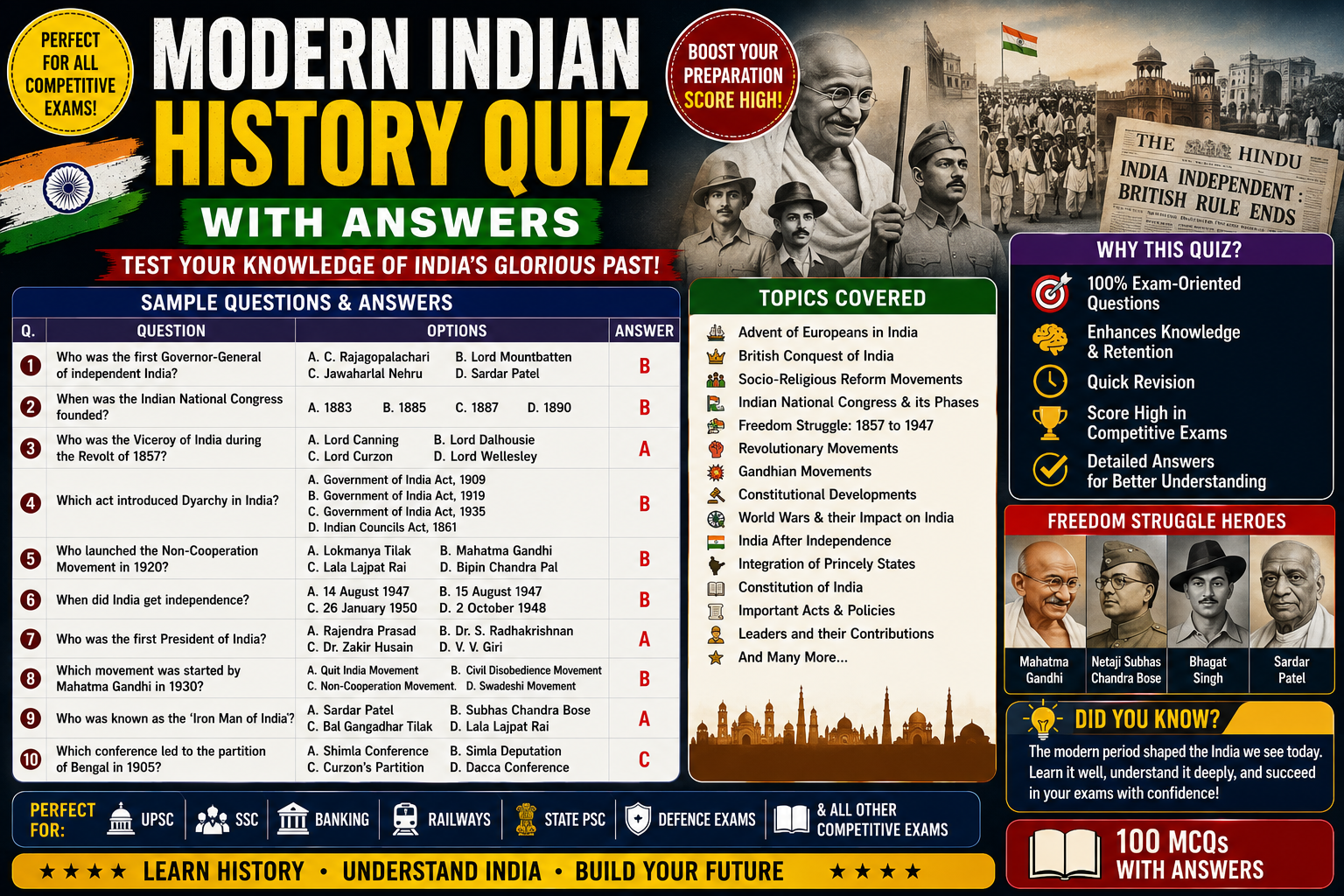
Modern Indian History is the Most Important for Exams
Let me ask you a question.
How many questions from Modern Indian History appear in competitive exams?
- UPSC Prelims: 10-15 questions every year (highest weightage)
- SSC CGL/CHSL: 6-10 questions
- State PSCs: 10-15 questions
- Railways (RRB NTPC): 8-12 questions
- Banking (IBPS, SBI): 4-6 questions
Modern Indian History (1707-1947) covers the period from the decline of the Mughal Empire to the Independence of India. This is the most important historical period for exams because it directly shaped the India we live in today. It includes the rise of British power, the revolt of 1857, the freedom struggle, the leadership of Mahatma Gandhi, and the eventual Partition.
Every serious aspirant knows: Modern Indian History is the highest-scoring subject if you master the sequence of events, key personalities, and important dates.
In this blog, I have created 100 original, exam-relevant questions on Modern Indian History. Each question is immediately followed by its answer. No separate answer key. No flipping pages. Instant learning.
(Add Image with Alt Text: “Modern Indian history quiz – timeline from Battle of Plassey to Independence with key events”)
Dofollow External Resource: National Archives of India – Modern Indian History – official source for original documents and records.
Part 1 – British Expansion and Conquest of India (Questions 1 to 12)
Question 1. Who granted the British East India Company the right to trade in Bengal in 1717?
Answer: The Mughal Emperor Farrukhsiyar. The Company received a “farman” (imperial decree) granting them duty-free trade in Bengal.
Question 2. In which year was the Battle of Plassey fought? Who won?
Answer: 1757. The British East India Company (led by Robert Clive) defeated Siraj-ud-Daulah (the Nawab of Bengal).
Question 3. Who was the Commander-in-Chief of Siraj-ud-Daulah’s army who betrayed him at the Battle of Plassey?
Answer: Mir Jafar. He was promised the position of Nawab by the British in exchange for his betrayal.
Question 4. After the Battle of Plassey, who was installed as the puppet Nawab of Bengal?
Answer: Mir Jafar. He was later replaced by Mir Qasim when he failed to satisfy British demands.
Question 5. In which year was the Battle of Buxar fought? Who won?
Answer: 1764. The British East India Company defeated the combined army of Mir Qasim (Nawab of Bengal), Shuja-ud-Daulah (Nawab of Awadh), and Shah Alam II (Mughal Emperor).
Question 6. What was the major outcome of the Battle of Buxar?
Answer: The British East India Company was granted the Diwani (right to collect revenue) of Bengal, Bihar, and Orissa by the Mughal Emperor Shah Alam II (Treaty of Allahabad, 1765).
Question 7. Which British Governor introduced the “Dual System of Government” in Bengal?
Answer: Robert Clive (after the Battle of Buxar). Under this system, the British had the Diwani (revenue rights) and the Nawab had the Nizamat (judicial and police powers).
Question 8. Which British Governor abolished the Dual System of Government in Bengal?
Answer: Lord Warren Hastings (1772). He brought the revenue and judicial administration directly under British control.
Question 9. In which year did the British defeat the French in India? Which battle sealed French defeat?
Answer: The French were finally defeated in the Seven Years’ War (1756-1763). The decisive battle was the Battle of Wandiwash (1760), where the British defeated the French led by Count de Lally.
Question 10. Which wars were fought between the British East India Company and the Kingdom of Mysore?
Answer: Four Anglo-Mysore Wars (1767-1769, 1780-1784, 1790-1792, 1799). Tipu Sultan was killed in the Fourth Anglo-Mysore War (1799).
Question 11. Who was the famous ruler of Mysore who died fighting the British?
Answer: Tipu Sultan (the “Tiger of Mysore”). He was killed at Seringapatam in 1799 while defending his fort.
Question 12. Which Maratha Peshwa signed the Treaty of Bassein (1802) with the British, leading to the Second and Third Anglo-Maratha Wars?
Answer: Baji Rao II. The treaty gave the British control over Maratha affairs and eventually led to the annexation of the Maratha Empire.
Part 2 – Economic Impact and Administrative Changes (Questions 13 to 20)
Question 13. Who introduced the Permanent Settlement of Bengal in 1793?
Answer: Lord Cornwallis. Under this system, Zamindars (landlords) were made the permanent owners of land and had to pay a fixed revenue to the British.
Question 14. What was the main problem with the Permanent Settlement?
Answer: The revenue was fixed too high, leading to the exploitation of peasants. Zamindars did nothing to improve agriculture (no incentive). Also, the British fixed the revenue in cash, causing hardship during famines.
Question 15. Who introduced the Ryotwari System of land revenue? Where was it first implemented?
Answer: Captain Alexander Read and Thomas Munro. It was first implemented in the Madras Presidency (present-day Tamil Nadu and Andhra Pradesh).
Question 16. What was the Mahalwari System of land revenue? Who introduced it?
Answer: The Mahalwari System was introduced by William Bentinck (after suggestions by Holt Mackenzie). Under this system, revenue was fixed for a “Mahal” (village or group of villages) jointly with the village headmen. It was implemented in the Gangetic Valley, Punjab, and Central India.
Question 17. What was the “Drain of Wealth” theory? Who propounded it?
Answer: The “Drain of Wealth” theory states that British rule drained India’s wealth to England through taxes, trade policies, and administrative expenses. It was propounded by Dadabhai Naoroji in his book “Poverty and Un-British Rule in India” (1901).
Question 18. Which British Governor-General introduced the Doctrine of Lapse?
Answer: Lord Dalhousie (1848-1856). Under this doctrine, if an Indian ruler died without a natural male heir, his kingdom would “lapse” (be annexed) by the British.
Question 19. Name any four states annexed under the Doctrine of Lapse.
Answer: Satara (1848), Jaipur (1849), Sambalpur (1849), Udaipur (1852), Jhansi (1853), Nagpur (1854), Awadh (1856) – any four are correct.
Question 20. What was the “Subsidiary Alliance” system? Who introduced it?
Answer: The Subsidiary Alliance was introduced by Lord Wellesley (1798-1805). Under this system, an Indian ruler had to accept British forces in their territory, pay for their maintenance, and dismiss all other foreign powers. In return, the British protected them from attacks.
Part 3 – Social and Religious Reform Movements (Questions 21 to 30)
Question 21. Who founded the Brahmo Samaj (1828) in Calcutta?
Answer: Raja Ram Mohan Roy. He is called the “Father of Modern Indian Renaissance.”
Question 22. Which social practices did Raja Ram Mohan Roy campaign against?
Answer: Sati (widow burning), child marriage, polygamy, caste discrimination, and idol worship.
Question 23. Who founded the Arya Samaj (1875)? Where was it founded?
Answer: Swami Dayanand Saraswati. He founded the Arya Samaj in Bombay (Mumbai). His motto was “Back to the Vedas.”
Question 24. What was the famous book written by Swami Dayanand Saraswati?
Answer: Satyarth Prakash (The Light of Truth). It is a commentary on the Vedas and a critique of other religions and practices.
Question 25. Who founded the Ramakrishna Mission (1897)?
Answer: Swami Vivekananda (born Narendranath Datta). He founded the mission in memory of his guru, Sri Ramakrishna Paramahamsa.
Question 26. Which famous speech did Swami Vivekananda deliver at the World’s Parliament of Religions in Chicago (1893)? What is its famous opening line?
Answer: The speech is simply called the “Chicago Address.” Its famous opening line is: “Sisters and brothers of America…” It received a 2-minute standing ovation.
Question 27. Who founded the Prarthana Samaj (1867) in Bombay?
Answer: Dr. Atmaram Pandurang. It was inspired by the Brahmo Samaj and focused on monotheism and social reforms (widow remarriage, inter-caste marriage).
Question 28. Who founded the Theosophical Society in India (1882) at Adyar, Madras (Chennai)?
Answer: Madame H.P. Blavatsky and Colonel H.S. Olcott. Later, Annie Besant became the leader of the society.
Question 29. Who was the famous Muslim reformer who founded the Aligarh Movement and the Muhammadan Anglo-Oriental College (later Aligarh Muslim University)?
Answer: Sir Syed Ahmad Khan. He wanted Muslims to accept British education and cooperate with the British.
Question 30. Who founded the Satyashodhak Samaj (Society of Truth Seekers) in 1873 to fight against caste discrimination?
Answer: Jyotirao Phule (also called Mahatma Jyotiba Phule). He along with his wife Savitribai Phule worked for the education of women and lower castes.
Part 4 – Revolt of 1857 (Questions 31 to 38)
Question 31. In which year did the Revolt of 1857 (Sepoy Mutiny) begin? Where did it start?
Answer: 1857. It began at Meerut on May 10, 1857.
Question 32. What was the immediate (immediate) cause of the Revolt of 1857?
Answer: The introduction of the new Enfield rifle which used greased cartridges. The grease was rumored to be made of cow fat (offensive to Hindus) and pig fat (offensive to Muslims). Soldiers had to bite the cartridges to open them.
Question 33. Who was the Mughal emperor at the time of the 1857 Revolt? Where did he live?
Answer: Bahadur Shah Zafar II. He lived in the Red Fort, Delhi. He was proclaimed the symbolic leader of the revolt.
Question 34. Name the four most prominent leaders of the 1857 Revolt.
Answer:
- Rani Lakshmibai of Jhansi
- Nana Saheb Peshwa (Kanpur)
- Kunwar Singh (Bihar)
- Begum Hazrat Mahal (Awadh)
Question 35. Who led the revolt in Lucknow (Awadh)?
Answer: Begum Hazrat Mahal (wife of Nawab Wajid Ali Shah). She proclaimed her son Birjis Qadr as the Nawab.
Question 36. Which British official suppressed the revolt and recaptured Delhi?
Answer: General John Nicholson was killed, but the final recapture was led by General Archdale Wilson and Colonel Edward Greathed. Ultimately, the British army under Commander-in-Chief Colin Campbell and General Hugh Rose suppressed the revolt.
Question 37. What happened to Bahadur Shah Zafar after the revolt was crushed?
Answer: He was captured, tried, and exiled to Rangoon (Burma, now Yangon, Myanmar). He died there in 1862.
Question 38. Who announced the assumption of direct rule of India by the British Crown (Queen Victoria) in 1858?
Answer: Lord Canning (the Governor-General at the time). The “Government of India Act 1858” transferred all powers from the East India Company to the British Crown.
Part 5 – Rise of Indian Nationalism (Questions 39 to 45)
Question 39. Who founded the East India Association in London (1866)?
Answer: Dadabhai Naoroji (also called the “Grand Old Man of India”). He was a nationalist leader, economist, and later the first Indian MP in the British Parliament.
Question 40. Who founded the Indian Association of Calcutta (1876)?
Answer: Surendranath Banerjea and Anandamohan Bose. This association was a precursor to the Indian National Congress.
Question 41. Who founded the Madras Mahajana Sabha (1884)?
Answer: M. Viraraghavachari, G. Subramania Iyer, and P. Anandacharlu.
Question 42. Who founded the Bombay Presidency Association (1885)?
Answer: Pherozeshah Mehta, K.T. Telang, and Badruddin Tyabji.
Question 43. Who founded the Indian National Congress (INC) and in which year?
Answer: Allan Octavian Hume (a retired British civil servant) along with Dadabhai Naoroji, Dinshaw Wacha, and others. The INC was founded in 1885.
Question 44. Where was the first session of the Indian National Congress held? Who presided over it?
Answer: The first session was held in Bombay (Mumbai) at Gokuldas Tejpal Sanskrit College. Womesh Chunder Bonnerjee was the first President.
Question 45. How many delegates attended the first INC session?
Answer: 72 delegates attended. All were educated, professional men (lawyers, journalists, teachers). They represented almost all regions of India.
Part 6 – Indian National Congress – Early Phase (Questions 46 to 55)
Question 46. What are the names of the three groups (phases) of the Indian National Congress?
Answer:
- Early Nationalists (Moderates) – 1885 to 1905
- Assertive Nationalists (Extremists) – 1905 to 1919
- Gandhian Era – 1919 to 1947
Question 47. Who were the three most prominent Moderate leaders of the INC?
Answer: Dadabhai Naoroji, Pherozeshah Mehta, and Gopal Krishna Gokhale.
Question 48. What were the methods of the Moderates to achieve their demands?
Answer: They used constitutional methods – petitions, prayers, resolutions, public meetings, and memoranda to the British government. They believed in gradual reform.
Question 49. Who were the three most prominent Assertive (Extremist) leaders?
Answer: Bal Gangadhar Tilak, Bipin Chandra Pal, and Lala Lajpat Rai (Lal-Bal-Pal).
Question 50. What famous slogan did Bal Gangadhar Tilak give?
Answer: “Swaraj is my birthright and I shall have it.” Also, “Swaraj (self-rule), Swadeshi (indigenous goods), Boycott, and National Education.”
Question 51. Who was called the “Tiger of Bengal”?
Answer: Bipin Chandra Pal.
Question 52. Who founded the “Indian Home Rule League” (1916)?
Answer: Bal Gangadhar Tilak (April 1916) and Annie Besant (September 1916). They had separate leagues.
Question 53. What was the Lucknow Pact (1916)?
Answer: An agreement between the Indian National Congress and the Muslim League, where they agreed to work together for self-rule. They also agreed on separate electorates for Muslims (already existing) and a formula for representation.
Question 54. Who was the president of the INC session in Lucknow (1916)?
Answer: Ambika Charan Majumdar. The session is famous for the Lucknow Pact between Congress and Muslim League.
Question 55. In which year did the Moderates and Extremists reunite in the INC?
Answer: 1916 (at the Lucknow session). They had split in 1907 at the Surat session.
Part 7 – Partition of Bengal and Swadeshi Movement (Questions 56 to 60)
Question 56. Who announced the Partition of Bengal? In which year?
Answer: Lord Curzon (the Viceroy of India) announced the partition on July 19, 1905, and it came into effect on October 16, 1905.
Question 57. What was the official reason given for the Partition of Bengal? What was the real reason?
Answer: Official reason: Administrative convenience (Bengal was too large to govern). Real reason: Divide and rule – to weaken the nationalist movement by dividing Hindus and Muslims.
Question 58. What was the Swadeshi Movement?
Answer: The Swadeshi Movement (1905-1911) was a boycott of foreign (British) goods and the promotion of indigenous (Indian) goods. It was a response to the Partition of Bengal.
Question 59. Which famous song was sung during the Swadeshi Movement?
Answer: “Vande Mataram” (by Bankim Chandra Chatterjee from the novel Anandamath). It became the rallying cry of the movement.
Question 60. In which year was the Partition of Bengal annulled (reversed)?
Answer: 1911 (by Lord Hardinge II). The capital was shifted from Calcutta to Delhi at the same time.
Part 8 – Gandhi Era – Rowlatt, Non-Cooperation, Civil Disobedience (Questions 61 to 70)
Question 61. When did Mahatma Gandhi return to India from South Africa?
Answer: 1915 (January 9). This day is celebrated as “Pravasi Bharatiya Divas” (NRI Day) in India.
Question 62. Where did Gandhi ji first practice the technique of Satyagraha in India (1916)?
Answer: Champaran (Bihar). He protested against the forced indigo cultivation by British planters on poor peasants.
Question 63. What was the Rowlatt Act (1919)?
Answer: The Rowlatt Act (also called the Black Act) allowed the British government to arrest and imprison any person without trial (no habeas corpus). It also allowed detention for up to 2 years without judicial review.
Question 64. What was the Jallianwala Bagh massacre (1919)? Where did it happen?
Answer: On April 13, 1919 (Baisakhi day), British General Reginald Dyer ordered his troops to fire on a peaceful crowd of unarmed men, women, and children in a walled garden (Jallianwala Bagh) in Amritsar, Punjab. Official British records say 379 dead; Indian estimates say over 1,000 dead.
Question 65. What was the Khilafat Movement (1919-1924)? Who led it in India?
Answer: The Khilafat Movement was a protest by Indian Muslims against the British for abolishing the Caliphate (Ottoman Empire) after World War I. It was led by the Ali Brothers (Maulana Mohammad Ali and Maulana Shaukat Ali) and was supported by Mahatma Gandhi.
Question 66. What was the Non-Cooperation Movement (1920-1922)? What were its main activities?
Answer: The Non-Cooperation Movement was launched by Mahatma Gandhi in 1920. Its activities included:
- Surrender of government titles and honorary positions
- Boycott of law courts, government schools and colleges, foreign cloth
- Boycott of elections (legislative councils)
- Promotion of Swadeshi (khadi, hand-spinning)
Question 67. What was the Chauri Chaura incident (1922)? What was its impact?
Answer: On February 4, 1922, a violent mob killed 22 policemen in Chauri Chaura (Uttar Pradesh). This incident of violence deeply disturbed Gandhi, and he called off the Non-Cooperation Movement immediately, despite widespread support.
Question 68. What was the Simon Commission (1927)? Why was it boycotted?
Answer: The Simon Commission (led by Sir John Simon) was sent to India to recommend constitutional reforms. It was boycotted because there was not a single Indian member on the commission. The slogan “Simon Go Back” was raised everywhere.
Question 69. Who was the viceroy who announced the “Dominion Status” for India in 1929?
Answer: Lord Irwin (Viceroy 1926-1931). He announced the “Irwin Declaration” (October 31, 1929) that India would eventually be granted Dominion Status (like Canada, Australia).
Question 70. What was the Dandi March (Salt March)? When did it take place?
Answer: Mahatma Gandhi led a march from Sabarmati Ashram (Ahmedabad) to Dandi (a coastal village in Gujarat) from March 12 to April 6, 1930. He broke the salt law by picking up natural salt from the beach. This was the beginning of the Civil Disobedience Movement.
Part 9 – Revolutionary Movements and Subhash Chandra Bose (Questions 71 to 75)
Question 71. Who founded the Hindustan Socialist Republican Association (HSRA) in 1928?
Answer: Chandrashekhar Azad, Bhagat Singh, Sukhdev, and Rajguru. The earlier name was Hindustan Republican Association (HRA).
Question 72. What was the Lahore Conspiracy Case (1929)? Which famous slogan was given by Bhagat Singh in court?
Answer: Bhagat Singh and Batukeshwar Dutt threw a bomb in the Central Legislative Assembly (Delhi) on April 8, 1929. They did not intend to kill anyone (the bomb was weak) but to “make the deaf hear.” In court, Bhagat Singh gave the slogan “Inquilab Zindabad” (Long Live the Revolution).
Question 73. When and where were Bhagat Singh, Sukhdev, and Rajguru executed?
Answer: They were executed on March 23, 1931, in Lahore Central Jail (now in Pakistan).
Question 74. Who founded the Indian National Army (INA) and in which year?
Answer: Subhash Chandra Bose (Netaji) in 1942 (in Singapore). The INA was formed from Indian prisoners of war captured by Japan.
Question 75. What is the famous slogan given by Subhash Chandra Bose to the INA?
Answer: “Jai Hind” and “Tum Mujhe Khoon Do, Main Tumhe Aazadi Dunga” (Give me blood, I will give you freedom).
Part 10 – Constitutional Developments (Questions 76 to 80)
Question 76. What were the “Round Table Conferences” (1930-1932)? How many were held?
Answer: Three Round Table Conferences were held in London to discuss constitutional reforms in India.
| Conference | Year | Key Points |
|---|---|---|
| First | 1930 | Congress boycotted (Gandhi was in jail after Dandi March). Only Muslim League, princes, and British officials attended. |
| Second | 1931 | Gandhi attended as the sole Congress representative. No agreement reached. |
| Third | 1932 | Congress boycotted again. Minor attendance. |
Question 77. What was the “Communal Award” (1932) announced by British Prime Minister Ramsay MacDonald?
Answer: The Communal Award granted separate electorates to Muslims, Sikhs, Christians, Anglo-Indians, and also to the Depressed Classes (Dalits).
Question 78. What was the “Poona Pact” (1932)? Who signed it?
Answer: The Poona Pact was an agreement between Mahatma Gandhi and B.R. Ambedkar. Gandhi went on a fast unto death against separate electorates for Dalits. Ambedkar agreed to joint electorates with reserved seats for Dalits. The pact was signed on September 24, 1932.
Question 79. What was the “Government of India Act 1935”? How many provinces had elected legislatures?
Answer: The Government of India Act 1935 introduced provincial autonomy. It divided India into 11 provinces (later 11, expanded). Elections were held in 1937, and the Congress won in 8 provinces.
Question 80. Under the Government of India Act 1935, what was the difference between “Federal List,” “Provincial List,” and “Concurrent List”?
Answer:
- Federal List: Central subjects (defense, foreign affairs, railways) – 59 items
- Provincial List: Provincial subjects (police, local government, agriculture) – 54 items
- Concurrent List: Joint subjects (criminal law, marriage, bankruptcy) – 36 items
Part 11 – Towards Independence – 1940s (Questions 81 to 90)
Question 81. What was the “August Offer” (1940)? Who made it?
Answer: The August Offer was made by Viceroy Lord Linlithgow. It promised Dominion Status to India after the war, expanded the Executive Council, and set up a Constituent Assembly.
Question 82. What was the “Cripps Mission” (1942)? Why did it fail?
Answer: The Cripps Mission (led by Sir Stafford Cripps) was sent to India to secure Indian cooperation in World War II. It proposed Dominion Status, a Constituent Assembly, and the right of provinces to not join the Indian Union. It failed because:
- Congress wanted immediate transfer of power
- Muslim League wanted a separate Pakistan
- Gandhi called it “a post-dated cheque on a failing bank”
Question 83. What was the “Quit India Movement” (1942)? Who gave the famous slogan?
Answer: The Quit India Movement was launched on August 8, 1942, by Mahatma Gandhi at the Gowalia Tank Maidan (Mumbai). The famous slogan was “Do or Die” (Karo Ya Maro).
Question 84. What was the “Indian National Army (INA) Trials” (1945-46)? Where were they held?
Answer: The INA trials (Red Fort Trials) were held at the Red Fort, Delhi. Three INA officers – General Shah Nawaz Khan, Colonel Prem Kumar Sahgal, and Colonel Gurbaksh Singh Dhillon – were put on trial. The trials created widespread public sympathy, and the British released them under public pressure.
Question 85. What was the “Wavell Plan” and the Simla Conference (1945)?
Answer: The Wavell Plan (proposed by Viceroy Lord Wavell) suggested an Executive Council with equal representation of Hindus and Muslims (except for the Viceroy). The Simla Conference (June-July 1945) failed because Muslim League claimed it was the sole representative of Indian Muslims, and Congress rejected this claim.
Question 86. What was the “Cabinet Mission Plan” (1946)? Why did it fail?
Answer: The Cabinet Mission (three British ministers – Pethick-Lawrence, Stafford Cripps, A.V. Alexander) proposed a federal India with three groups of provinces:
- Group A: Hindu-majority provinces
- Group B: Muslim-majority provinces (Punjab, Sind, NWFP, Baluchistan)
- Group C: Muslim-majority provinces (Bengal and Assam)
Both Congress and Muslim League initially accepted but later rejected. Congress disagreed with grouping. Muslim League wanted a separate Pakistan.
Question 87. What was the “Direct Action Day” (August 16, 1946)? Who called for it?
Answer: The Muslim League called for “Direct Action Day” to achieve Pakistan. Massive communal riots broke out in Calcutta (Kolkata). Known as the “Great Calcutta Killing,” it left over 5,000 people dead and 15,000 injured.
Question 88. Who was the last Viceroy of India? When did he arrive?
Answer: Lord Louis Mountbatten (appointed Viceroy in March 1947). He was given the mandate to transfer power by June 30, 1948, but he advanced the date to August 15, 1947.
Question 89. What was the “Indian Independence Act 1947”? When was it passed by the British Parliament?
Answer: The Indian Independence Act was passed by the British Parliament in July 1947. It declared that India would be divided into two independent dominions: India and Pakistan. It received royal assent on July 18, 1947.
Question 90. What was the “Radcliffe Line”? Who drew it?
Answer: The Radcliffe Line was the boundary line dividing India and Pakistan (Punjab and Bengal). It was drawn by Sir Cyril Radcliffe, a British lawyer who had never visited India before.
Part 12 – Partition of India and Integration of Princely States (Questions 91 to 95)
Question 91. When did India become independent? Who took the oath as the first Prime Minister?
Answer: India became independent on August 15, 1947. Jawaharlal Nehru took the oath as the first Prime Minister of independent India.
Question 92. What was the “Mountbatten Plan” (June 3, 1947)?
Answer: The Mountbatten Plan proposed the partition of India into two dominions – India and Pakistan. It also proposed that princely states could choose to join either dominion or remain independent (with the advice to join based on geography and population).
Question 93. Who was the last Governor-General of independent India?
Answer: C. Rajagopalachari (Chakravarti Rajagopalachari). He served from 1948 to 1950. Lord Mountbatten was the first Governor-General of independent India (August 1947 to June 1948).
Question 94. Who was responsible for the integration of over 560 princely states into India?
Answer: Sardar Vallabhbhai Patel (the first Deputy Prime Minister and Home Minister of India) along with V.P. Menon (Secretary of the Ministry of States).
Question 95. Which three princely states were the most difficult to integrate into India?
Answer:
- Junagadh (Gujarat) – The Nawab wanted to join Pakistan, but the population was Hindu. India held a plebiscite and integrated it.
- Hyderabad (largest princely state) – The Nizam wanted to remain independent. India launched “Operation Polo” (1948) and annexed it.
- Kashmir and Jammu – Maharaja Hari Singh signed the Instrument of Accession to India in October 1947 after Pakistani tribal invaders attacked.
Part 13 – Miscellaneous and Landmark Facts (Questions 96 to 100)
Question 96. Who was the first Indian to pass the Indian Civil Services (ICS) examination?
Answer: Satyendranath Tagore (brother of Rabindranath Tagore) in 1863.
Question 97. Which famous Indian nationalist wrote the book “Poverty and Un-British Rule in India” (1901)?
Answer: Dadabhai Naoroji. In this book, he first propounded the “Drain of Wealth” theory.
Question 98. What was the “Ilbert Bill” controversy (1883)? Who introduced it?
Answer: The Ilbert Bill was introduced by Lord Ripon (Viceroy 1880-1884). It proposed that Indian judges could try British offenders. The British community violently opposed it, and the bill was watered down.
Question 99. Who was the founder of the “Servants of India Society” (1905)?
Answer: Gopal Krishna Gokhale. The society was founded in Pune to train national missionaries for the service of India.
Question 100. Who designed the Indian national flag? When was it adopted?
Answer: The current Indian flag (with saffron, white, green, and the Ashoka Chakra) was designed by Pingali Venkayya. It was adopted on July 22, 1947, by the Constituent Assembly.
14. Conclusion – Your Revision Checklist
Dosto, Modern Indian History is the most important historical subject for competitive exams. It covers the 250 years that shaped modern India.
Quick Revision Checklist:
| Period | Key Events | Key Personalities |
|---|---|---|
| British Expansion (1757-1857) | Plassey, Buxar, Anglo-Mysore, Anglo-Maratha, Doctrine of Lapse | Robert Clive, Warren Hastings, Dalhousie, Tipu Sultan |
| Revolt of 1857 | Meerut, Delhi, Jhansi, Lucknow | Bahadur Shah Zafar, Rani Lakshmibai, Nana Saheb, Kunwar Singh |
| Social Reform | Brahmo Samaj, Arya Samaj, Ramakrishna Mission, Aligarh | Raja Ram Mohan Roy, Dayanand, Vivekananda, Sir Syed |
| Nationalism (1885-1919) | INC founded, Partition of Bengal, Swadeshi, Home Rule | Dadabhai Naoroji, Tilak, Gokhale, Annie Besant |
| Gandhi Era (1919-1947) | Rowlatt, Non-Cooperation, Civil Disobedience, Quit India | Mahatma Gandhi, Nehru, Patel, Bose, Jinnah |
| Partition & Independence | Mountbatten Plan, Radcliffe Line, Integration of States | Mountbatten, Patel, V.P. Menon |
Your 10-Day Action Plan:
| Day | Task |
|---|---|
| Day 1 | Read all 100 Q&As once (2.5 hours) |
| Day 2 | Test yourself on Q1-Q30 (British expansion, reforms) |
| Day 3 | Test yourself on Q31-Q60 (1857, nationalism, Swadeshi) |
| Day 4 | Test yourself on Q61-Q80 (Gandhi era, constitutional dev.) |
| Day 5 | Test yourself on Q81-Q100 (Independence, Partition, misc.) |
| Day 6 | Revise all battles and their dates |
| Day 7 | Revise all important personalities and their contributions |
| Day 8 | Revise all viceroys and their major events |
| Day 9 | Solve all 100 again (timed – 80 minutes) |
| Day 10 | Take a full mock test on Modern Indian History |
Comment below: Which year of Modern Indian History do you find most interesting?
Share this blog with your study group. Master Modern History together.
Also Check : Medieval Indian History – 100 MCQs with Answers (Exam Edition)