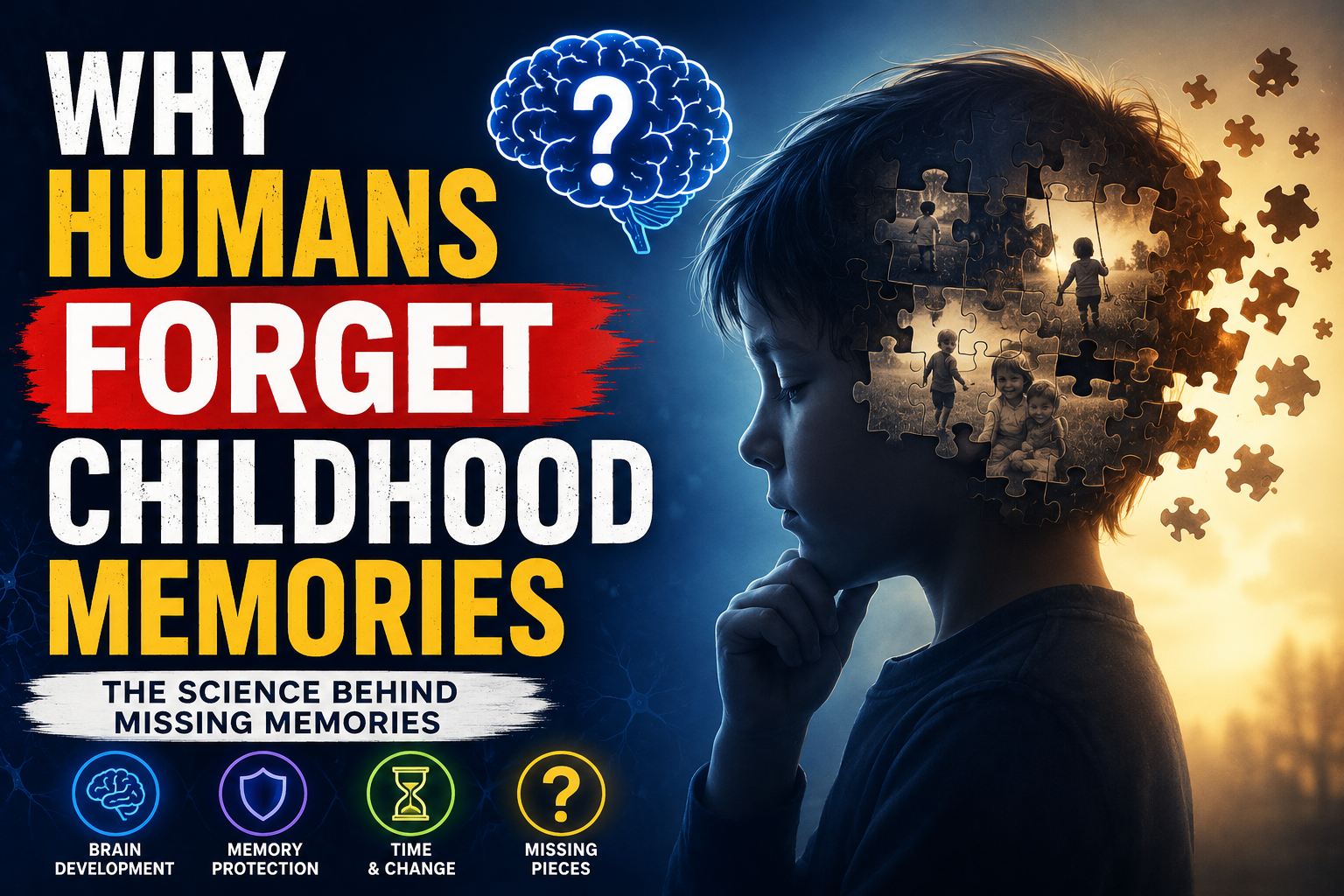
The Mystery of Vanishing Childhood Memories
Let me ask you something.
Think back to your earliest memory. What do you see?
Maybe a birthday cake with candles. Maybe falling down and scraping your knee. Maybe your mother’s face smiling at you.
Now think: How old were you in that memory? Three? Four? Five?
Now try to remember anything from when you were two years old. Or one. Or a newborn.
You can’t. Almost no one can.
And that is strange, isn’t it? Your brain was working. You were learning to walk, talk, recognize faces, and eat food. You were experiencing the world. But those experiences – thousands of them – have simply vanished.
This phenomenon has puzzled scientists, parents, and philosophers for over a century. Sigmund Freud called it “infantile amnesia.” Modern science calls it childhood amnesia.
In this blog, I will explain why humans forget childhood memories – the brain science, the psychology, and the evolutionary reasons. And by the end, you will understand that this forgetting is not a flaw. It is a feature of how your brain develops.
(Add Image with Alt Text: “Why humans forget childhood memories – silhouette of a child with fading photographs representing forgotten memories”)
Dofollow External Resource: National Institute of Health – Childhood Amnesia Research – official NIH research on infant memory formation.
2. What is Childhood Amnesia? (The Scientific Term)
Childhood amnesia – also called infantile amnesia – is the inability of adults to retrieve episodic memories (memories of specific events) from the first 2-4 years of life.
Key facts about childhood amnesia:
| Fact | Explanation |
|---|---|
| Average age of earliest memory | 3.5 years old |
| Memories before age 2 | Almost non-existent in adults |
| Memories between 2-3 years | Very few, mostly fragments |
| Memories between 3-5 years | Some, but often unreliable |
| Adult-like memory formation | Begins around age 6-7 |
Important distinction:
This is NOT the same as dementia or Alzheimer’s. Childhood amnesia is universal and normal. Every human experiences it. It is a natural part of brain development.
“Infantile amnesia is not a disorder. It is a developmental milestone.” – Dr. Patricia Bauer, Emory University
3. Surprising Statistics About Childhood Memory Loss
The numbers are fascinating. Research over the past 50 years has given us clear data on why humans forget childhood memories:
Statistical breakdown:
| Age of Memory | Percentage of Adults Who Have Such Memories |
|---|---|
| Before age 1 | Less than 1% |
| Age 1-2 | 2-5% (mostly fragments, not full scenes) |
| Age 2-3 | 10-15% (vague, often misattributed) |
| Age 3-4 | 30-40% (fading rapidly) |
| Age 4-5 | 60-70% (still losing many) |
| Age 6-7 | 80-90% (adult-like retention begins) |
Longitudinal study findings:
Researchers followed children from age 3 to age 10. They asked them about recent events, then asked again years later.
- At age 3: Children remembered 60-70% of events from weeks prior
- At age 5: Those same children remembered only 40% of those events
- At age 7: Only 20% remained
- At age 10: Less than 10% remained
The memories didn’t just fade – they disappeared almost completely over time.
4. The Science of Memory Formation in the Infant Brain
To understand why humans forget childhood memories, you first need to understand how memories are formed.
How adult memory works:
- Encoding: You experience an event. Your brain processes sights, sounds, emotions.
- Consolidation: Over hours and days, the memory becomes stable. The hippocampus (a seahorse-shaped structure deep in your brain) plays a critical role here.
- Storage: The memory moves to the neocortex (outer brain) for long-term storage.
- Retrieval: You recall the memory when needed.
How infant memory works differently:
In infants (0-2 years), steps 1 and 2 work, but step 3 fails. Memories are formed but not properly stored. They fade within days or weeks instead of lasting years.
Think of it like writing on wet clay. The adult brain presses hard – the memory stays. The infant brain presses softly – the memory is there for a moment but disappears as the clay dries and changes shape.
(Add Image with Alt Text: “Why humans forget childhood memories – diagram showing hippocampus development in infant vs adult brain”)
5. Reason #1: The Hippocampus is Still Under Construction
This is the most important scientific explanation for why humans forget childhood memories.
What is the hippocampus?
The hippocampus is a small, seahorse-shaped structure deep inside your brain. It acts as a “memory gateway.” For a memory to become permanent, it must pass through the hippocampus.
The critical fact:
The hippocampus is not fully developed at birth. It continues growing and maturing until age 5-7.
What this means for memory:
| Age | Hippocampus Development | Memory Ability |
|---|---|---|
| Newborn | Very immature | No episodic memory |
| 6 months | Beginning to function | Can remember for days |
| 1 year | Still developing | Can remember for weeks |
| 2 years | Partial development | Can remember for months |
| 4 years | 70-80% mature | Memories begin to last |
| 6-7 years | Adult-like | Long-term storage works |
The key experiment (2000s research):
Researchers genetically engineered mice to delay hippocampal development. These mice showed extended infantile amnesia – they forgot earlier than normal. When they accelerated hippocampal development, mice showed reduced infantile amnesia – they remembered more from infancy.
The evidence is clear: The hippocampus simply isn’t ready to store long-term memories during early childhood.
Dofollow Resource: Harvard Medical School – The Hippocampus and Memory – detailed explanation from leading researchers.
6. Reason #2: Language Creates Memories – And Babies Don’t Have It Yet
Here is a fascinating fact. Memories are not just images and sounds. They are stories we tell ourselves.
And stories require language.
The language-memory connection:
When you recall a memory, you are essentially re-telling a narrative. “I remember my third birthday. I was wearing a red shirt. My grandmother gave me a toy car.”
Without words, that narrative doesn’t exist.
What research shows:
- Children who develop language earlier tend to have earlier first memories
- Children with larger vocabularies at age 3 have more detailed memories at age 5
- Bilingual children sometimes show different memory patterns depending on which language they use to recall
The bilingual phenomenon:
Researchers studied adults who were adopted from Korea to the US as young children. When asked to recall childhood memories in Korean (their first language), they remembered more than when asked in English.
Language doesn’t just describe memories. It shapes and preserves them.
7. Reason #3: The “Sense of Self” is Missing in Early Childhood
Another critical reason why humans forget childhood memories is that infants and toddlers lack a stable sense of self.
What is episodic memory?
Episodic memory is memory for personal events – things that happened to you. It requires a sense of “I” – a self that experiences and remembers.
The mirror test (self-recognition):
Researchers put a dot of lipstick on a child’s nose, then place them in front of a mirror.
- Under 18 months: Child touches the mirror, thinking it’s another child
- 18-24 months: Child touches their OWN nose, recognizing the reflection is themselves
The correlation:
Children who pass the mirror test (develop self-awareness) start forming longer-lasting episodic memories. Children who haven’t developed self-awareness yet cannot form episodic memories at all.
Without a “me,” there is no “what happened to me.”
8. Reason #4: Neural Pruning – The Brain’s Spring Cleaning
Your brain undergoes dramatic changes between birth and age 7.
The numbers are staggering:
- At birth: 100 billion neurons (same as adult)
- At age 2-3: 50% more neural connections than adult brain (overproduction)
- Between ages 3-10: The brain eliminates 50% of those connections
This elimination is called synaptic pruning.
Why pruning happens:
The infant brain creates connections rapidly – far more than needed. Many are random or inefficient. Pruning removes weak connections and strengthens important ones.
What this means for memories:
A memory is stored in a network of neural connections. If those connections get pruned (because they weren’t used frequently), the memory disappears.
Your childhood bedroom might have been important to you at age 2. But did you think about it consistently between ages 3-10? Probably not. Those connections weakened and were pruned.
9. Reason #5: Different Types of Memory (Implicit vs Explicit)
Not all memories are the same. This distinction is crucial for understanding why humans forget childhood memories.
Implicit Memory (Procedural Memory):
- Memory for how to do things
- Doesn’t require conscious recall
- Develops early and lasts
- Examples: How to walk, how to eat with a spoon, how to ride a bike
Explicit Memory (Declarative Memory):
- Memory for facts and events
- Requires conscious recall
- Develops later
- Examples: Your third birthday party, the name of your first pet
The key finding:
Infants have implicit memory from birth. A 6-month-old can remember how to press a lever to make a toy move (implicit). But that same infant cannot explicitly recall the event a week later.
You don’t “remember” learning to walk. But your body remembers. That’s implicit memory.
Babies remember – just not in the way adults do.
10. Reason #6: Emotional Memories Fade Differently
You might have a memory of being scared as a child. Or feeling intense joy. But what about ordinary Tuesday afternoons?
The emotion-memory connection:
Emotional events trigger the release of stress hormones (cortisol, adrenaline). These hormones strengthen memory formation. This is why you remember your first day of school but not the 47th day.
The problem for infants:
The infant stress-response system is immature. Their brains don’t produce the same memory-strengthening hormones in response to emotion.
What this means:
- A frightening event at age 4 might be remembered
- The same event at age 1 probably won’t be
- Happy, calm events are even harder to retain
11. Reason #7: Infantile Amnesia Also Happens in Animals
Humans are not unique in forgetting early memories. Infantile amnesia occurs across the animal kingdom.
Research on rats:
Rats learn to avoid certain smells or locations. Adult rats remember this for weeks. But infant rats (equivalent to human age 0-2) forget within days.
Research on mice:
When mice are trained on a task at 16 days old (infant equivalent), they forget within a week. When trained at 30 days old (juvenile equivalent), they remember for months.
Research on monkeys:
Monkeys show similar patterns. Memories formed before a certain developmental age are rapidly lost.
The evolutionary conclusion:
Infantile amnesia is not a human quirk. It is a biological feature present across mammals. This suggests it serves an important evolutionary purpose.
12. What Age Do Our Earliest Lasting Memories Form?
The million-rupee question: When does lasting memory begin?
Research consensus:
| Age | Typical Memory Retention |
|---|---|
| 0-1 years | Almost no lasting memories |
| 1-2 years | Very few – mostly fragments, often unreliable |
| 2-3 years | Some memories, but most will fade |
| 3-4 years | More memories, but still significant loss |
| 4-5 years | Many memories survive into adulthood |
| 5-6 years | Adult-like retention begins |
The “age 3.5” average:
The average adult’s earliest memory comes from around 3.5 years of age.
But there is variation:
- Some people (10-15%) have a first memory from age 2
- Some people (5-10%) don’t have a memory until age 5
- Women tend to have earlier first memories than men
- People with more complex life narratives have earlier memories
(Add Image with Alt Text: “Why humans forget childhood memories – timeline from birth to age 7 showing memory retention by age”)
13. Why Some People Remember More Than Others
Not everyone forgets childhood equally. Here is what research shows about individual differences:
Factors that predict better childhood memory:
| Factor | Effect on Memory |
|---|---|
| Female gender | Slightly earlier, more detailed memories |
| Higher verbal ability | Strong correlation with memory retention |
| Maternal reminiscing style | Mothers who discuss past events in detail = children with better memories |
| Attachment security | Securely attached children remember more |
| Later birth order | Younger siblings often have earlier memories (they hear older siblings’ stories) |
| Psychotherapy experience | Therapy can recover or reshape memories |
| Trauma history | Trauma can create very vivid OR suppressed memories (variable) |
The parenting effect:
Parents who engage in elaborative reminiscing (asking open-ended questions: “What did you see at the zoo? How did you feel when the lion roared?”) raise children with richer and earlier memories.
14. Cultural Differences in Childhood Memory Retention
This is fascinating. Culture shapes memory.
Western cultures (US, Europe):
- Emphasis on individual experiences
- Focus on “your own unique story”
- Earliest memories: Often self-focused (“I fell down,” “I won a prize”)
- Average age of first memory: 3.5 years
Eastern cultures (Japan, China, India):
- Emphasis on collective experiences
- Focus on family and community
- Earliest memories: Often group-focused (“We had a family dinner,” “We visited grandmother”)
- Average age of first memory: 4.5-5 years (later than Westerners!)
Why the difference?
- Western parents ask: “What did YOU do today?”
- Eastern parents ask: “What did WE do today?”
- The sense of self develops differently across cultures
- The “individual self” emerges earlier in Western cultures
What about India?
Indian parenting styles vary widely. Urban, English-educated parents often use Western-style elaborative reminiscing. Rural, traditional families often use more collective memory framing. This affects when and what children remember.
15. Can You Recover “Lost” Childhood Memories?
This is a controversial question. The short answer: It’s complicated.
What science says:
- True “recovery” of accurate early memories (before age 2) is almost certainly impossible – the hippocampus wasn’t mature enough to store them
- Memories from ages 3-5 may be partially recoverable through cues (photographs, stories from parents, familiar smells)
- However, recovered memories are often reconstructions, not perfect replays
Methods that help:
| Method | Effectiveness | Reliability |
|---|---|---|
| Looking at photos | High | High (triggers real memories) |
| Talking to family | High | Medium (their memories may be wrong) |
| Returning to childhood home | Medium | Medium (smells/sights trigger fragments) |
| Hypnosis | Low | Very Low (can create false memories) |
| Guided visualization | Low | Low (risk of false memories) |
The danger of false memories:
Researchers have successfully implanted false childhood memories in 25-30% of participants. They told adults they got lost in a mall as a child (never happened). A quarter of participants “remembered” the event in detail.
This is why recovered memory therapy is controversial. Memories from early childhood are particularly vulnerable to suggestion.
16. The Controversy: Repressed vs False Memories
This is one of psychology’s most heated debates.
The “Repressed Memory” view (Freudian):
- Traumatic memories are pushed into the unconscious
- They can be recovered through therapy
- Popular in the 1980s-1990s
The “False Memory” view (Cognitive science):
- The brain doesn’t repress memories
- “Recovered” memories are often created by therapists’ suggestions
- Now the dominant scientific view
Where the science stands today:
- Real forgetting happens naturally (childhood amnesia)
- Real remembering can be triggered by cues
- But the idea that the brain systematically represses specific traumatic memories is not supported by evidence
- Most memory researchers reject the repressed memory model
17. Why You Remember Trauma But Not Birthday Parties
You might have a vivid memory of falling off a bicycle at age 4. But you don’t remember your 4th birthday cake.
The explanation:
The brain prioritizes survival-relevant information.
| Type of Memory | Retention | Evolutionary Reason |
|---|---|---|
| Potentially dangerous event | High | Learn to avoid danger |
| Painful experience | High | Learn to prevent harm |
| Strong emotional event | High | Emotional tagging strengthens memory |
| Routine, happy event | Low | Not survival-relevant |
| Ordinary day | Very Low | No adaptive value |
This explains why:
- You remember falling down stairs (danger)
- You remember getting lost in a market (fear)
- You remember being yelled at (social pain)
- You don’t remember most birthday parties (safe, routine)
Your brain is not a camera recording everything. It is a survival machine that selectively stores what matters.
18. Fascinating Experiments on Childhood Memory
Scientists have conducted brilliant experiments to understand why humans forget childhood memories.
Experiment 1: The “Magic Shrinking Machine” (2000s)
Researchers showed 3-year-olds a machine that supposedly shrinks toys. The children were amazed. They were asked about it years later.
- At age 3: 80% remembered the event in detail
- At age 5: Only 50% remembered
- At age 7: Only 30% remembered
- At age 10: Less than 20% remembered
Experiment 2: The Grocery Store Trip
Researchers took 4-year-olds on a simulated grocery store trip. They tested memory immediately, then 1 year later.
- Immediate: 90% remembered specific items
- 1 year later: Only 30% remembered any items
- 2 years later: Less than 15% remembered
Experiment 3: The Infant Rat Study (2000s)
Researchers trained infant rats on a task. Then they stopped hippocampal neurogenesis (growth of new brain cells). The infant rats retained memories longer.
Conclusion: The growth of new brain cells in the hippocampus actively disrupts old memories. Your brain literally “writes over” early memories as it grows.
19. Tips to Help Preserve Your Child’s Memories
As a parent, you might want to help your child keep more of their early memories. Here is what science suggests:
What works:
| Strategy | Why It Works | How to Do It |
|---|---|---|
| Elaborative reminiscing | Strengthens neural pathways | Ask open-ended questions: “What did you see at the park? How did you feel?” |
| Photo albums & videos | Visual cues trigger recall | Review albums together regularly |
| Family storytelling | Memory becomes shared narrative | Tell stories about “when you were little” |
| Physical souvenirs | Objects anchor memories | Save ticket stubs, drawings, toys |
| Consistent routines | Landmark events stand out | Annual birthday interviews (“What was your favorite thing this year?”) |
What doesn’t work:
- Rote memorization (flashcards, repetition) – not how episodic memory works
- Pressure to remember – causes anxiety, not better recall
- Comparing to siblings – each child develops differently
The most important finding:
Children whose parents discuss past events in rich, detailed, emotional language have the best retention of early memories – regardless of the child’s natural ability.
Your parenting can literally shape your child’s memory.
(Add Image with Alt Text: “Why humans forget childhood memories – parent and child looking at photo album together preserving memories”)
20. Common Myths About Childhood Memory (Debunked)
| Myth | Truth |
|---|---|
| “You can remember being born” | Impossible. Hippocampus not developed. |
| “Traumatic memories are always accurate” | Trauma can distort memory as much as enhance it. |
| “Photographic memory exists in children” | No evidence for true photographic memory. |
| “If you try harder, you’ll remember more” | Effort doesn’t recover memories that never consolidated. |
| “Hypnosis recovers true memories” | Hypnosis increases false memories more than true ones. |
| “Some people remember everything from age 2” | Extremely rare (less than 1%), often fragmentary. |
21. The Evolutionary Reason We Forget Our Early Years
This is the deepest question. Why would evolution design brains that forget infancy?
The leading theory: Energy efficiency
The infant brain is rapidly learning basic survival skills: walking, talking, recognizing faces, understanding objects. Storing detailed episodic memories would require enormous neural resources – resources better used for building foundational skills.
Theory #2: The “Clean Slate” hypothesis
Early childhood is a time of rapid learning and neural change. The brain that remembered everything would be stuck with outdated, often incorrect information. Forgetting allows the brain to update and adapt.
Theory #3: Self-narrative development
Our sense of self is built from memories. But the infant “self” is so different from the adult self that retaining infant memories might feel like remembering a different person. Forgetting allows a coherent self-narrative to form.
The bottom line:
Childhood amnesia is not a design flaw. It is a design feature. Your brain forgot your infancy so you could become who you are today.
22. Conclusion – Embracing the Mystery of Memory
Dosto, now you understand the fascinating science behind why humans forget childhood memories.
Quick Recap – The 7 Main Reasons:
| Reason | Explanation |
|---|---|
| 1. Hippocampus development | The memory gateway isn’t mature until age 5-7 |
| 2. Language | Without words, memories can’t be narrated or stored |
| 3. Sense of self | No “me” = no “what happened to me” |
| 4. Neural pruning | The brain eliminates unused connections |
| 5. Implicit vs explicit memory | Babies remember HOW, not WHAT |
| 6. Emotional system immaturity | Stress hormones don’t tag memories effectively |
| 7. Animal pattern | It’s a biological feature across mammals |
The Beautiful Truth:
You don’t remember your first steps. But your legs do.
You don’t remember learning your mother’s face. But your brain recognizes her instantly.
You don’t remember the sound of your native language. But you speak it fluently.
The memories that matter most are not stored in explicit recall. They are built into who you are – your skills, your attachments, your identity.
What You Can Do:
If you are a parent:
- Take photos and videos
- Tell stories about “when you were little”
- Ask elaborative questions
- Don’t stress if your child forgets – it’s normal
If you are an adult wishing you remembered more:
- Look at old photos with family
- Visit childhood places
- Accept that gaps are normal
- Don’t trust “recovered memory” therapies
One Final Reflection:
The fact that you cannot remember being a baby does not mean your baby self didn’t matter.
Every hug, every feeding, every song your parents sang – those moments shaped your brain even if you don’t remember them. Your attachment style, your emotional regulation, your ability to love – all built in those forgotten years.
The memories are gone. But the impact remains.
Comment below: What is your earliest childhood memory? How old were you? I would love to hear your stories.
Share this blog with parents who worry about their child’s memory, with students studying psychology, or with anyone who has ever wondered about their vanishing childhood.
Also Check : Children’s General Knowledge: 150+ Simple GK Questions and Answers